A developer is preprocessing a large text corpus for an NLP application. They need to choose between stemming and lemmatization for normalization. What is the fundamental difference in how these two techniques reduce words to their base forms?
Select an answer to reveal the explanation.
Short Explanation and Infographic
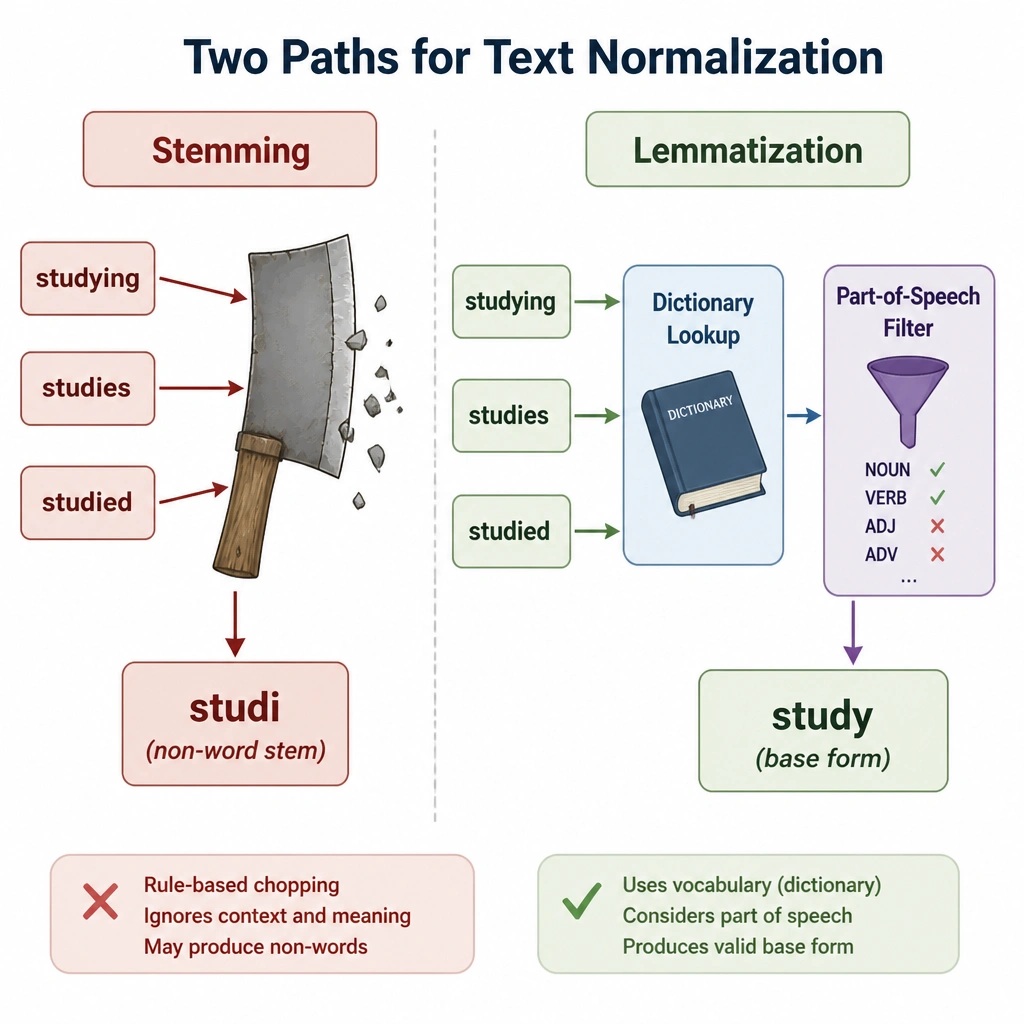
Think of it like this: stemming is like a lumberjack with a chainsaw, just hacking off the ends of words based on simple rules. If you run "flies" through it, it might chop it down to "fli"—which isn't even a real word! Lemmatization is way smarter. It's like a linguistic detective that looks at the word "flies", understands its context as a verb or noun, and references a dictionary to give you the real root, "fly". In production, stemming is fast but sloppy, while lemmatization is precise but takes a bit more horsepower. Cisco wants you to remember that stemming chops and can leave you with gibberish, while lemmatization uses a real dictionary to find the lemma.
Full explanation below image
Full Explanation
Text normalization is a crucial preprocessing step in Natural Language Processing (NLP) designed to reduce vocabulary size by mapping different forms of a word to a common base. Stemming and lemmatization are the two primary techniques used to achieve this, but they operate under completely different mechanisms and yield different results.
Stemming relies on simple, rule-based heuristics to strip common prefixes or suffixes (like "-ing", "-ed", or "-es") from the ends of words. A classic example is the Porter Stemmer, which uses a cascade of rules to prune words. Because stemming does not possess any understanding of grammar, syntax, or context, it often produces truncated strings that are not valid dictionary words. For example, the words "arguing", "argued", and "argues" might all be reduced to the stem "argu". While stemming is computationally fast, lightweight, and requires no external vocabulary databases, its crude nature can lead to under-stemming (failing to reduce related words to the same root) or over-stemming (reducing unrelated words to the same root, such as mapping "universal" and "university" both to "univers").
Lemmatization, by contrast, performs a full morphological and grammatical analysis of the word. It leverages a vocabulary database (such as WordNet) and takes into account the word's part of speech (POS) and context to resolve it to its actual dictionary base form, known as a lemma. Under lemmatization, "is", "was", and "am" all resolve to "be", and "better" resolves to "good"—relationships a stemmer could never identify. This makes lemmatization highly accurate and semantically precise, although it is computationally more expensive and has a larger memory footprint.
Regarding the incorrect options: - Option A is incorrect because it reverses the definitions of stemming and lemmatization. - Option C is incorrect because stemming can be applied to any part of speech and is not restricted to English verbs and nouns. - Option D is incorrect because the two techniques are fundamentally different, and stemming is actually much faster than lemmatization, not slower, since it does not perform database lookups or contextual analysis.