An AI developer is configuring a Named Entity Recognition (NER) pipeline to parse unstructured email text. What is the primary objective of this NER model?
Select an answer to reveal the explanation.
Short Explanation and Infographic
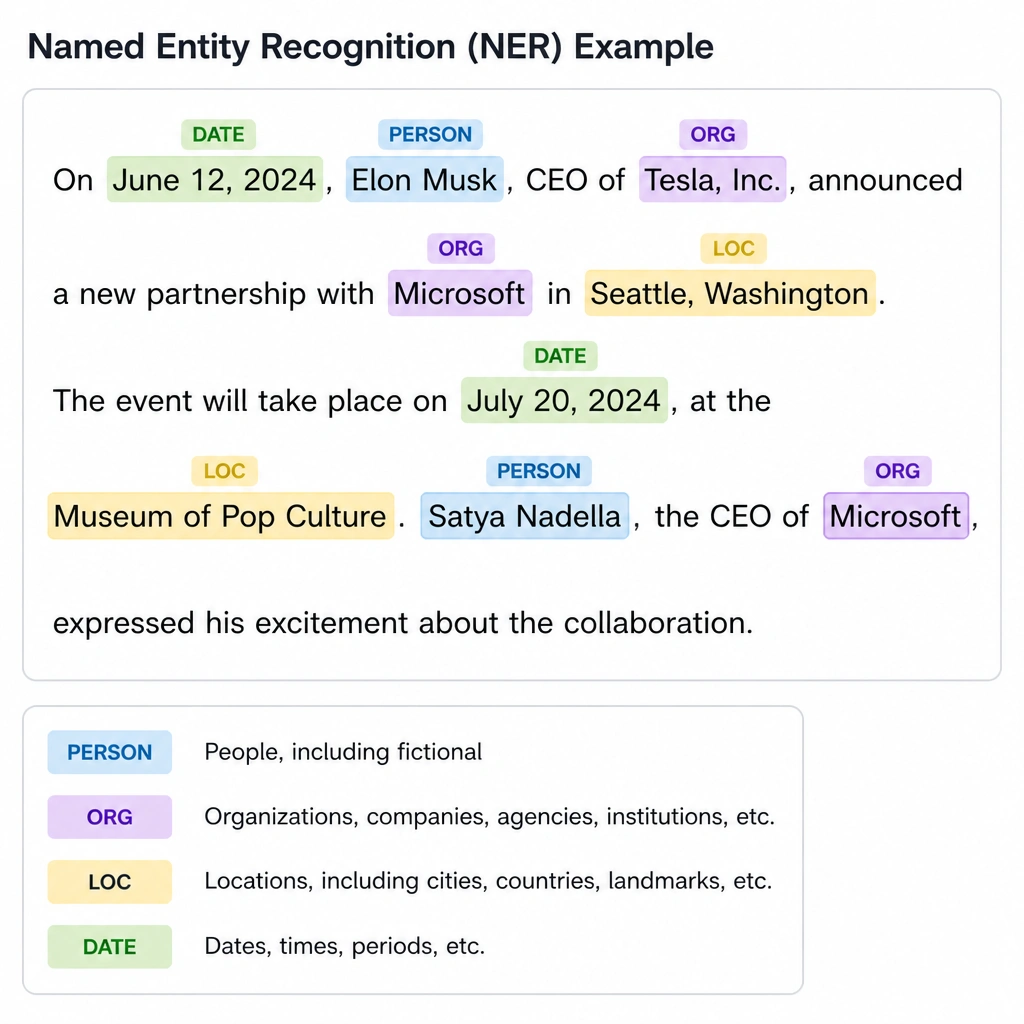
Think of it like this: if you're reading a network log, you want to instantly spot the IP addresses, server names, and timestamps. You don't care about the filler words; you just want those specific, critical items. That is exactly what Named Entity Recognition (NER) does for plain text! It acts like a high-end highlighter that scans a document and automatically marks the people (like "John Swartz"), the organizations (like "Cisco"), and the places (like "San Jose"). It doesn't just find them—it actually categorizes them so your database knows exactly what's what. It's not trying to figure out if someone is happy or sad (that's sentiment analysis), and it's not generating new text. It's strictly about extraction and classification. Got it? Sweet. Let's keep rolling.
Full explanation below image
Full Explanation
Named Entity Recognition (NER) is a subtask of information extraction that aims to identify and classify named entities in unstructured text into predefined categories. - Option A is correct. The objective of NER is to locate spans of text representing real-world entities (e.g., individuals, corporations, geographic entities, numeric quantities) and assign them labels (e.g., PERSON, ORG, LOC, DATE). - Option B is incorrect. Sentiment analysis is the process of classifying the overall polarity or emotional tone of a text, not extracting specific entities. - Option C is incorrect. Generating a shorter, condensed version of a text is the goal of Text Summarization. - Option D is incorrect. Converting text from one language to another is Machine Translation, which is a sequence-to-sequence generation task.