
During the convolution operation in a Convolutional Neural Network (CNN), what does the term "stride" specifically refer to?
Select an answer to reveal the explanation.
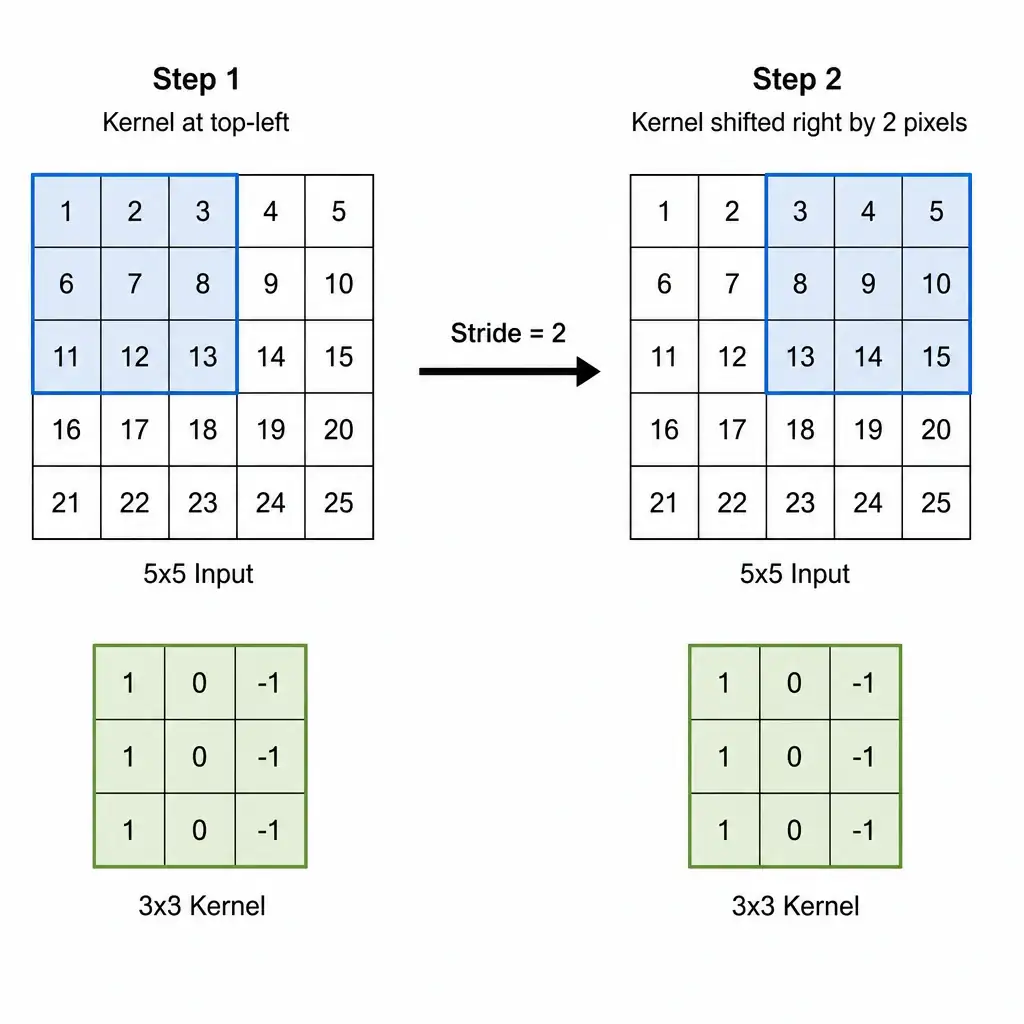
Short Explanation
Think of stride like taking steps down a sidewalk. If your stride is one, you step on every concrete square; if it's two, you skip every other one. In a CNN, that's the step size the filter uses as it slides across the input pixels.
Full Explanation
In a Convolutional Neural Network (CNN), the stride is a hyperparameter that controls how the filter, or kernel, moves across the input data, such as a 2D image. When performing convolution, the filter is placed on the input, element-wise multiplication is performed, and the results are summed to produce a single value in the output feature map. The filter then shifts by a set number of pixels defined by the stride. If the stride is set to 1, the filter slides one pixel at a time. If the stride is set to 2, the filter shifts by two pixels at a time, skipping intermediate positions. Increasing the stride reduces the overlap between receptive fields and decreases the spatial dimensions of the output feature map. The option describing the total number of filters applied to the input image is not the stride; it determines the depth, or number of channels, of the output feature map. The option describing the height and width dimensions of the sliding kernel matrix is the kernel size, such as 3x3 or 5x5, not the stride. The option describing the depth of the resulting feature map after convolution is also not the stride; the output depth is set by the number of filters, while the output spatial dimensions are influenced by the stride but are not the stride itself. For the exam, remember that stride dictates the movement step size of the kernel across the input.