
In a Convolutional Neural Network (CNN), what is the primary reason for applying zero-padding to the input image or feature maps before performing a convolution operation?
Select an answer to reveal the explanation.
Short Explanation
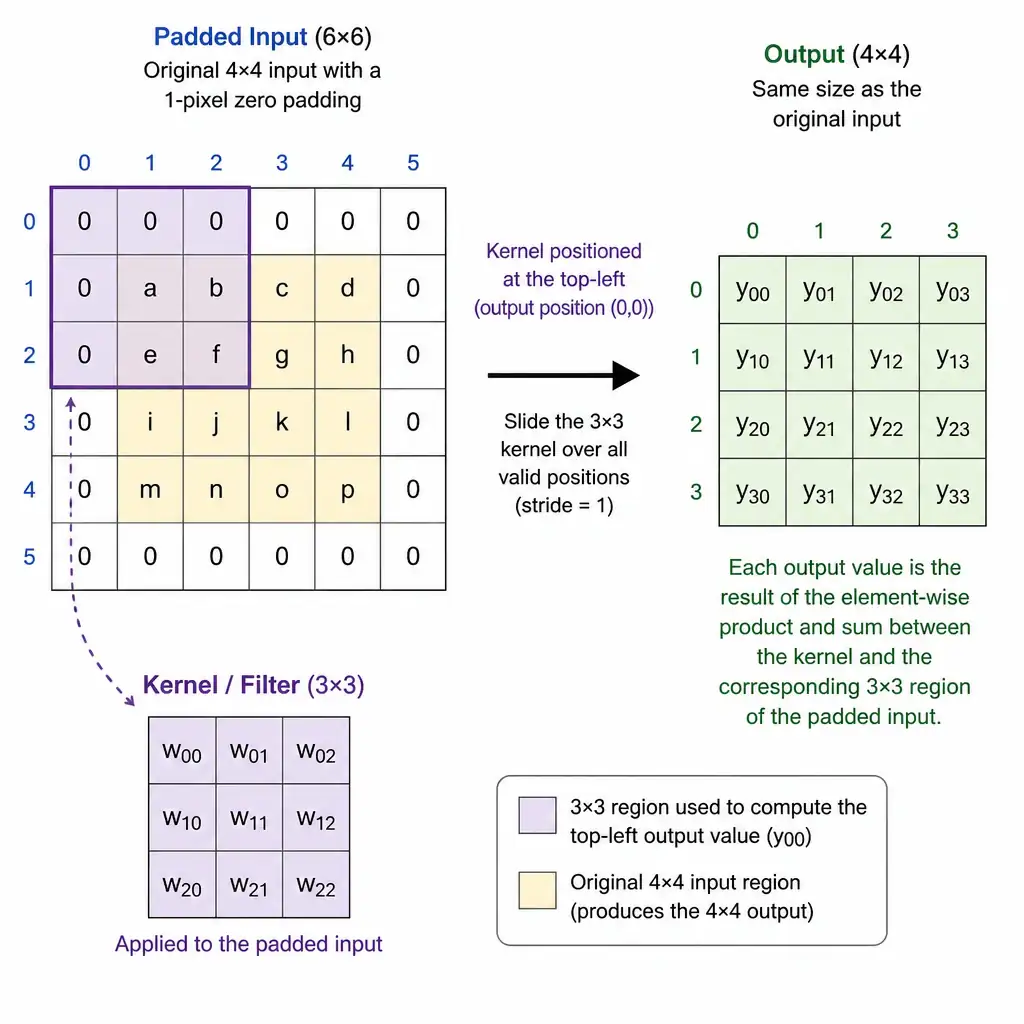
Think of zero-padding like putting a protective bumper around your image. Every convolution shrinks the output and barely touches edge pixels, so you'd lose border details and make feature maps smaller layer after layer. Adding zeros keeps the spatial size the same and gives edge pixels fair attention.
Full Explanation
In Convolutional Neural Networks (CNNs), the convolution operation involves sliding a kernel (filter) across an input tensor. If we apply convolution to an input of size width × height without padding (known as 'valid' padding), the spatial dimensions of the output feature map will shrink to (width - kernel size + 1) × (height - kernel size + 1).
Furthermore, pixels located at the edges and corners of the image are only covered by the kernel filter a few times, whereas center pixels are included in multiple overlapping steps. This results in two major issues: 1. Dimensionality Shrinkage: The feature maps rapidly get smaller as they pass through deep convolutional layers, limiting how deep the network can be before the spatial dimensions collapse. 2. Loss of Edge Information: Information near the borders of the image is underrepresented and gradually discarded.
To address these issues, padding (typically zero-padding) is used. By surrounding the boundaries of the input matrix with additional rows and columns of zeros, the spatial dimensions can be preserved (often called 'same' padding, where the output width and height match the input). This ensures that edge pixels are processed with the same frequency as internal pixels, preserving border details.
Let's look at why the other choices are incorrect: - The choice about introducing non-linear characteristics into layer outputs is incorrect because non-linearity is introduced by activation functions (like ReLU or GeLU), not padding. - The choice about reducing spatial resolution to decrease memory consumption is incorrect because padding increases or maintains the size of feature maps; it does not reduce them. Pooling layers (like Max Pooling) or strided convolutions are used to reduce spatial resolution. - The choice about dynamically adjusting the size of kernel filters based on input dimensions is incorrect because filter sizes are fixed hyperparameters set before training; padding does not alter the size of the kernel filter itself.