
You are tasked with building a model that reads movie reviews and classifies the sentiment as positive or negative. Because textual reviews consist of variable-length sequences of words where context and order are critical, which of the following neural network architectures is most appropriate?
Select an answer to reveal the explanation.
Short Explanation
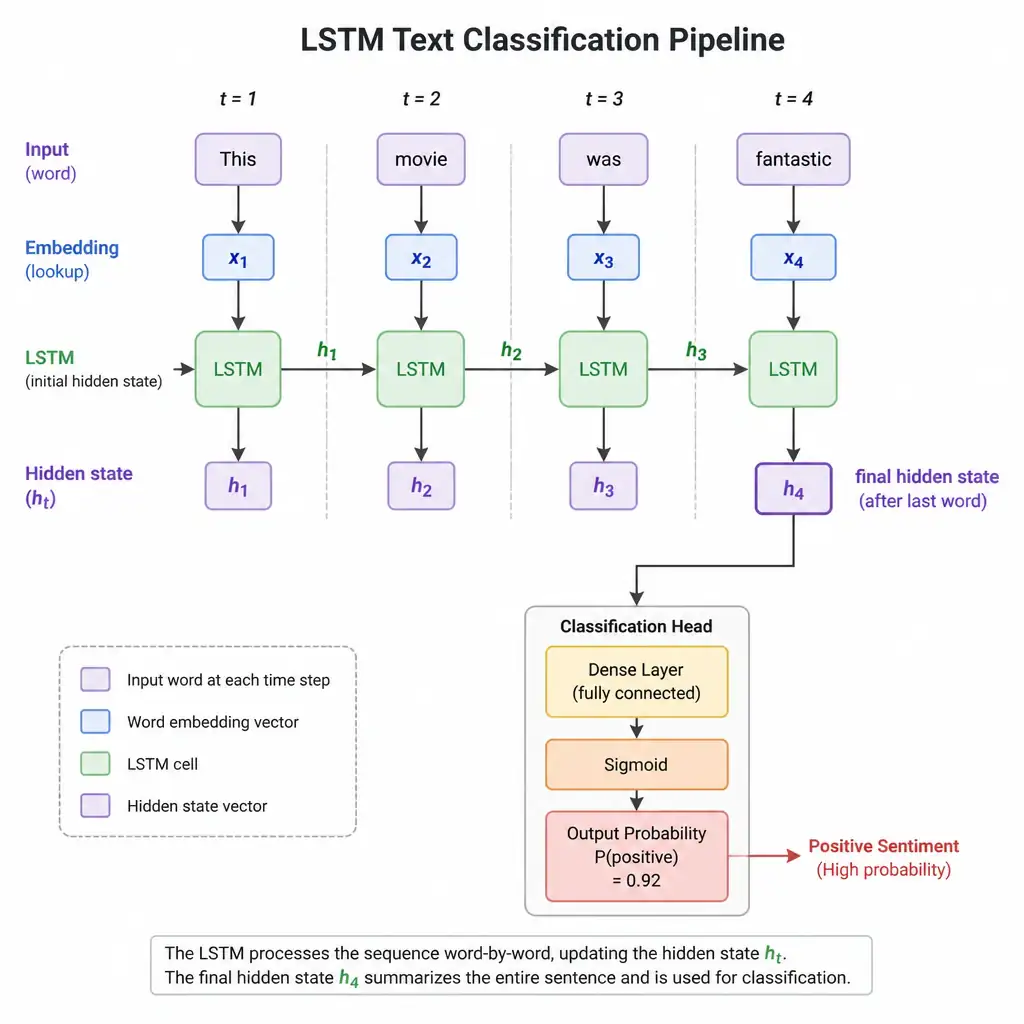
If you're classifying movie reviews, you're dealing with sequential text, so you need architecture that can carry context from one word to the next. That's why the recurrent neural network or long short-term memory network is the right fit. It loops information back into itself so the model can remember what came before.
Full Explanation
Sentiment analysis of text, such as movie reviews, is classic natural language processing problem. Text data is inherently sequential; words are read in order, and their meaning is highly dependent on both preceding and succeeding context. The correct choice is the recurrent neural network or long short-term memory network because these architectures are specifically designed for sequential data. Unlike standard feedforward networks, they possess recurrent connections that allow information to persist. Long short-term memory networks, in particular, use gates (input, forget, output) to maintain cell state over long sequences, preventing gradients from vanishing and enabling the model to remember context across many words. Additionally, modern natural language processing pipelines also utilize Transformers (like BERT or GPT), which use self-attention mechanisms to model sequence dependencies in parallel. However, within recurrent architectures, long short-term memory networks remain classic and highly effective choice for capturing temporal dynamics over variable-length text sequences, whereas feedforward networks fail entirely to maintain sequence context. The K-Means clustering model is incorrect because K-Means is unsupervised clustering algorithm. Sentiment analysis is supervised classification task. K-Means is not neural network and cannot naturally model sequence patterns or labels. The standard feedforward neural network with static input size is incorrect because it requires fixed input size, meaning reviews would have to be padded or truncated heavily and sequence context would be lost, and it lacks recurrent connections, rendering it poor at capturing word order. The convolutional neural network configured with 3D kernel filters is incorrect because while 1D convolutional neural networks can sometimes be applied to text to extract local n-gram features, 3D convolutional neural networks are specifically designed for video processing or volumetric spatial data, where there are three spatial dimensions plus channels, making them overly complex and inappropriate for text sentiment analysis.