
In deep learning optimization algorithms, the acronym "Adam" refers to which specific technique name?
Select an answer to reveal the explanation.
Short Explanation
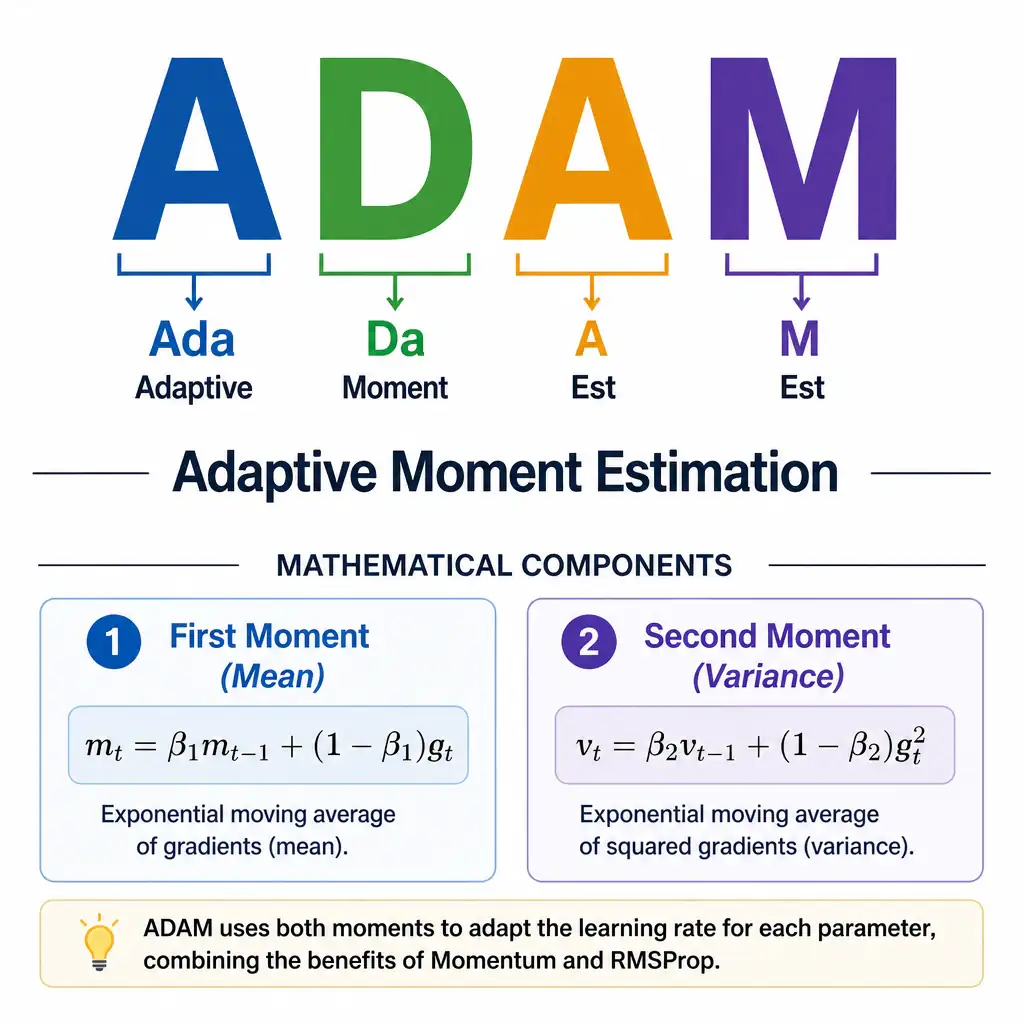
Adam stands for Adaptive Moment Estimation, not a person's name. You can remember it because it adapts learning rates and estimates gradient moments. Write this down, because it's a quick win on the test.
Full Explanation
The term "Adam" is short for Adaptive Moment Estimation. It is an optimization algorithm that has gained widespread popularity in deep learning since its introduction by Diederik Kingma and Jimmy Ba in 2014.
The name directly reflects its mathematical operations: - Adaptive: The algorithm dynamically adapts the learning rates for individual parameters throughout the training process. - Moment Estimation: The adaptation is based on estimating the first and second moments of the gradients. - The first moment is the mean (the exponentially decaying average of past gradients), which acts as the momentum component to help the optimizer push past flat regions. - The second moment is the uncentered variance (the exponentially decaying average of past squared gradients), which scales the learning rate for each parameter individually based on its historical update magnitudes.
The other answer choices are incorrect: - Advanced Decay Alignment Method, Asymmetric Momentum descent Model, and Algorithmic Model Averaging are fabricated terms that do not correspond to the true name of the optimization algorithm. While they use terms common in machine learning (like "Decay," "Momentum," and "Averaging"), they do not represent the correct expansion of the acronym "Adam." In academic literature and official frameworks like PyTorch and TensorFlow, Adam is defined strictly as Adaptive Moment Estimation.
Mathematically, the first moment acts as a low-pass filter on the gradients, smoothing out noisy oscillations, while the second moment acts as a step-size normalizer, preventing parameters with extremely large gradients from taking dangerously large steps. Together, these estimates provide a robust, self-tuning update step that makes Adam particularly suited for complex architectures with noisy gradients or sparse data.