When building a neural network in TensorFlow, a developer wants to use a clean, high-level API to define model layers, compile the model with an optimizer and loss function, and train it using simple commands. Which API within the TensorFlow ecosystem is designed for this?
Select an answer to reveal the explanation.
Short Explanation and Infographic
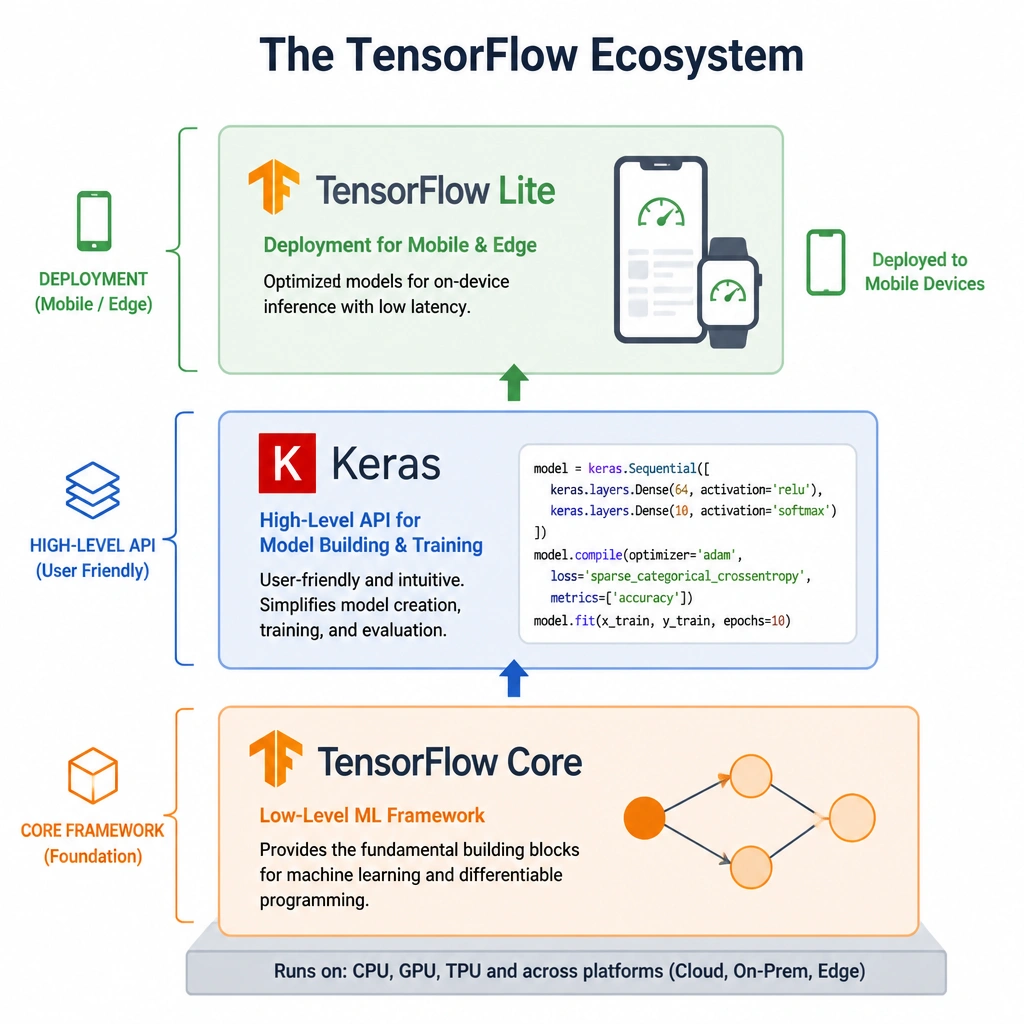
Alright, let's talk about efficiency. You could build a neural network from scratch using low-level math and manually defining every single matrix multiplication. But honestly, who has time for that in the real world? That's where Keras comes in. Keras is the official high-level API for TensorFlow. It lets you stack layers like Lego blocks using clean, simple commands like model.add(), compile it with one line, and train it with model.fit(). TensorFlow Core is the low-level engine underneath, Tensors are just the data structures, and TensorFlow Lite is what you use to run models on mobile devices. If you want to build models fast without getting bogged down in math, Keras is your best friend. Make sure you know this one!
Full explanation below image
Full Explanation
Keras is a high-level neural networks API designed for human beings, which is integrated directly into TensorFlow (as tf.keras). It allows for fast prototyping and model building by providing user-friendly, modular, and extensible abstractions. With Keras, developers can define sequential or functional architectures, configure training configurations (optimizers, loss functions, and metrics) using the compile() method, and execute training and evaluation using fit() and evaluate(). - Distractor A is incorrect because Tensors are the multi-dimensional arrays representing data, not an API for model construction. - Distractor C is incorrect because TensorFlow Core refers to the lower-level APIs and runtime engine of TensorFlow, which require verbose, manual implementation of mathematical operations. - Distractor D is incorrect because TensorFlow Lite is a framework optimized for deploying models on mobile, embedded, and edge devices, not for defining or training architectures.