During the training of a deep neural network, a developer notices that the model is performing exceptionally well on training data but poorly on the validation set. How does introducing a Dropout layer help address this issue?
Select an answer to reveal the explanation.
Short Explanation and Infographic
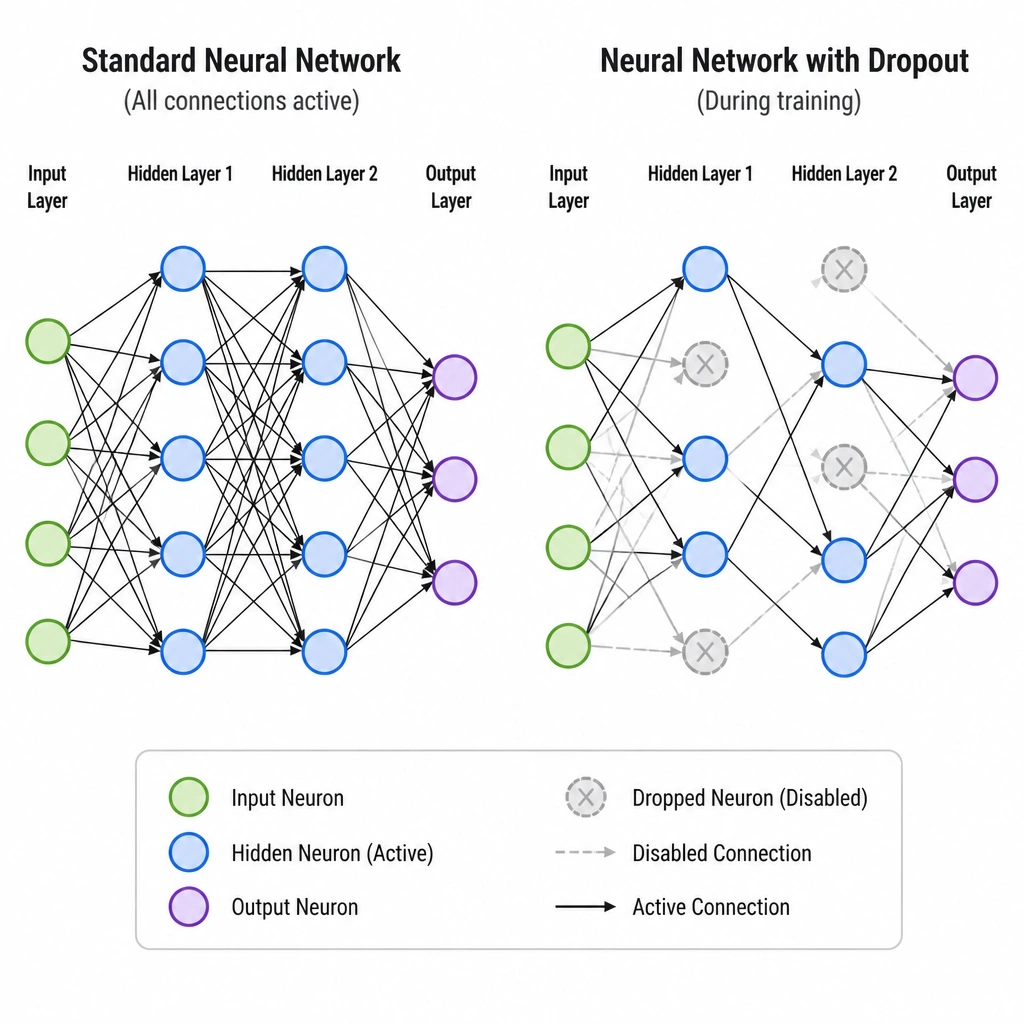
Here's the deal with dropout: it's a super powerful tool to stop your model from memorizing the training data, which we call overfitting. Imagine you have a team of developers, but one or two people do all the work while the rest just coast. If those key people get sick, the project falls apart! Dropout is like randomly telling a bunch of your neurons to take the day off during training. Since the remaining neurons can't rely on their 'star' players, they're forced to step up and learn the features themselves. This creates a much more robust network that performs well on new, unseen data. Just remember, we only use dropout during training, not during inference. And it doesn't permanently delete weights or change your learning rate. Trust me, you'll see this concept on the exam!
Full explanation below image
Full Explanation
Dropout is a widely used regularization technique designed to prevent overfitting in deep neural networks. During training, a dropout layer randomly 'drops out' (sets to zero) a predefined fraction of the active neurons at each forward/backward pass. This prevents neurons from co-adapting too closely (relying heavily on specific neighboring neurons), forcing the network to learn more robust, distributed representations of the data. During inference, dropout is disabled, and all neurons are utilized (with weights scaled proportionally). - Distractor B is incorrect because stabilizing training by normalizing activations is the function of Batch Normalization, not Dropout. - Distractor C is incorrect because dropout only temporarily zeroes out activations during training steps; it does not permanently prune or reduce the number of parameters in the model architecture. - Distractor D is incorrect because adjusting the learning rate is the responsibility of learning rate schedulers or adaptive optimizers (like Adam).