What is the primary function and benefit of enabling Eager Execution (the Eager runtime) in TensorFlow?
Select an answer to reveal the explanation.
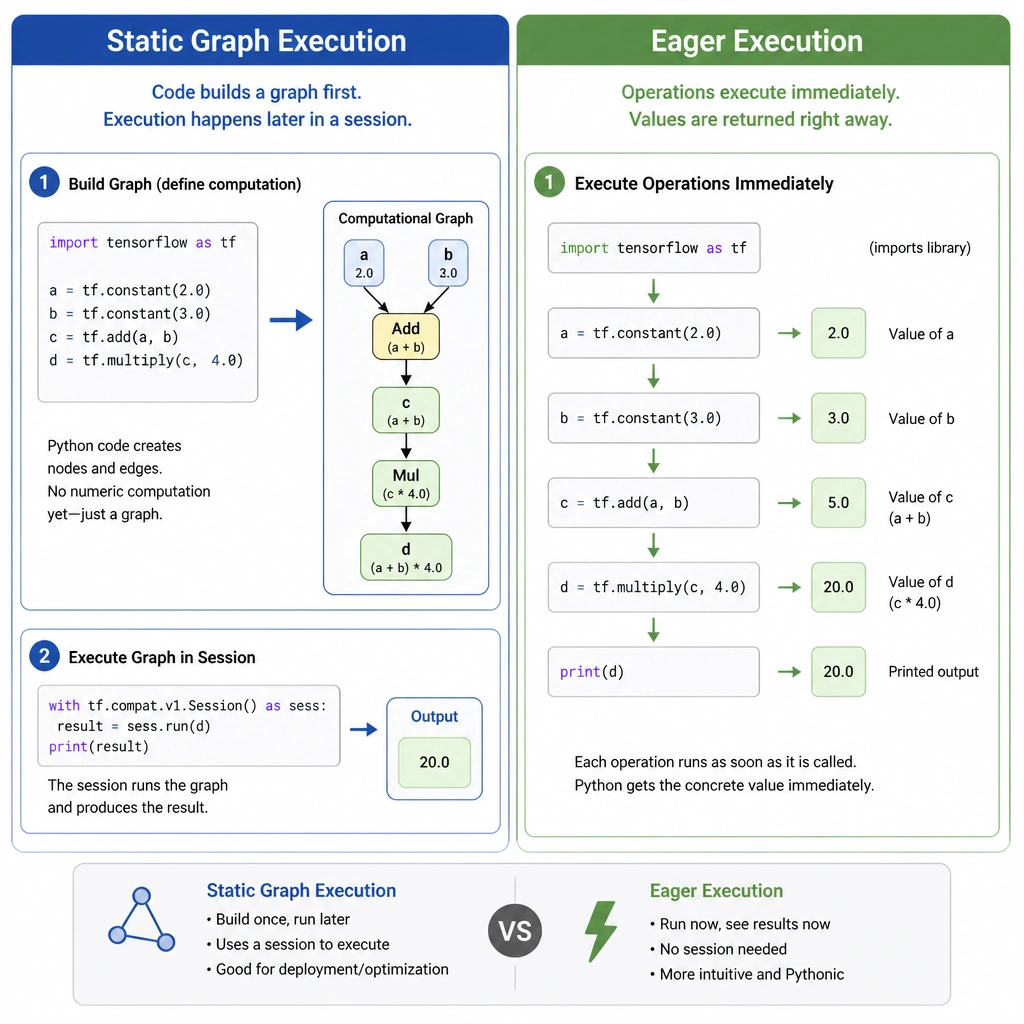
Short Explanation and Infographic
If you worked with early versions of TensorFlow, you probably remember writing code, compiling a static graph, and then running it inside a 'Session' to actually see if it worked. It was a headache to debug! But then TensorFlow introduced Eager Execution. Think of it like this: eager execution means operations are executed immediately as you write them. If you add two tensors, they add right then and there, and you can print the result instantly. No need to build a massive static graph first. This makes prototyping and debugging a breeze because it acts like normal Python code. It has nothing to do with saving files, running on CPUs, or mobile optimization. Eager mode is all about instant execution and pythonic coding!
Full explanation below image
Full Explanation
TensorFlow Eager Execution is an imperative programming environment that evaluates operations immediately, without building graphs. Operations return concrete values instead of constructing a computational graph to be executed later in a session. This provides a more intuitive interface, making it easier to write, debug, and prototype models using standard Python control flow and debugging tools (like pdb). - Distractor B is incorrect because optimizing models for mobile and edge devices is the function of TensorFlow Lite (TF Lite), not Eager Execution. - Distractor C is incorrect because saving and serializing models is handled by saving APIs (e.g., model.save() or SaveModel format). - Distractor D is incorrect because Eager Execution works on both CPU and GPU hardware, automatically utilizing GPUs when available.