A computer vision engineer is designing a Convolutional Neural Network (CNN) from scratch to classify various species of birds in photographs. What is the standard sequential progression of layer types used to extract features and classify the input image?
Select an answer to reveal the explanation.
Short Explanation and Infographic
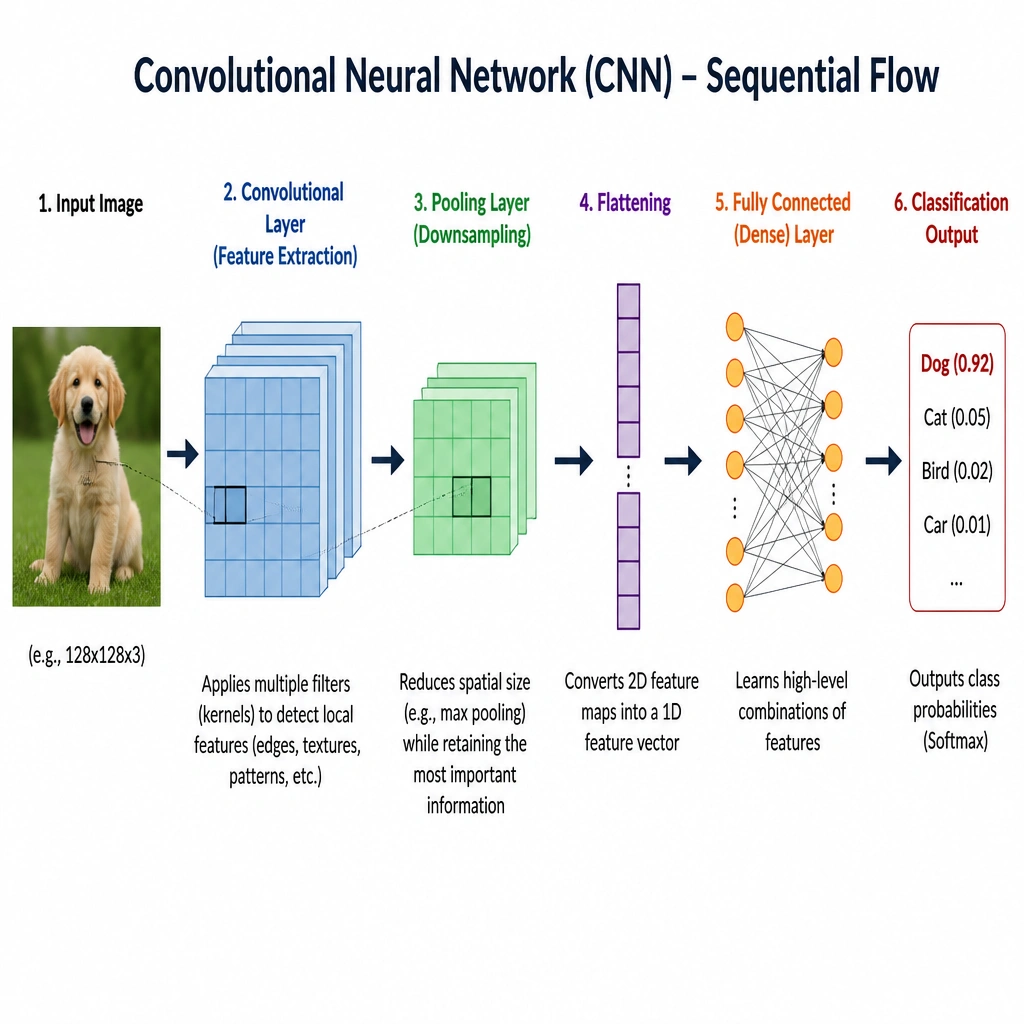
Here's the deal: when you design a CNN for image classification, you have a very specific workflow. First, you feed the image into Convolutional layers. These layers are like tiny detectives scanning the image to spot edges, corners, and textures. Next up is the Pooling layer. Pooling is all about downsampling—it shrinks the spatial size of the data so we don't blow up our memory, and it makes the model less sensitive to exactly where a feature is located in the frame. Finally, after extracting all those features, we flatten the data and send it through Fully Connected (Dense) layers to make the final classification. Putting a Dense layer first or throwing RNNs into a basic image classifier doesn't make sense. Trust me on this, this layout is classic CNN architecture!
Full explanation below image
Full Explanation
A standard Convolutional Neural Network (CNN) architecture for image classification consists of three main stages in sequence: 1. Convolutional Layers: These apply filters to the input image to extract spatial features, starting with low-level features like edges and progressing to high-level features like shapes and objects. 2. Pooling Layers: These perform downsampling (e.g., Max Pooling) to reduce the spatial dimensions of the feature maps, which minimizes the computational load and provides translation invariance. 3. Fully Connected (Dense) Layers: After feature extraction, the multi-dimensional feature maps are flattened into a vector and passed to dense layers to perform the final classification mapping. - Distractor A is incorrect because Recurrent Neural Networks (RNNs) are designed for sequence data, not primary image feature extraction, and putting them first is not standard. - Distractor C is incorrect because mixing RNNs directly between convolutional and dense layers is not a typical feedforward CNN flow for image classification. - Distractor D is incorrect because placing the dense layer first would destroy the spatial relationships of the pixels before the convolutional layers could extract local features.