
What is the primary function of the forget gate within a Long Short-Term Memory (LSTM) network cell?
Select an answer to reveal the explanation.
Short Explanation
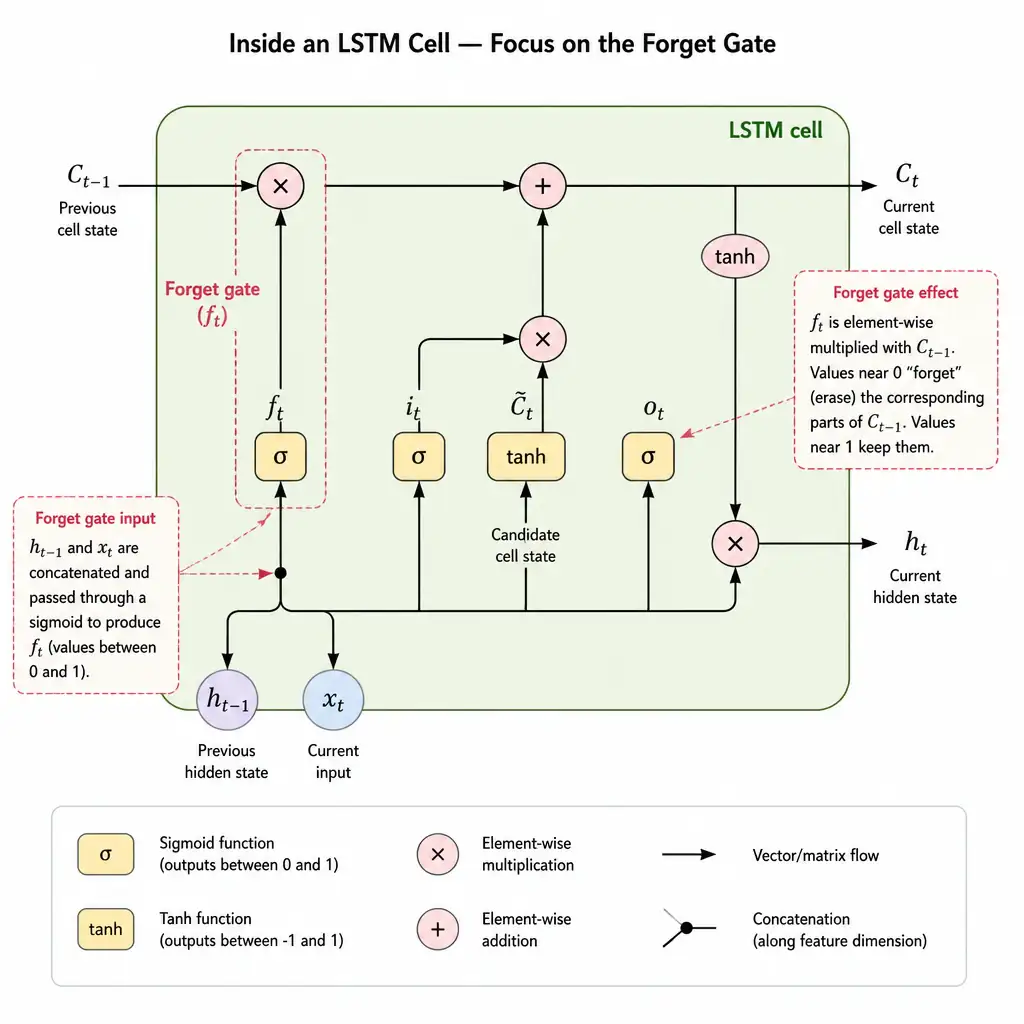
The forget gate is the gatekeeper of the cell state. It looks at the previous hidden state and current input, then decides what old info to drop and what to keep. If you see this on the exam, remember: it controls what gets discarded from the past cell state.
Full Explanation
The Long Short-Term Memory (LSTM) cell contains three gates that regulate the flow of information: the forget gate, the input gate, and the output gate. These gates allow the LSTM to maintain and update its long-term memory, known as the cell state.
In the LSTM cell's operations, the forget gate acts before the cell state is updated. Its mathematical representation is: f_t = σ(W_f · [h_{t-1}, x_t] + b_f), where σ represents the Sigmoid activation function, h_{t-1} is the previous hidden state, and x_t is the current input. Because Sigmoid outputs values strictly between 0 and 1 for each value in the cell state, the forget gate acts as a multiplicative filter. When the output is close to 0, it tells the cell state to discard the corresponding information from the previous cell state. When the output is close to 1, it preserves the information. This capability prevents the network from carrying irrelevant past information forward indefinitely.
The choice saying it decides what new information from the current input should be written to the cell state describes the input gate and the candidate cell state generator, which determine what new information is added to the cell state. The choice saying it determines the final output value of the hidden state based on the current cell state describes the output gate, which controls how much of the current cell state is revealed as the cell's output hidden state to the next step. The choice saying it temporarily resets the weights of the hidden connections during the forward pass to prevent overfitting is incorrect because gates in an LSTM are learned parameters that dynamically control information flow; they do not perform weight initialization or model training tasks.