In computer vision architectures, what is the primary role of a convolutional layer within a Convolutional Neural Network (CNN)?
Select an answer to reveal the explanation.
Short Explanation and Infographic
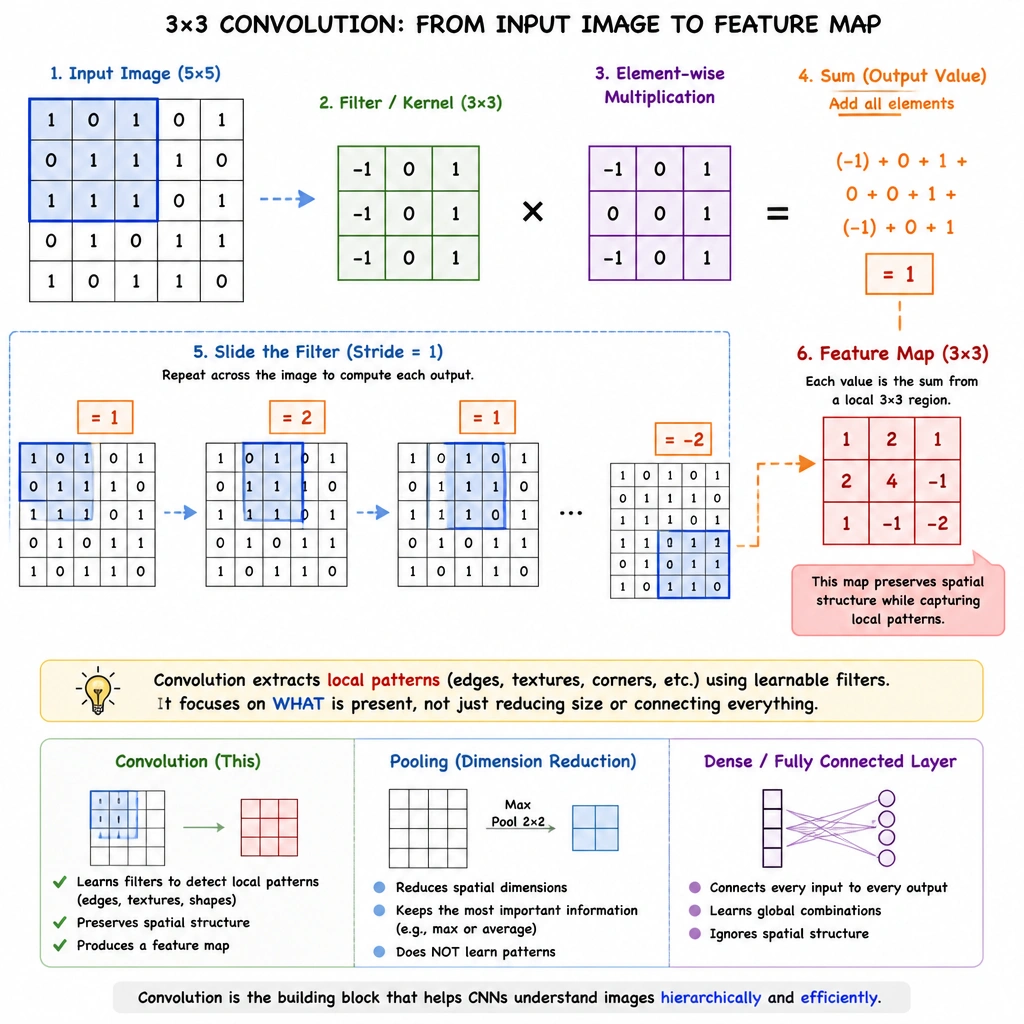
Think of a convolutional layer like a detective scanning a photo with a magnifying glass. The detective isn't looking at the whole picture at once; they are searching zone-by-zone for specific clues—like an edge here, a texture there, or a corner. That magnifying glass is the filter (or kernel), and as it slides across the image, it performs math to highlight these local features. Downsampling is what pooling layers do, non-linearity comes from activation functions like ReLU, and fully connected layers link everything together at the end. For the exam, remember: convolution is all about feature extraction!
Full explanation below image
Full Explanation
In a Convolutional Neural Network (CNN), the convolutional layer is the fundamental building block responsible for feature extraction. It works by sliding one or more small filters (or kernels) across the input data (such as an image) and computing the dot product between the filter weights and the local input regions. This operation preserves spatial relationships and allows the network to learn localized features. Early convolutional layers typically detect low-level features such as vertical and horizontal edges, color transitions, and simple textures. As data flows deeper into the network, subsequent convolutional layers combine these basic features to detect higher-level patterns like eyes, noses, or entire objects. The distractors represent other distinct components of a CNN pipeline: Reducing dimensionality is the primary function of pooling layers (e.g., max pooling), which downsample the feature maps. Adding non-linearity is performed by activation functions such as ReLU (Rectified Linear Unit), which are applied after the convolution. Connecting every neuron in one layer to every neuron in the next is the characteristic of fully connected (or dense) layers, which typically appear at the end of the network to perform the final classification.