When moving from traditional Stochastic Gradient Descent (SGD) to more advanced optimizers, why do many deep learning engineers default to using Adam? What is the main improvement Adam introduces?
Select an answer to reveal the explanation.
Short Explanation and Infographic
Here's the deal: traditional SGD is like driving down a bumpy mountain road with a single, stiff cruise control setting. It doesn't adjust. Adam is like a smart, adaptive cruise control. It combines two great ideas: momentum (which keeps you moving in the right direction, like a heavy ball rolling downhill) and RMSprop (which scales the speed based on how bumpy the road is for each specific wheel). By adjusting the learning rate for every single parameter dynamically, Adam helps you find the minimum much faster and with less manual tuning. Trust me, it's the go-to optimizer for a reason!
Full explanation below image
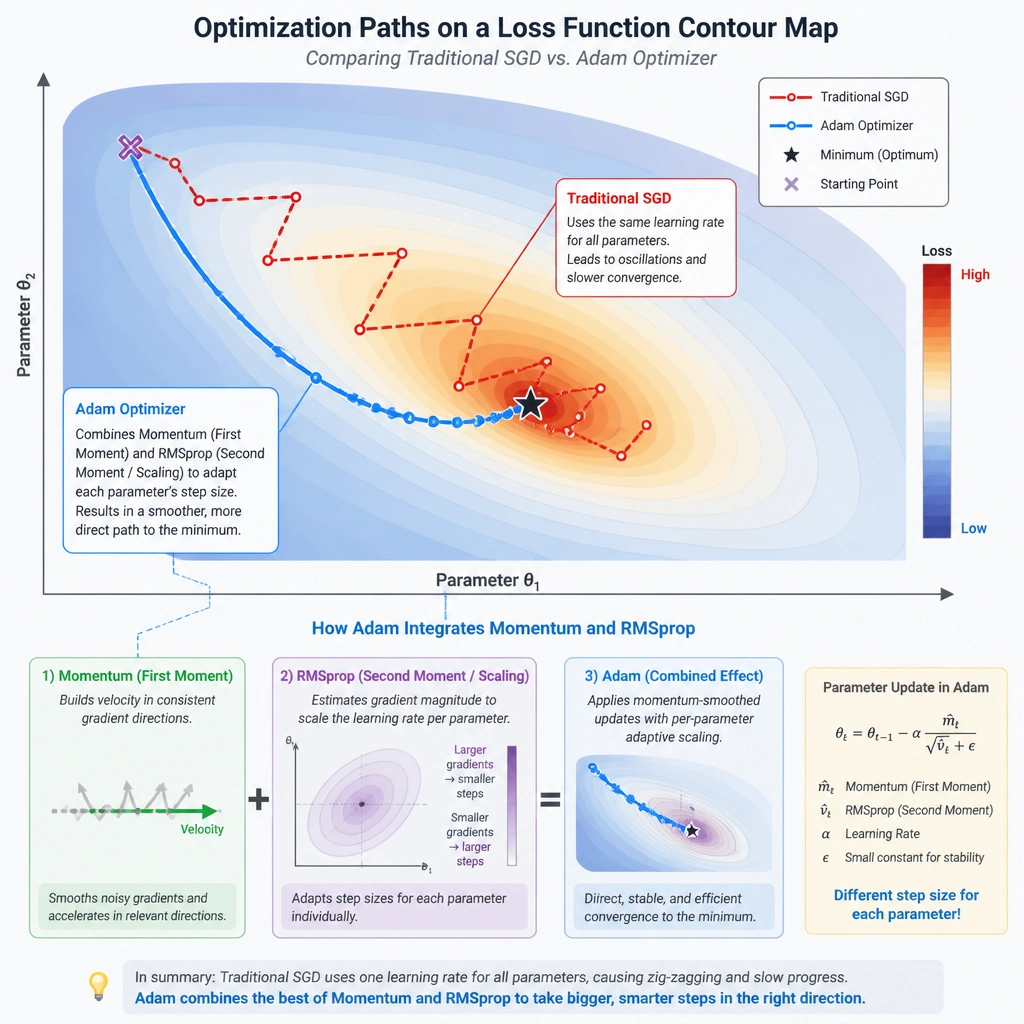
Full Explanation
Adam, short for Adaptive Moment Estimation, is an optimization algorithm that improves upon classic Stochastic Gradient Descent (SGD) by dynamically calculating adaptive learning rates for each parameter. It achieves this by maintaining running estimates of both the first raw moment (the mean) and the second uncentered moment (the uncentered variance) of the gradients. Essentially, it combines the concepts of Gradient Descent with Momentum (which helps accelerate the optimizer in the correct direction and dampens oscillations) and RMSprop (which scales the learning rate based on the recent magnitude of gradients to prevent exploding or vanishing updates). By adapting the learning rate for individual weights, Adam performs exceptionally well on noisy gradients and sparse data, which are common in complex deep learning architectures. Traditional SGD, in contrast, applies a single global learning rate to all parameters, which can lead to slow convergence in ravines or saddle points where gradients are steep in one dimension but gentle in another. The distractors are incorrect because Adam does not use a fixed or constant learning rate, and it absolutely relies on calculating loss and backpropagation to obtain gradients.