
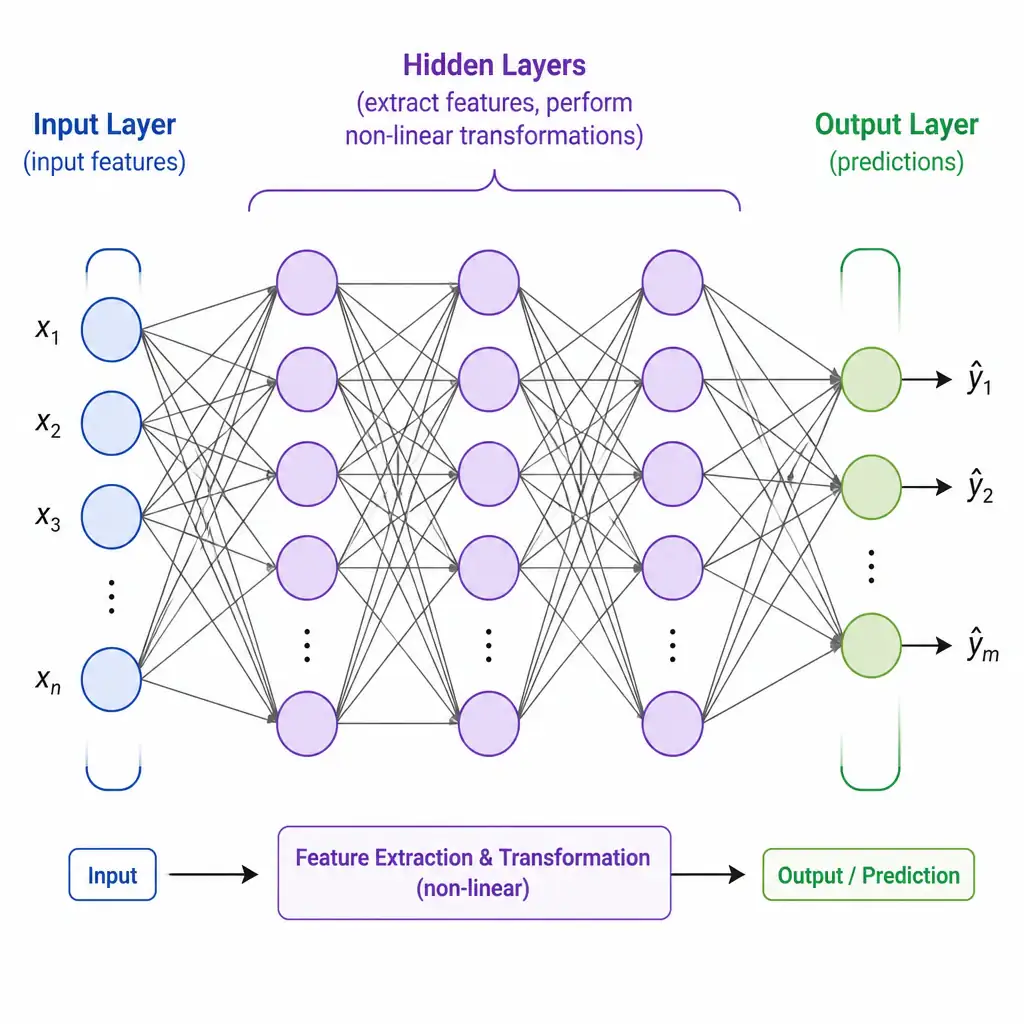
In a multi-layer perceptron (MLP) architecture, input features are passed through several intermediate layers of neurons where they undergo non-linear transformations before reaching the final layer that outputs the model's predictions. What are these intermediate layers called?
Select an answer to reveal the explanation.
Short Explanation
When you look at a neural network, the layers between the inputs and outputs are hidden layers. They do the middle work of extracting patterns and learning features, while the output layer makes the final prediction.
Full Explanation
The correct answer is Hidden layers. An artificial neural network consists of three types of layers: the input layer, one or more hidden layers, and the output layer. The input layer receives the raw features, and the output layer generates the final prediction. The hidden layers are located between the input and output layers. They are called 'hidden' because their intermediate activations are not directly visible as inputs or outputs of the system. In these layers, neurons compute weighted sums of their inputs, add a bias, and apply a non-linear activation function. This allows the network to learn complex, non-linear relationships and represent abstract features at different levels of hierarchy. The bias-layer idea is incorrect because biases are parameters added to individual neurons within layers, not separate layers themselves. The prediction-layer idea is incorrect because the final predictions are generated by the output layer, not intermediate layers. The static-layer idea is incorrect because the weights and biases within the hidden layers are dynamic and updated continuously during training using optimization techniques like gradient descent.