
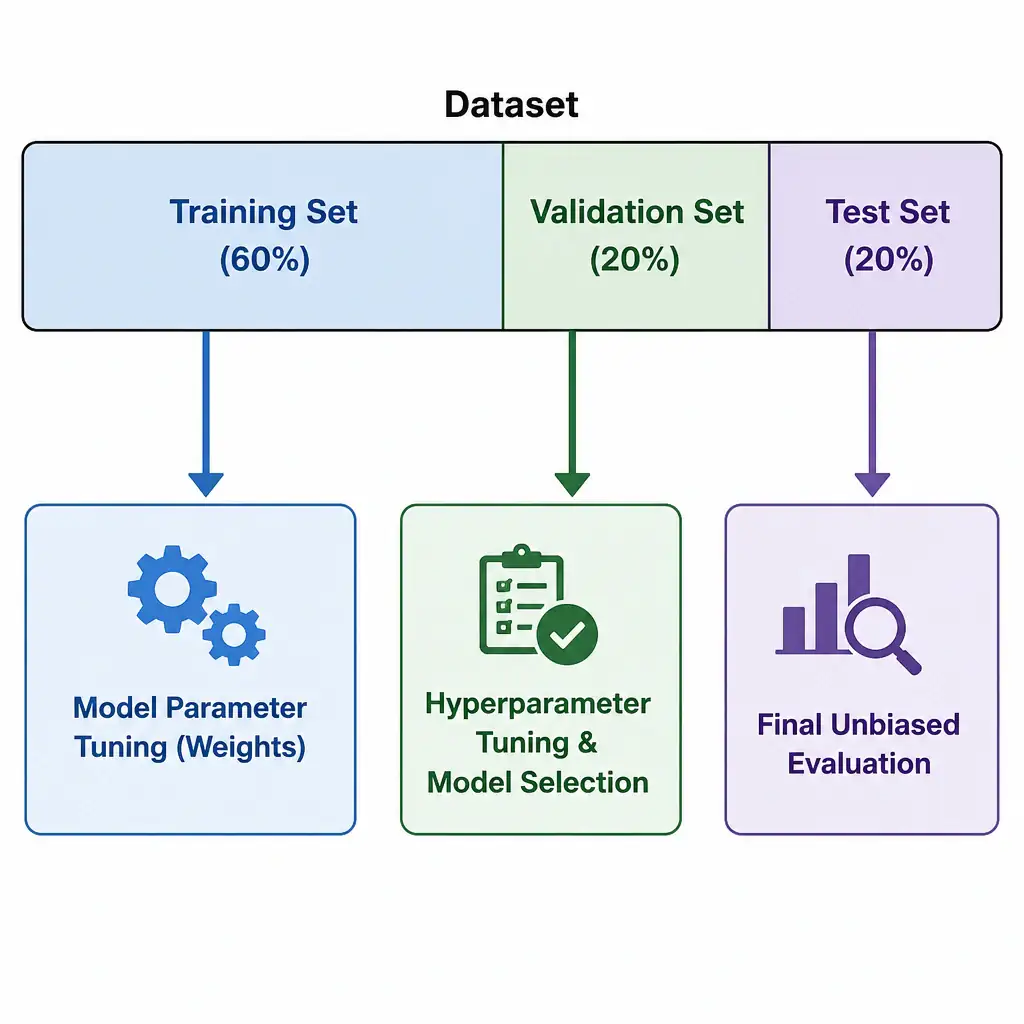
When preparing a dataset for training a machine learning model, you split the data into three separate partitions: training, validation, and test. During model development, you repeatedly train the model on the training partition and evaluate it on the validation partition to adjust hyperparameters (like learning rate and regularization strength). What is the primary purpose of the validation partition in this workflow?
Select an answer to reveal the explanation.
Short Explanation
Here's the deal: you use the validation partition as a practice quiz to tune hyperparameters and choose the best model without letting it memorize the training data. If you tune on the test set, you're cheating and you'll get burned in production. Train for learning, validate for tuning, and save the test set for the final score.
Full Explanation
The validation partition is used to tune hyperparameters and perform model selection while preventing overfitting to the training data. In standard machine learning workflows, data is partitioned into three sets to ensure proper generalization: the training set, the validation set, and the test set. The training set is used to adjust the model's parameters, such as weights and biases, through optimization algorithms. The validation set is used to evaluate the model's performance during training to select the best hyperparameters, such as learning rate, batch size, or network depth, and to choose the architecture. Because the model's parameters are not directly updated using the validation set, it serves as an independent benchmark to detect overfitting to the training data. Once the final model and hyperparameters are chosen, the test set is used for one final evaluation of generalization performance. The statement about directly optimizing the network weights and biases via backpropagation describes the training set, not the validation set. The statement about performing a final, unbiased evaluation of the fully trained model's generalization capability describes the test set, which must remain unseen until model development is complete to avoid optimistic bias. The statement about calculating statistics for normalizing the input features describes feature scaling or normalization procedures, which are data preprocessing steps, not the purpose of the validation split.