
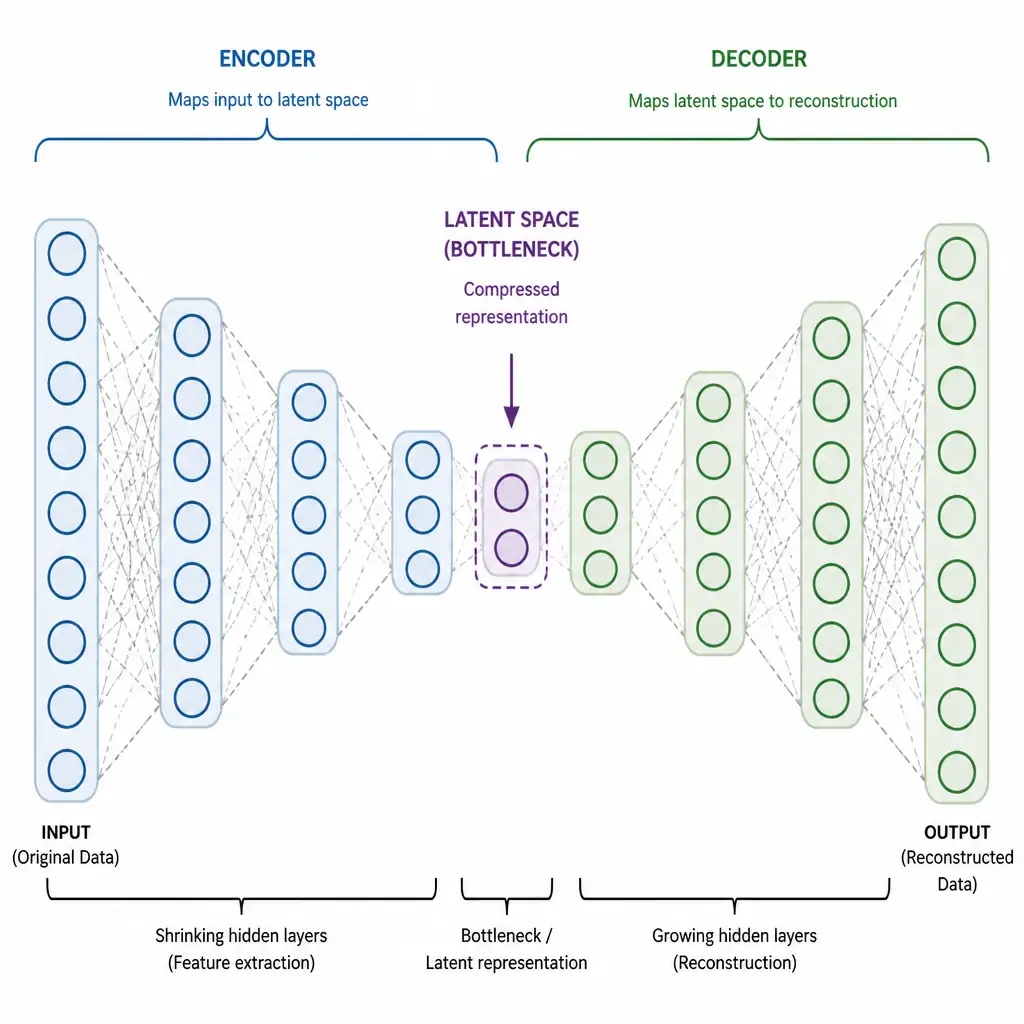
A developer is building an autoencoder model to detect anomalies in network traffic. The architecture must first compress high-dimensional input packets into a low-dimensional bottleneck space, and then attempt to reconstruct the original input from this bottleneck. What is the fundamental role of the encoder-decoder architecture in this setup?
Select an answer to reveal the explanation.
Short Explanation
Think of the encoder as a compressor and the decoder as a decompressor. You squash network packets into a tiny latent space, then rebuild the original packet; bad reconstruction flags anomalies.
Full Explanation
The encoder-decoder architecture is a core design pattern in deep learning, particularly in sequence-to-sequence tasks (like machine translation) and unsupervised learning (like autoencoders). The encoder network takes the input data and compresses it into a high-density, low-dimensional vector representing the core features or semantics (the latent space or bottleneck). The decoder network then takes this compressed representation and attempts to reconstruct the target output (which, in autoencoders, is the original input itself, or in translation, the target language). This forced compression forces the model to learn the most salient features of the data. The image-classification choice is incorrect because image classification typically uses a feedforward convolutional neural network (CNN) that outputs class probabilities, not a reconstructed version of the input. The choice about generating entirely new data distributions from random noise vectors describes generative models like Generative Adversarial Networks (GANs) or the generation phase of Variational Autoencoders (VAEs), which sample from noise, rather than the core deterministic encoder-decoder bottleneck mapping. The linear-regression choice is incorrect as regression models map inputs directly to continuous output values using simpler linear or fully connected layers without bottleneck reconstruction.