
In a reinforcement learning setup, an autonomous agent interacts with an environment to learn an optimal policy. What is the term for the numerical feedback signal returned by the environment to evaluate the quality of the agent's action?
Select an answer to reveal the explanation.
Short Explanation
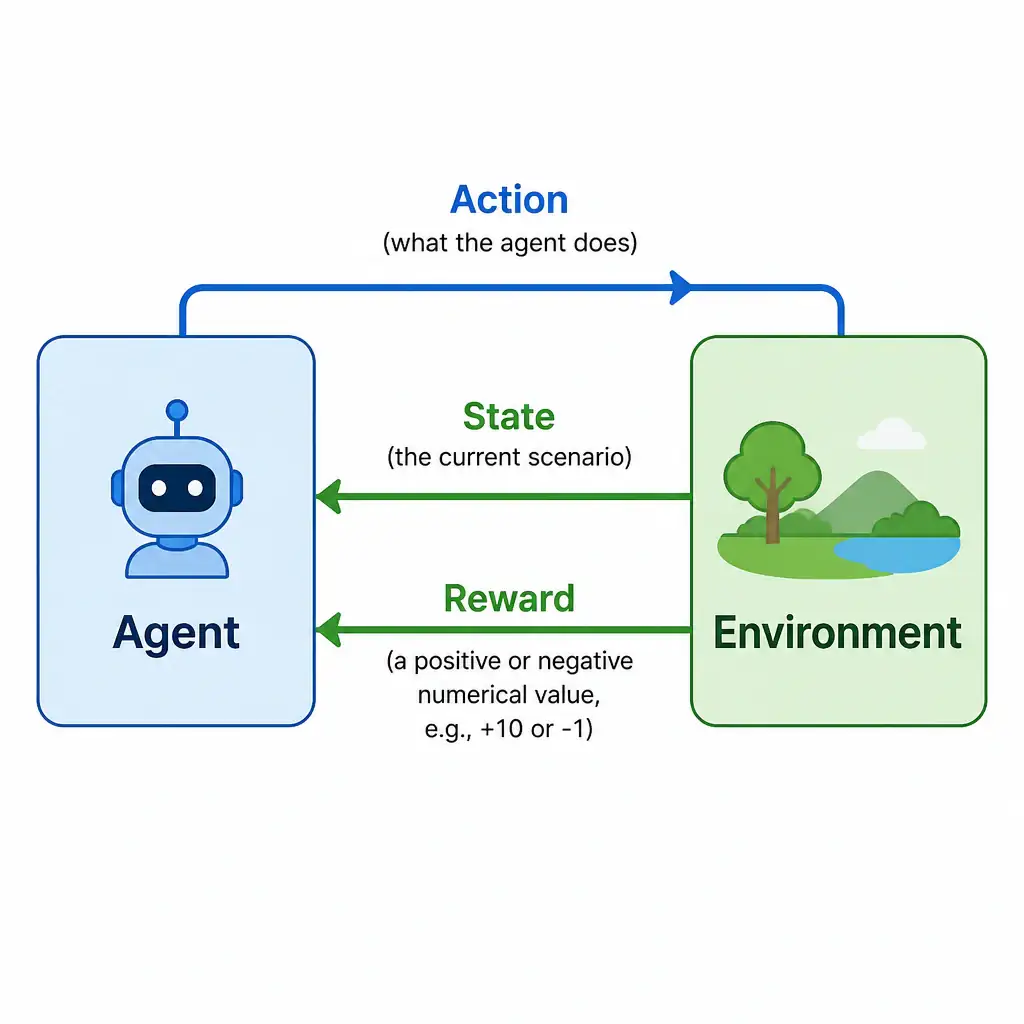
Think of reinforcement learning like training a puppy. If the puppy sits when you tell it to, you give it a treat; if it chews your favorite shoes, you don't. In this setup, the agent is the puppy and the reward is the treat: a numerical value sent back by the environment after every action, with positive meaning "good job" and negative meaning "stop doing that."
Full Explanation
Reinforcement Learning is a machine learning paradigm where an agent learns to make decisions by interacting with an environment. The core components are: Agent: the decision-maker model that performs actions. Environment: the world the agent interacts with. State: the current situation or configuration of the environment. Action: a move or choice made by the agent. Reward: a scalar feedback signal, a numerical value, returned by the environment immediately after the agent takes an action. The reward signal defines the goal in a reinforcement learning problem. If the action moves the agent closer to the goal, the reward is positive; if it moves it away or causes a failure, the reward is negative or zero. The objective of the agent is to learn a policy, a mapping from states to actions, that maximizes the cumulative reward, or return, it receives over time. The correct description is a scalar feedback value returned by the environment to evaluate an agent's action because that is precisely the reward signal. The user-configured hyperparameter like the discount factor or learning rate is incorrect because a hyperparameter is a configuration setting set before training, whereas the reward is dynamic feedback received during training. The complete set of observations representing the current state of the environment is incorrect because the state represents the current environment conditions, not the feedback signal. The action output vector calculated by the agent's policy network is incorrect because the model output in reinforcement learning is the action selected by the agent's policy, whereas the reward is the environmental evaluation of that action.