
When building a decision tree model, you find that the tree has grown extremely deep, splitting down to individual leaf nodes for almost every training instance. Which technique should you apply to simplify this model and improve its ability to generalize?
Select an answer to reveal the explanation.
Short Explanation
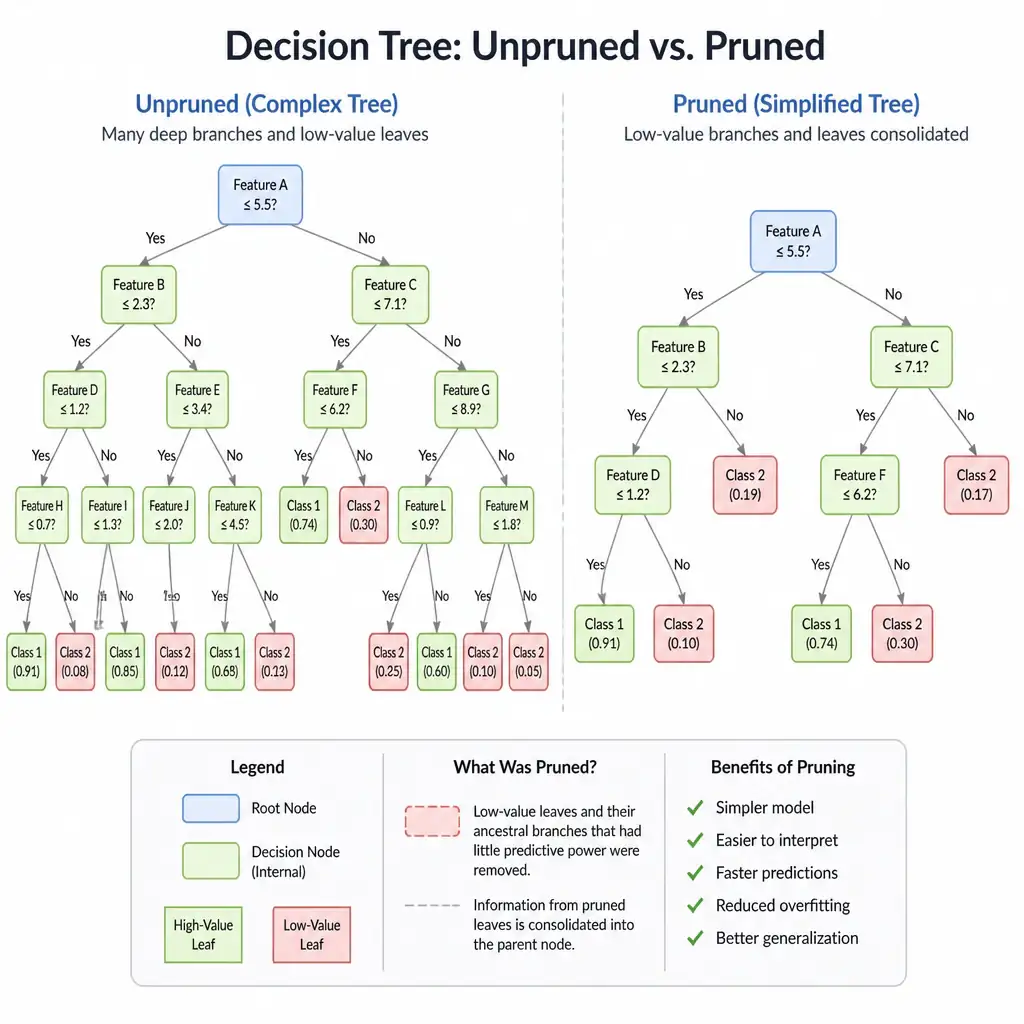
Think of it like this: if you let a decision tree grow without limits, it'll keep splitting until it memorizes almost every training case. Pruning is exactly what it sounds like—you snip off those extra, hyper-specific branches that don't add real value. By keeping the tree simpler, it works much better when it meets new data.
Full Explanation
Decision trees are highly prone to overfitting because they can continue splitting the data until every training instance is perfectly classified in its own leaf node. Pruning is a critical regularization technique designed to counter this. By cutting back non-significant branches (either after the tree is fully grown, known as post-pruning, or by stopping growth early, known as pre-pruning), you reduce the model's complexity. A simpler tree is more robust and generalizes much better to unseen data. The boosting approach, which combines multiple weak trees sequentially to decrease overall bias, is an ensemble method that increases model complexity by training sequential trees to correct the errors of previous ones. The feature engineering approach, which adds extra columns to the dataset to assist the tree's decision boundaries, involves creating new inputs to improve performance but does not directly simplify an existing overfit tree. The bootstrapping approach, which generates multiple subsets of the dataset to train a forest of trees, is a sampling technique used in bootstrap aggregating (bagging) to train ensembles of trees, not a method for simplifying an individual tree. Pruning is often guided by evaluating cost complexity, where branches are removed if their elimination does not significantly increase the tree's training error relative to the reduction in complexity.