
You are working on a project to generate realistic synthetic training data for an autonomous driving simulator, specifically creating realistic images of different weather conditions. Which of the following machine learning architectures is classified as a generative model and would be most appropriate for this task?
Select an answer to reveal the explanation.
Short Explanation
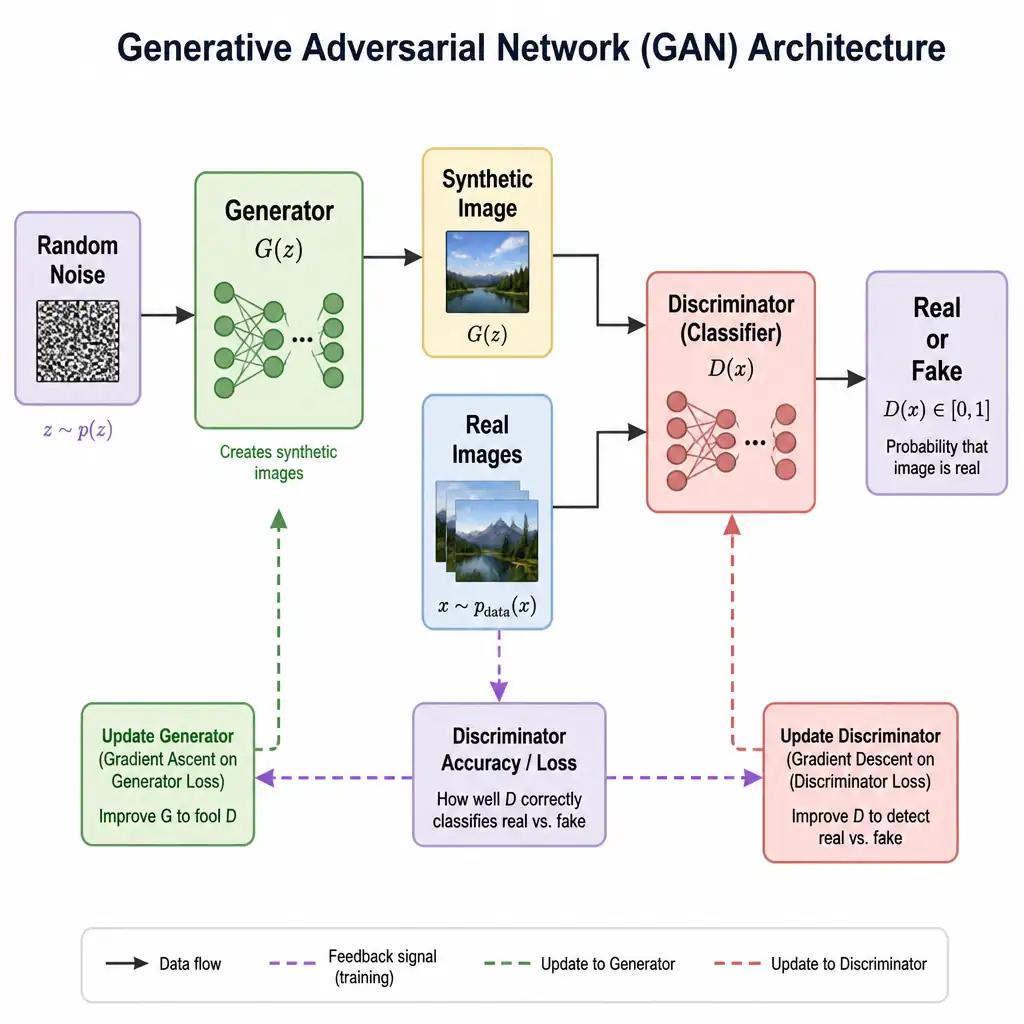
You need a generative model that can create new synthetic images, not just classify or cluster existing ones. The Generative Adversarial Network pits a generator against a discriminator until it can produce realistic weather-condition images. That makes it the right fit for synthetic training data.
Full Explanation
Generative models are a class of machine learning models that learn the underlying probability distribution of the input dataset in order to generate new, synthetic data points that resemble the training data. This contrasts with discriminative models, which learn the boundaries between classes to categorize input data.
The Generative Adversarial Network is a prominent generative modeling architecture introduced by Ian Goodfellow and his colleagues in 2014. A GAN consists of two neural networks trained simultaneously in a zero-sum game: the Generator takes random noise as input and attempts to generate synthetic data, such as realistic images, while the Discriminator takes both real training data and synthetic data from the generator and attempts to classify them as 'real' or 'fake'. During training, the generator becomes better at producing realistic data to fool the discriminator, while the discriminator becomes better at detecting fakes. This adversarial process continues until the generator produces highly authentic synthetic data that is indistinguishable from real data.
Let's review the incorrect approaches: the Support Vector Machine approach, which finds an optimal hyperplane to classify images, is a discriminative model used for classification and regression; it defines decision boundaries rather than generating new data. The K-Means approach, which groups unlabeled images into distinct clusters, is an unsupervised clustering algorithm that groups existing data points based on distance metrics; it does not generate new data. The Linear Regression approach, which predicts a continuous numerical output value, is a simple discriminative model used to predict continuous target values based on input features.
Therefore, the Generative Adversarial Network approach, which uses two competing neural networks to generate new data instances, is the correct choice as a generative model.