
You've built a customer segmentation model, and in an effort to make it as accurate as possible, you keep adding new features—tracking everything from daily website clicks to zip codes, ending up with over 500 features. Suddenly, you notice your model's performance drops, and data points that used to be clearly grouped now seem equidistant from one another. What concept explains this phenomenon?
Select an answer to reveal the explanation.
Short Explanation
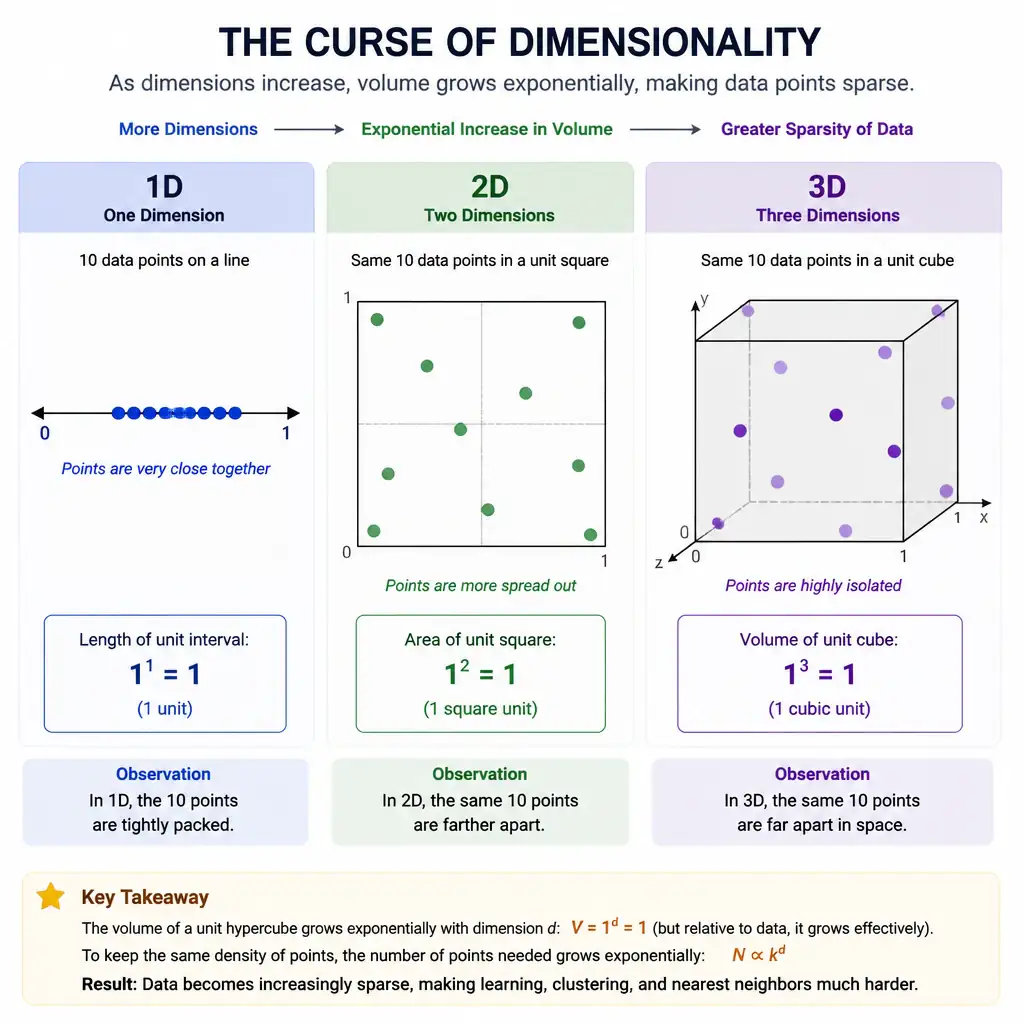
Here's the deal—more features aren't always better. When you add hundreds of dimensions, the space explodes, your data gets sparse, and distances stop meaning much. That's the curse of dimensionality, so keep your feature count in check.
Full Explanation
The curse of dimensionality refers to various phenomena that arise when analyzing and organizing data in high-dimensional spaces, often hundreds or thousands of dimensions, that do not occur in low-dimensional settings. As the number of features increases, the volume of the space grows exponentially. Consequently, the available data points become extremely sparse within this massive space. For any machine learning algorithm to find a reliable statistical pattern, the amount of data required to maintain a given density of data points must grow exponentially with the number of dimensions. Without an exponential increase in the size of the training dataset, models are prone to overfitting because they can easily find spurious patterns in the sparse space. Additionally, distance-based metrics such as Euclidean distance lose their effectiveness in high-dimensional spaces. As the number of dimensions increases, the distance between any two points in the dataset converges to the same value. Because the maximum distance and minimum distance between points become virtually identical, algorithms that rely on distance calculations, such as centroid-based clustering, nearest-neighbor, or anomaly detection, fail to differentiate between close and distant points. The vanishing gradient problem is a neural network training issue where gradients become too small to update early layers, which is unrelated to the geometric sparsity of input features. Overfitting due to high bias is wrong because high bias represents underfitting, when a model is too simple and underrepresents complex relationships, whereas high-dimensional sparsity typically leads to high variance and overfitting. Covariance shift is a form of dataset shift where the input distribution changes between training and production, which is an operational issue rather than a structural issue caused by high feature counts. Therefore, the curse of dimensionality is the correct term for spatial volume expansion causing data sparsity.