
Your team is developing an AI system for natural language translation and time-series forecasting. Because these tasks involve data points where the order and context of previous inputs directly influence the meaning or prediction of subsequent inputs, which type of data structure is most suitable for a Recurrent Neural Network (RNN)?
Select an answer to reveal the explanation.
Short Explanation
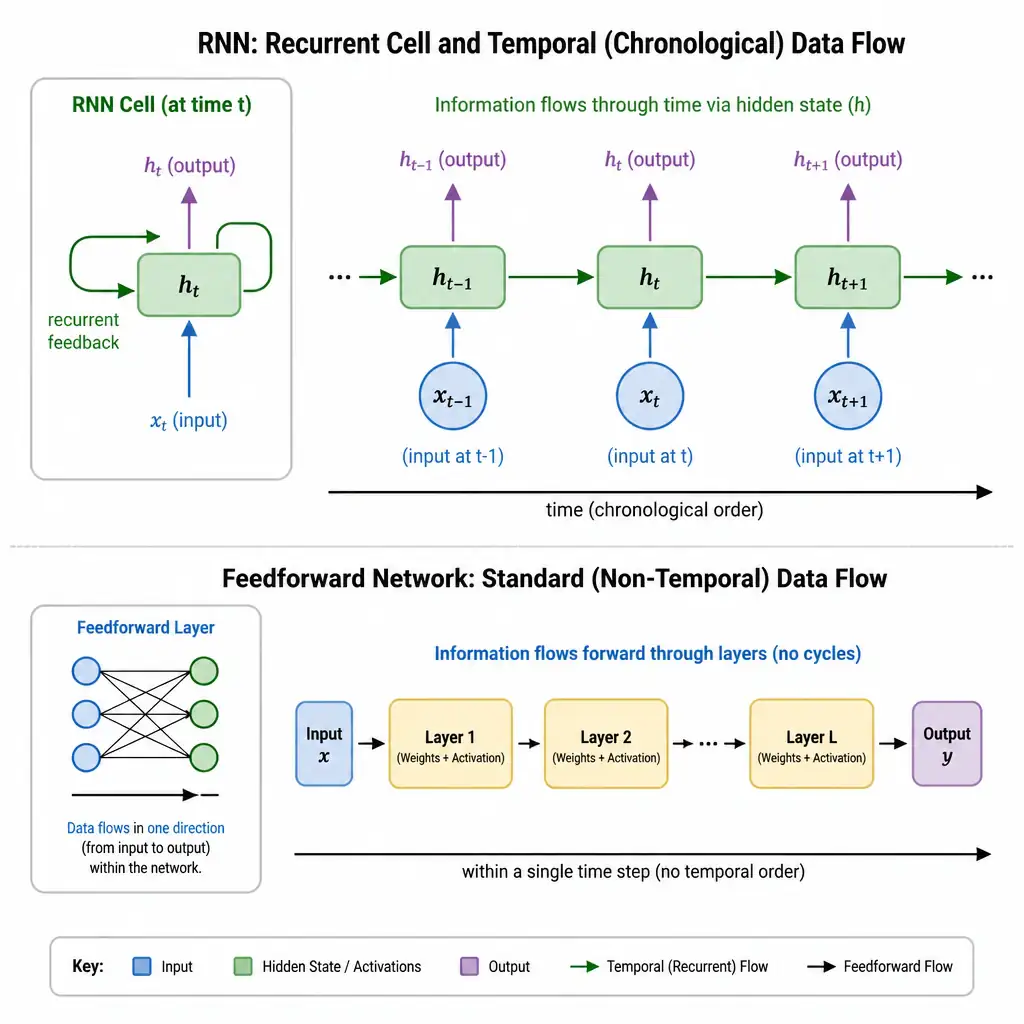
Check this out: standard neural networks are kind of like they have amnesia—they treat every input as completely independent. But if you're reading a sentence or watching a stock chart, the current word or value only makes sense because of what came before it. That's why an RNN is built for chronological or sequential data; if you feed it static images or unordered categories, you're missing the point.
Full Explanation
Recurrent Neural Networks are a class of artificial neural networks specifically designed to process sequence data. Unlike feedforward neural networks, which assume all inputs are independent of one another, recurrent neural networks possess memory that allows them to retain information from prior inputs to influence current and future outputs. Chronological or sequential data is the ideal input for recurrent neural networks. Examples of sequential data include time-series data, such as daily stock prices, weather measurements, or sensor logs; natural language text, where the meaning of a word depends on the preceding words; and audio streams. Recurrent neural networks handle this by passing the hidden state from the previous step into the activation of the current step, capturing temporal dependencies. Static multi-dimensional image arrays are best suited for convolutional neural networks. Convolutional neural networks leverage spatial hierarchies and grid-like structures to detect features such as edges, textures, and shapes. Recurrent neural networks are not optimized for extracting spatial features from static images. Relational tabular databases are typically structured in rows and columns where each row is an independent sample. Machine learning algorithms like gradient-boosted decision trees, such as XGBoost, or standard feedforward neural networks are better suited for tabular data because it lacks a dominant temporal sequence. Unordered categorical variables represent qualitative data without a natural sequence, such as product categories or zip codes. While they can be embedded into neural networks, they do not require or benefit from the sequential memory mechanism of a recurrent neural network. Thus, sequential or chronological data is uniquely suited for the temporal processing capabilities of recurrent neural networks.