
When configuring a machine learning pipeline, how does a 'hyperparameter' differ from a standard model parameter?
Select an answer to reveal the explanation.
Short Explanation
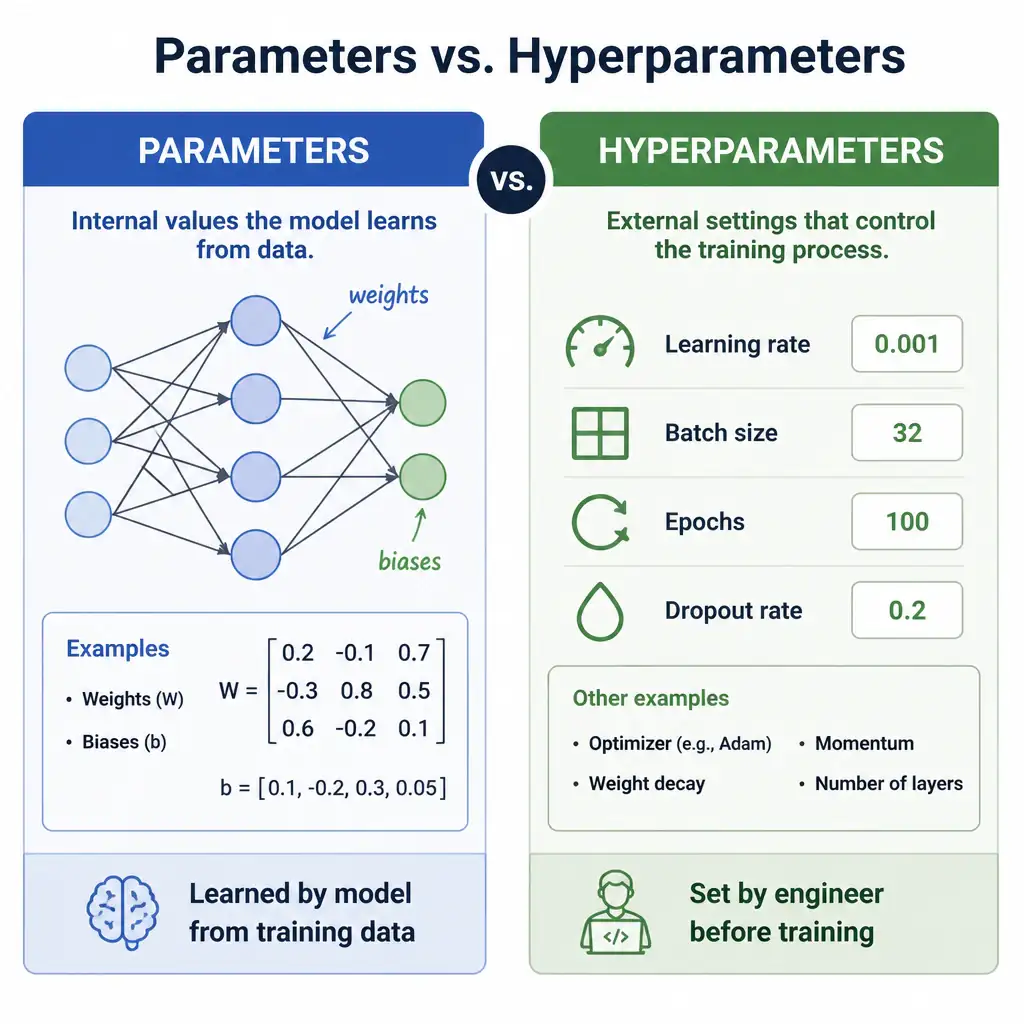
Here's the deal: you set hyperparameters by hand before training, while the model learns its own parameters from the data. Think of them as the rules you dial in before training starts, like learning rate or batch size. That's the right answer.
Full Explanation
In machine learning, it is crucial to distinguish between model parameters and hyperparameters, as they represent entirely different components of the model's architecture and training flow.
The correct description is that a hyperparameter is an external configuration setting that controls the learning process and must be set manually before training begins.
Model parameters are internal variables whose values are estimated or learned directly from the training data. The model optimizer, such as gradient descent, automatically updates these values. Examples of model parameters include weights and biases in artificial neural networks, coefficients in linear or logistic regression, and support vectors in support vector machines.
Hyperparameters, by contrast, are external configuration settings that are manually specified by the developer before training begins. They cannot be learned directly from the data. Instead, they control the overall learning process, model capacity, and training dynamics. Examples of hyperparameters include learning rate, batch size, number of hidden layers and neurons per layer, choice of activation functions such as ReLU or Sigmoid, regularization penalty coefficients such as L1 and L2, and number of training epochs.
Because hyperparameters directly influence model performance and training speed, practitioners often use optimization techniques like Grid Search, Random Search, or Bayesian Optimization to find the best combination of hyperparameter values for a given task.
Let's review the incorrect descriptions: - The description of a variable representing a column or feature in the raw input dataset refers to input features, which are the independent variables in the training dataset. - The description of the final predictive target output generated by the model during inference refers to the model's predictions or outputs. - The description of an internal weight or bias that the model automatically adjusts during the training process refers to model parameters, which are learned automatically during the training phase.
On the exam, remember: parameters are learned by the model; hyperparameters are set by the engineer to guide how the model learns.