
Which of the following statements provides the most accurate definition of the 'reinforcement learning' paradigm in machine learning?
Select an answer to reveal the explanation.
Short Explanation
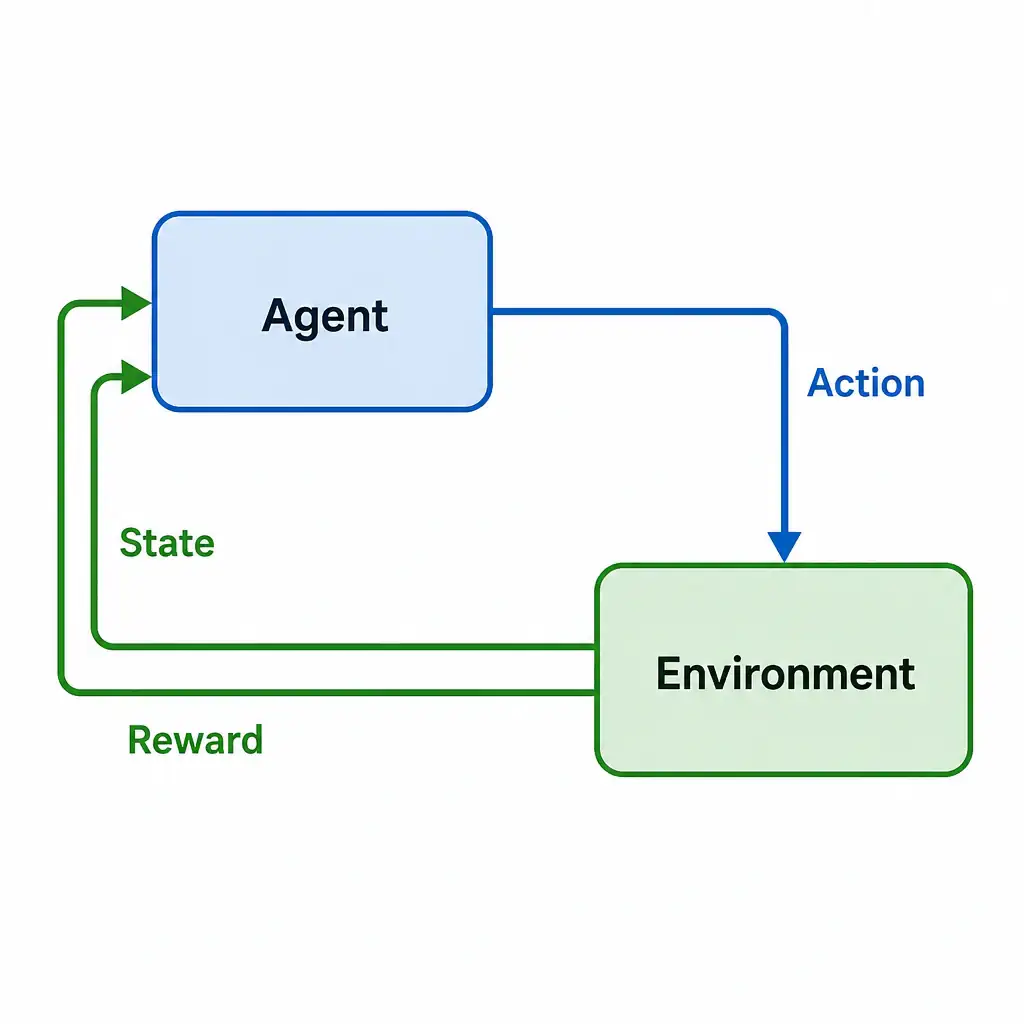
Think of reinforcement learning like training a puppy. You don't hand it a textbook; your agent acts in an environment, gets rewards or penalties, and learns which decisions maximize cumulative rewards over time. It doesn't rely on labeled examples or just find hidden patterns; it learns by interacting and adjusting its policy.
Full Explanation
Reinforcement learning is a distinct branch of machine learning, set apart from supervised and unsupervised learning. Instead of learning from a static historical dataset with explicit labels, a reinforcement learning model learns dynamically through interaction, making a sequence of decisions to maximize cumulative rewards.
The reinforcement learning framework is built around a continuous feedback loop between two main components: 1. The agent: the decision-maker or artificial intelligence model. 2. The environment: the world or system the agent interacts with.
At each step, the agent observes the current state of the environment and selects an action based on its internal strategy, called a policy. The environment responds by transitioning to a new state and returning a scalar feedback signal called a reward, which can be positive or negative. The goal of the agent is to learn an optimal policy that maximizes the total cumulative reward over time. Because the agent is not told the correct action to take, it must balance exploration, trying new actions to discover their effects, with exploitation, using known actions that yield high rewards. This makes reinforcement learning ideal for scenarios with complex, sequential decision paths, such as gameplay, including AlphaGo, robotic control, autonomous vehicle navigation, and automated resource scheduling.
The statement about grouping unlabeled datasets together based on mathematical similarities is incorrect because it describes clustering, a common task in unsupervised learning. The statement about a training process where a model learns mapping rules using pre-labeled inputs and correct outputs is incorrect because it describes supervised learning, where models are trained on datasets containing inputs paired with their corresponding correct labels. The statement about a model optimization process that identifies hidden structures in data without any external feedback is incorrect because it describes unsupervised learning generally, which focuses on pattern discovery, such as dimensionality reduction or density estimation, without external feedback loops.
On the exam, identify reinforcement learning by its characteristic agent-environment feedback loop and the optimization of cumulative rewards through trial and error.