When analyzing the structural layout of various neural network architectures, what is the primary difference between a shallow neural network and a deep neural network?
Select an answer to reveal the explanation.
Short Explanation and Infographic
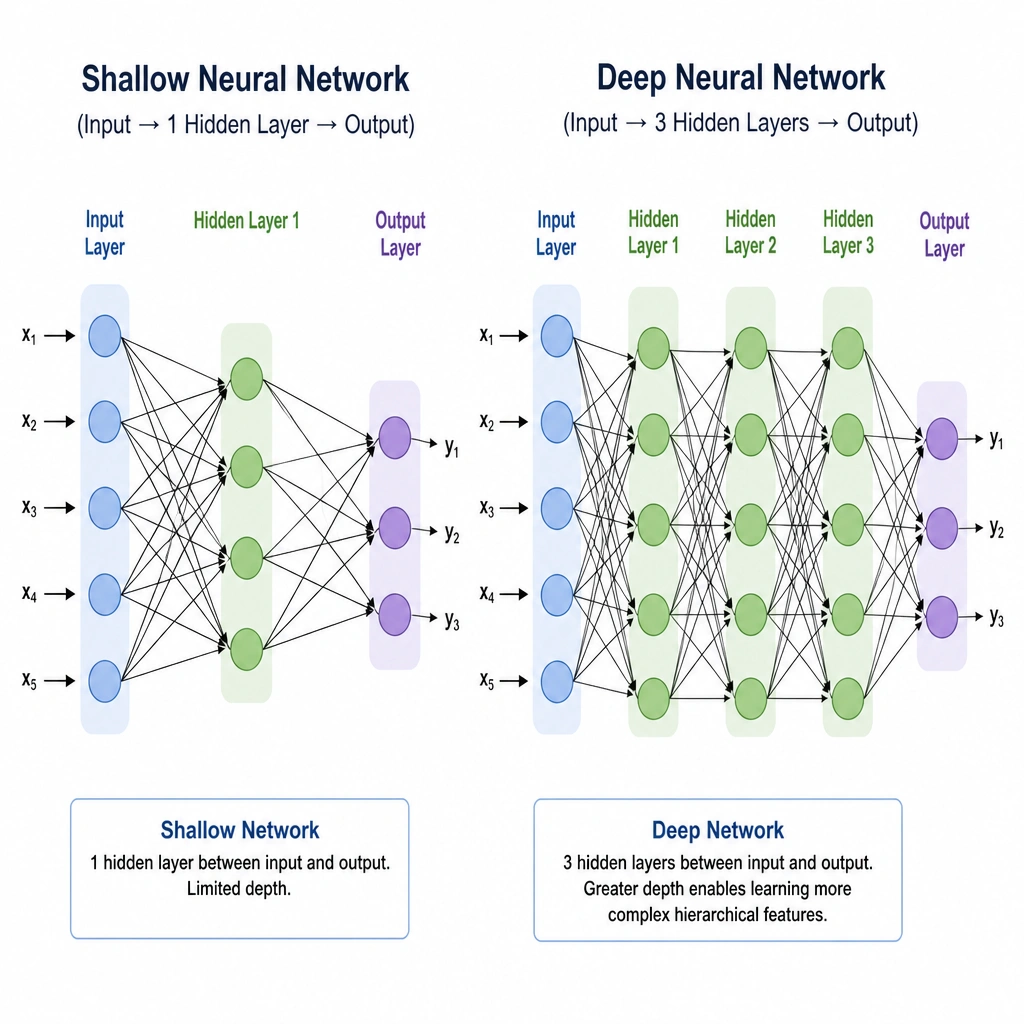
You've probably heard the term 'deep learning' a million times, but what does it actually mean? It's not magic—it's just depth! The 'deep' in deep learning refers to having multiple hidden layers stacked on top of each other between your input and output. A shallow network might only have one hidden layer, which limits how complex its patterns can be. Stacking more hidden layers lets the network build a hierarchy of features—learning simple things first, then combining them into complex concepts. Don't let the exam catch you on the distractors: shallow networks can use non-linear math, and deep networks run on all kinds of data. Option A is the correct answer.
Full explanation below image
Full Explanation
The fundamental distinction between shallow and deep neural networks lies in their architectural depth, which is determined by the number of hidden layers between the input and output layers.
A shallow neural network typically contains only one or two hidden layers. Under the Universal Approximation Theorem, a shallow network with a single hidden layer containing an infinite number of neurons can theoretically approximate any continuous function. However, representing complex functions with a shallow network requires an impractically large number of parameters (neurons), making it computationally inefficient and prone to overfitting. A deep neural network addresses this by stacking multiple hidden layers sequentially. This allows the model to learn hierarchical representations of the data. The early layers extract low-level features, which are then combined by deeper layers to represent highly abstract patterns. This hierarchical structure allows deep networks to approximate complex mappings with significantly fewer total parameters than a shallow network.
Let's break down why the other options are distractors: - Option B is incorrect because even a shallow network consists of at least three distinct layers: an input layer, one hidden layer, and an output layer. It is not restricted to a single combined layer. - Option C is incorrect because deep networks are general-purpose architectures used for wide-ranging data formats, including natural language (text), speech signals, tabular data, and time-series sequences—not just images. - Option D is incorrect because shallow networks can, and regularly do, utilize non-linear activation functions (such as Sigmoid, Tanh, or ReLU) to solve non-linear problems.
For the exam, remember that 'deep' refers directly to the presence of multiple sequential hidden layers that facilitate hierarchical feature extraction.