When designing a neural network to model sequential or time-series data—such as predicting stock prices or translating languages—which architectural component is essential for a Recurrent Neural Network (RNN) to track temporal dependencies?
Select an answer to reveal the explanation.
Short Explanation and Infographic
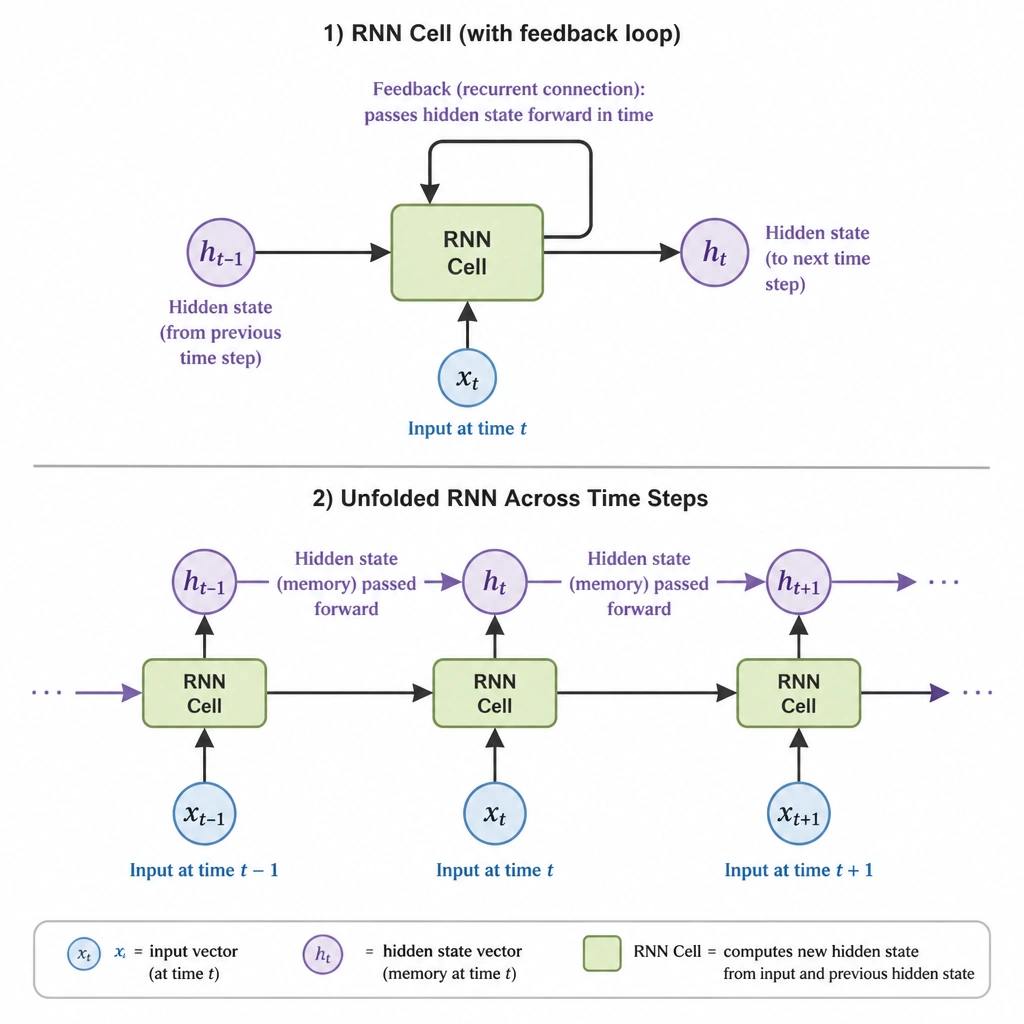
Here's the deal: traditional feedforward neural networks are like people with no short-term memory. You give them an input, they make a guess, and then they immediately forget everything. That doesn't work when you're reading a book—you need to remember word one to understand word ten! Recurrent Neural Networks (RNNs) solve this by using feedback loops, or recurrent units. These units act like little memory cells that pass information from one step of the sequence to the next, keeping the context alive. That's why Option A is the absolute right choice here.
Full explanation below image
Full Explanation
Recurrent Neural Networks (RNNs) are designed to process sequential data where the order of inputs is critical. Unlike standard feedforward architectures, which assume all inputs are independent, RNNs process sequences step-by-step and maintain an internal hidden state that acts as a memory of what the network has seen so far.
This memory is implemented via recurrent connections or memory cells (such as recurrent units). At each time step $t$, the recurrent unit takes the current input vector $x_t$ and the previous hidden state vector $h_{t-1}$ to calculate the new hidden state $h_t$. This hidden state is then passed forward to the next step. In more advanced architectures like Long Short-Term Memory (LSTM) networks or Gated Recurrent Units (GRUs), specialized internal gates (input, forget, and output gates) manage this memory, allowing the network to retain important long-term dependencies while discarding irrelevant information and mitigating the vanishing gradient problem.
Let's analyze the incorrect options: - Option B refers to convolutional filters, which are characteristic of Convolutional Neural Networks (CNNs) used for extracting spatial features from static images or grid data. - Option C refers to attention mechanisms, which are the core component of Transformer models. While Transformers handle sequences, they do so in parallel using self-attention rather than sequential recurrent memory cells. - Option D refers to Batch Normalization, which is an optimization technique used in many different architectures to accelerate training, but is not the defining architectural element of an RNN.
For the exam, remember that the defining feature of an RNN is its ability to handle sequence data through feedback loops and internal memory states.