
Editors need live page-view counters while analysts keep multi-year history. How should NoSQL and the lake share duties?
Select an answer to reveal the explanation.
Short Explanation
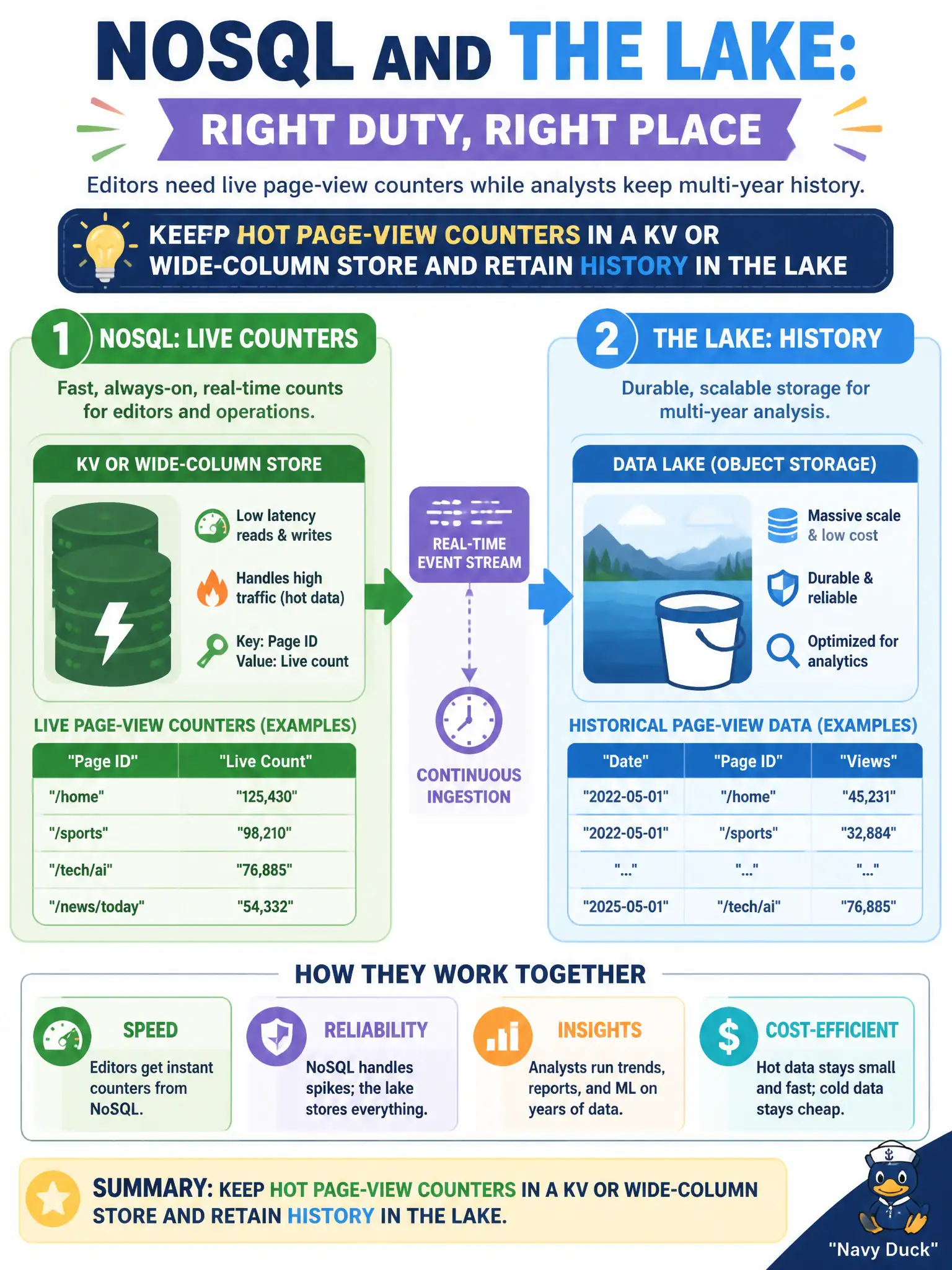
Live counters want a sprinter's shoes; history wants a warehouse. Stick hot tallies in a KV or wide-column store and park the long tale in the lake. Chapter 6 NoSQL skills show up right inside the chapter 10 analyzer.
Full Explanation
Keep hot page-view counters in a KV or wide-column store while retaining multi-year history in the lake so editors get live counters and analysts keep longitudinal depth. NoSQL and lake duties split by latency and retention inside the Cap. 10 analyzer, reusing Cap. 6 ideas for municipal portals. One size of store rarely fits both live and historical civic needs.
Putting only cold yearly archives in a hot KV store and live counters only on paper inverts the latency fit. Forcing live counter reads to full-scan petabyte lake files on every dashboard refresh is too slow and costly for editors. Avoiding NoSQL entirely and locking every page-view increment in a single spreadsheet cell cannot serve concurrent live traffic on a city portal.
Exam caveat: hot counters need idempotent increments and TTL or rollup strategies so they do not diverge silently from lake truth without reconciliation. Operational check: increment a staging counter via events, confirm sub-second dashboard reads from the KV store, and reconcile daily totals to lake aggregates within an agreed epsilon. Document the verified decision in the municipal architecture runbook so future on-call and audit staff inherit the same standard.