
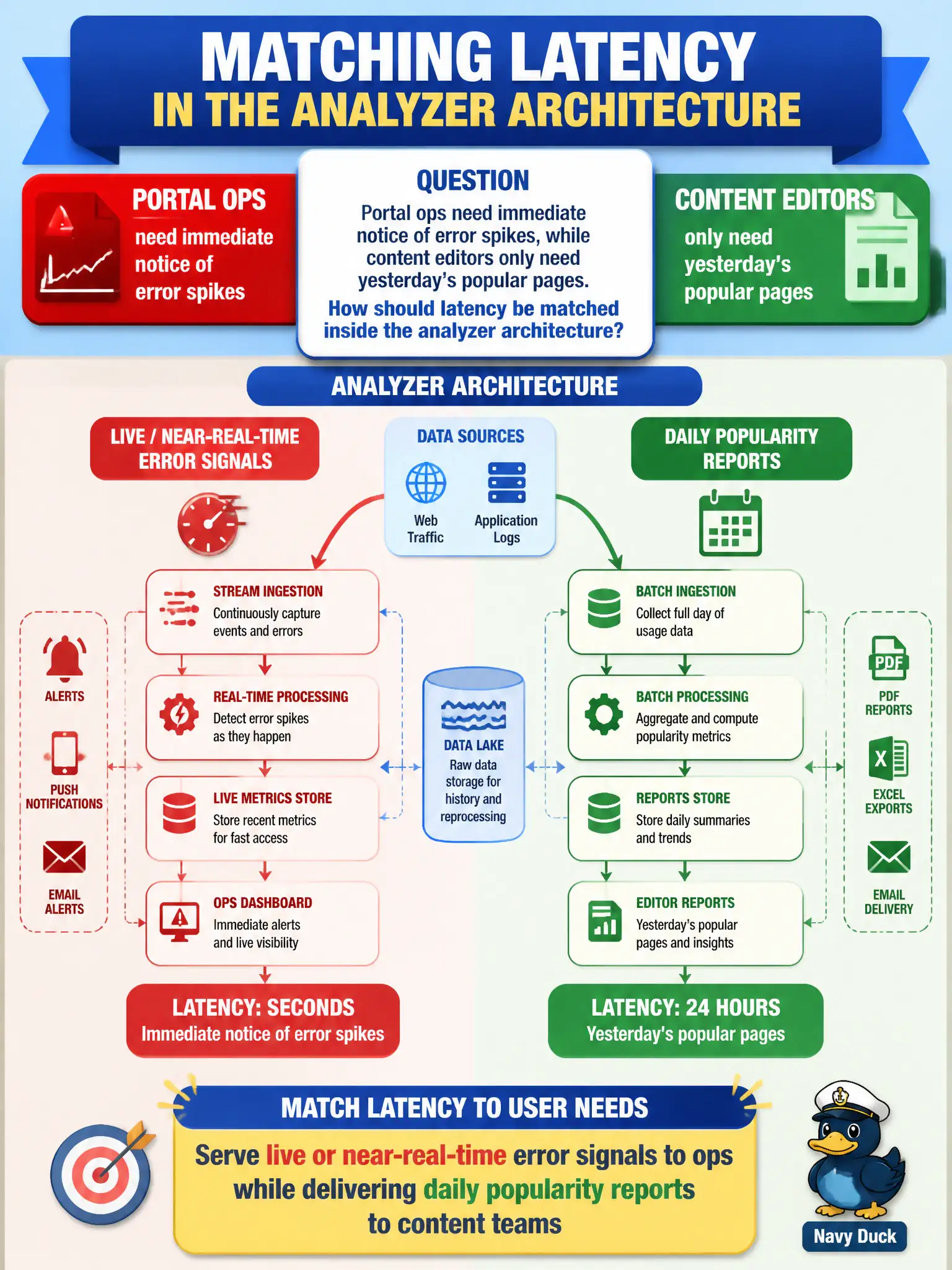
Portal ops need immediate notice of error spikes, while content editors only need yesterday's popular pages. How should latency be matched inside the analyzer architecture?
Select an answer to reveal the explanation.
Short Explanation
Not every metric needs a stopwatch. Ops watching errors want the fire alarm; content teams picking popular pages are fine with the daily newspaper. Match the pipeline speed to the decision speed and everyone stops fighting over one latency setting.
Full Explanation
Latency should be matched to audience need: serve live or near-real-time error signals to portal ops while delivering daily popularity reports to content editors. One architecture can support multiple serving tempos instead of forcing everyone onto the wrong refresh rate. That matching principle keeps Cap. 10 serving practical for mixed civic stakeholders on one platform.
Forcing both audiences onto a single monthly PDF denies ops the immediacy incidents require and slows content learning. Giving content editors streaming second-level alerts while ops receive only annual summaries inverts urgency and creates noise for the wrong users. Disabling streaming entirely because batch MapReduce is always the civic standard ignores operational error response needs.
Exam caveat: near-real-time paths cost more and can be noisier—define alert thresholds so ops are not paged for trivial blips while still catching true error spikes. Operational check: inject synthetic 5xx beacons in staging, confirm ops alerting fires within the published SLO, and verify content dashboards still refresh on their daily schedule without duplicate pages. Document the verified decision in the municipal architecture runbook so future on-call and audit staff inherit the same standard.