
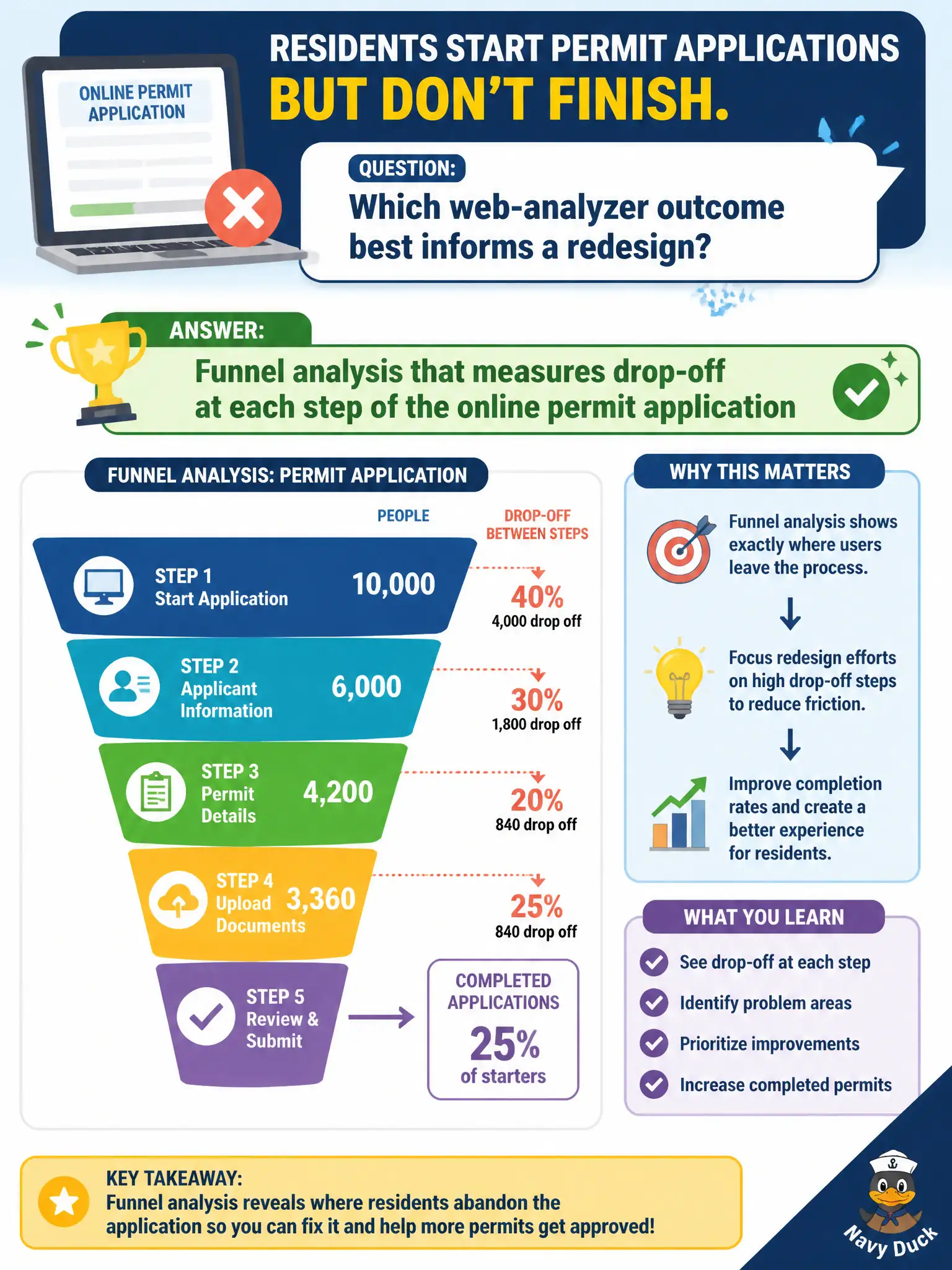
Permit staff notice many residents start an online application but never finish. Which web-analyzer outcome best informs a redesign?
Select an answer to reveal the explanation.
Short Explanation
Funnels are the breadcrumb trail through a city form—where folks start, stall, and bail. Step-level drop-off shows which screen needs love, not just that 'traffic happened.' That is how a permit redesign gets evidence instead of guesses.
Full Explanation
Funnel analysis that measures drop-off at each step of an online permit application best informs redesign when many residents start but never finish. Step-level abandonment shows where UX friction lives, unlike a single homepage popularity number. Civic digital services use funnels to improve task completion, not merely page fame on the municipal portal.
A single all-time page-view total for the home page with no step sequence cannot locate where applications die. Sorting CSS file download counts as a proxy for form completion quality measures assets, not task success. Publishing raw beacon JSON to social media for open-data credit alone does not produce actionable redesign evidence and may create privacy risk.
Exam caveat: funnels require consistent step event names and stable ordering; renaming steps without versioning breaks historical comparison. Operational check: instrument a staging permit flow with named steps, run ten test completions and ten intentional abandonments, and verify the funnel report shows drop-off at the expected step. Document the verified decision in the municipal architecture runbook so future on-call and audit staff inherit the same standard. Document the verified decision in the municipal architecture runbook so future on-call and audit staff inherit the same standard.