
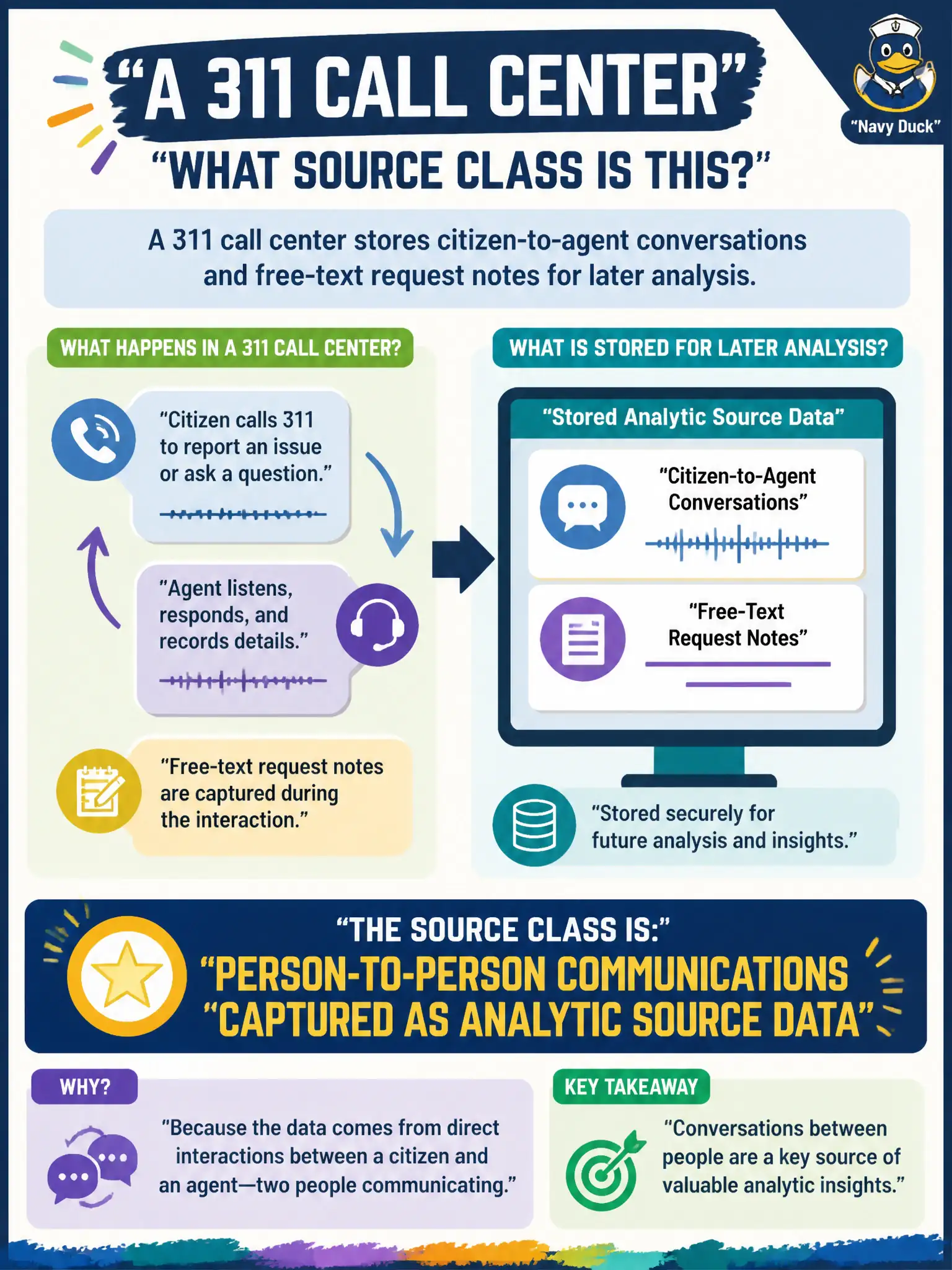
A 311 call center stores citizen-to-agent conversations and free-text request notes for later analysis. Which source class does that primarily represent?
Select an answer to reveal the explanation.
Short Explanation
A caller talking to an agent is people talking to people—even if phones and tickets sit in the middle. Those chats and notes are person-to-person source material for analytics. Do not shove them into the pure sensor bucket.
Full Explanation
Source typology in Big Data commonly distinguishes person–person, person–machine, and machine–machine communications. 311 conversations and free-text request notes are human-to-human exchanges recorded as analytic source data. Correct classification guides later tooling and privacy expectations for civic contact centers that serve residents who expect both help and confidentiality.
Calling them machine-to-machine telemetry with no human participants fails by concept: agents and citizens are in the loop. Calling them satellite imagery batches fails by concept: imagery is a different source class. Calling them person-to-machine clickstreams from a kiosk only fails by concept: conversational notes are P2P communications, not mere kiosk clicks.
Exam caveat: Free-text citizen–agent 311 content is person-to-person source data—not M2M, satellite, or click-only P2M.
Operational check: Tag 311 transcript and note corpora as P2P in the source inventory, apply conversation-appropriate privacy controls, and avoid piping them into M2M-only telemetry pipelines without review. Document residual risk for civic operators and revisit after the next production change window. Confirm owners, SLAs, and rollback criteria in the runbook before go-live.