
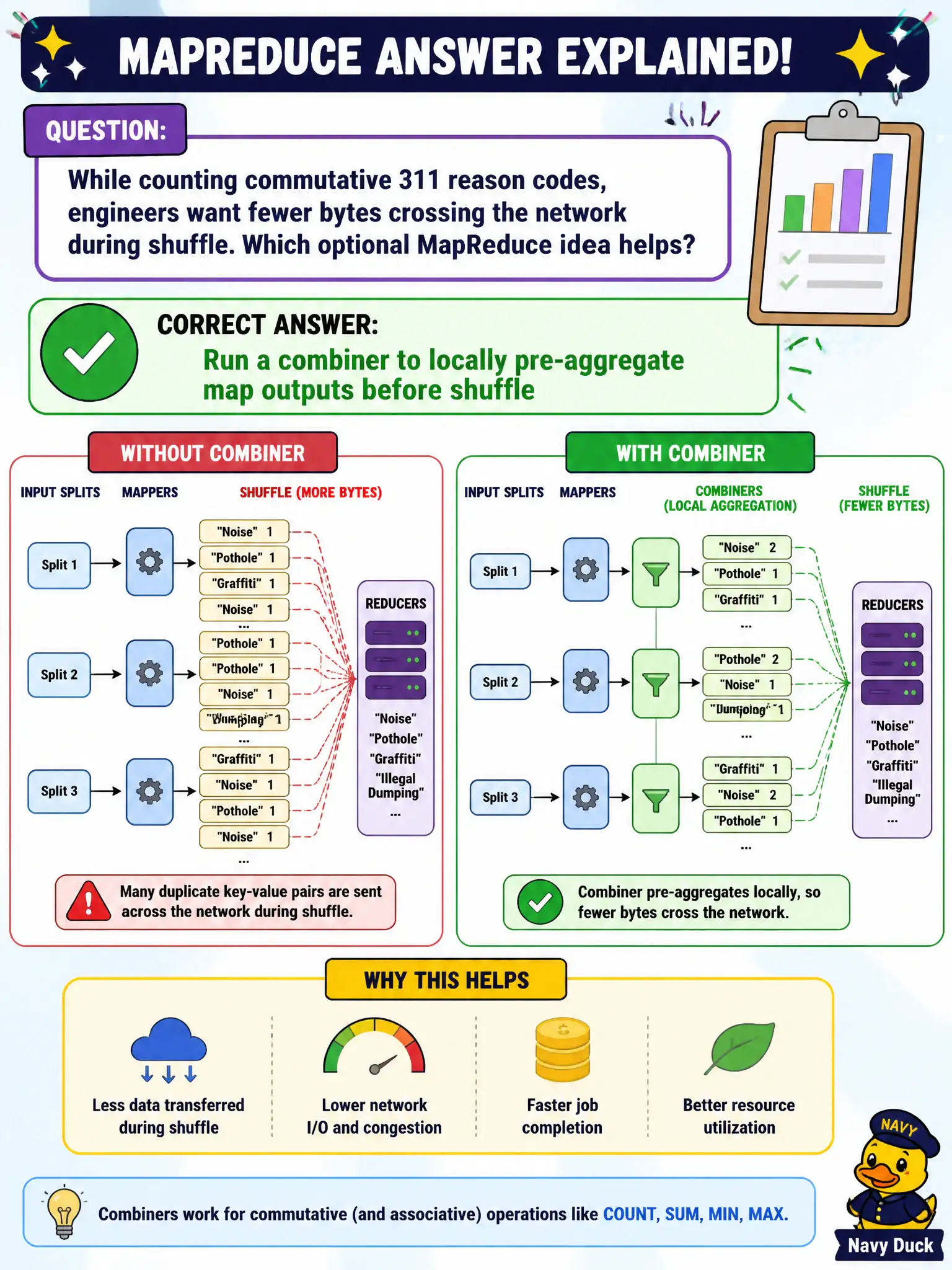
While counting commutative 311 reason codes, engineers want fewer bytes crossing the network during shuffle. Which optional MapReduce idea helps?
Select an answer to reveal the explanation.
Short Explanation
A combiner is like totaling each clerk's sticky notes at their own desk before the courier run. Local pre-sums cut how much crosses the network when the math is commutative. It is optional polish, not a new storage system.
Full Explanation
While counting commutative 311 reason codes, a combiner that locally pre-aggregates map outputs before shuffle helps fewer bytes cross the network—an optional MapReduce optimization that preserves correct sums for commutative aggregations on civic tallies. Disabling all HDFS replication so mappers write only one copy harms durability and is not a shuffle optimization. Forcing every unique key onto its own dedicated physical cluster is operationally absurd and unrelated to combiner semantics. Replacing the NameNode with a single local text file of offsets breaks HDFS rather than improving shuffle efficiency. Exam caveat: combiners are optional local reducers for suitable aggregations; they are not a substitute for replication or NameNode. Operational check: enable a sum combiner on the reason-code job, compare shuffle bytes and runtime before/after, and confirm final totals still match the control report. In municipal platform operations, record the rationale in the architecture decision record so future on-call staff know which pattern was chosen and which failure modes the rejected options would create for city services. Re-validate after the next maintenance window that monitoring, access paths, and recovery steps still match the documented design for agencies that depend on this platform.