
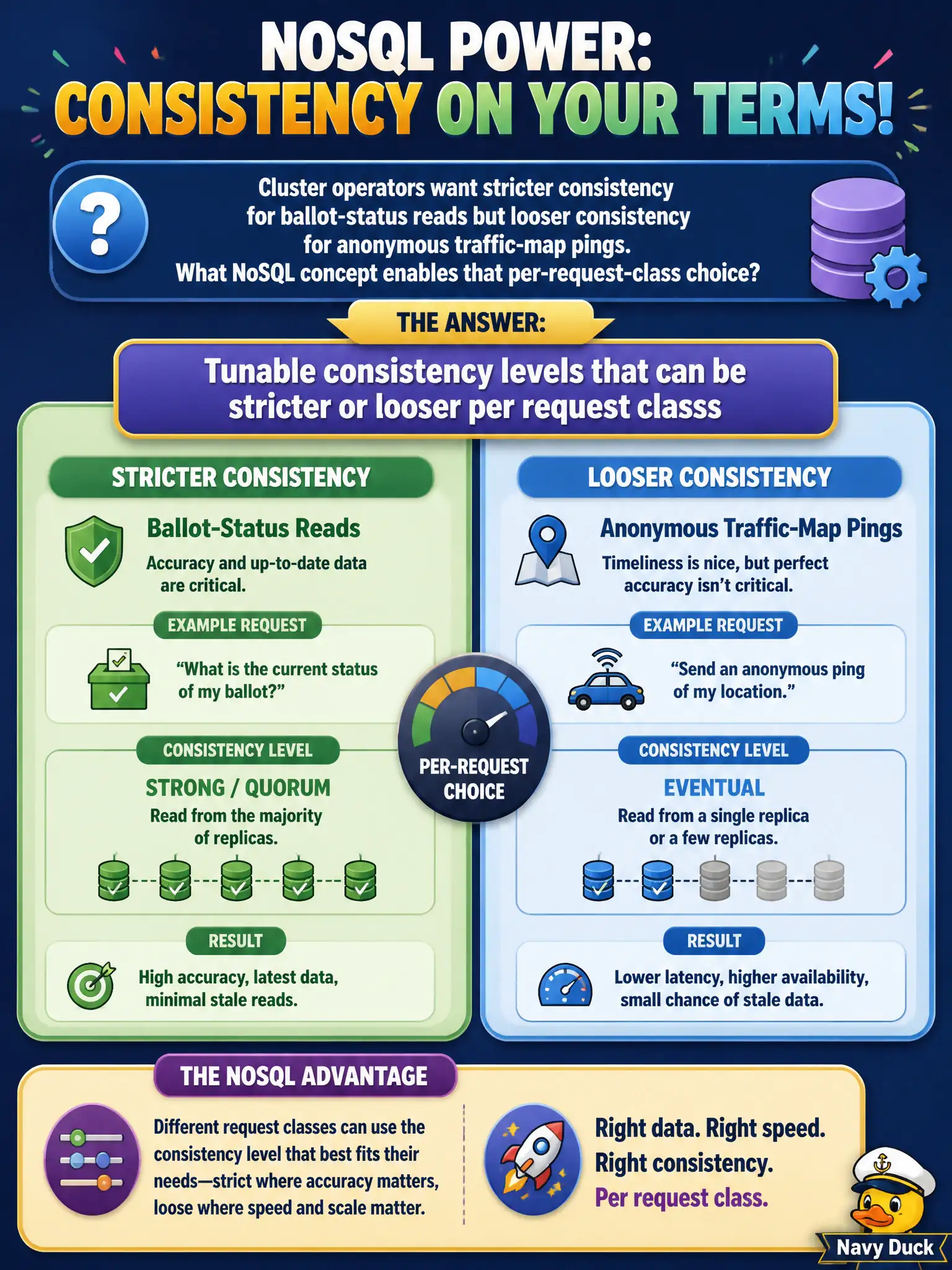
Cluster operators want stricter consistency for ballot-status reads but looser consistency for anonymous traffic-map pings. What NoSQL concept enables that per-request-class choice?
Select an answer to reveal the explanation.
Short Explanation
Not every civic read needs the same promise. Tunable consistency lets ballot checks run strict while map pings stay loose and fast. One cluster, dialed differently per request class.
Full Explanation
When ballot-status reads need stricter consistency while anonymous traffic-map pings can tolerate looser reads, the enabling NoSQL concept is tunable consistency levels selectable per request class. Operators raise consistency for high-stakes civic reads and relax it for high-volume, stale-tolerant telemetry. A single global lock forcing identical settings for every query forever removes that workload-specific control. Deleting consistency configuration so every read is random abandons deliberate engineering. Using only paper printouts to avoid consistency decisions is not an online systems answer. Exam caveat: tunable consistency still sits inside CAP realities under partition—know what your chosen level does when replicas are unreachable. Operational check: configure ballot-status gets at a strong/quorum level and traffic-map pings at a weaker level in staging, then partition a replica and confirm ballot reads fail closed or wait while map pings continue with possibly stale tiles. In production terms for tunable consistency by request class, assign an owning team, wire a dashboard that shows the pattern is healthy under peak civic load, and require a staging drill that rehearses failure and recovery before resident impact. Revisit the choice when traffic shape, retention, or integrity needs change, and keep a named rollback owner on the change record. Re-test both the happy path and the failure path for tunable consistency by request class after material dependency upgrades so regressions are caught before the next public release.