
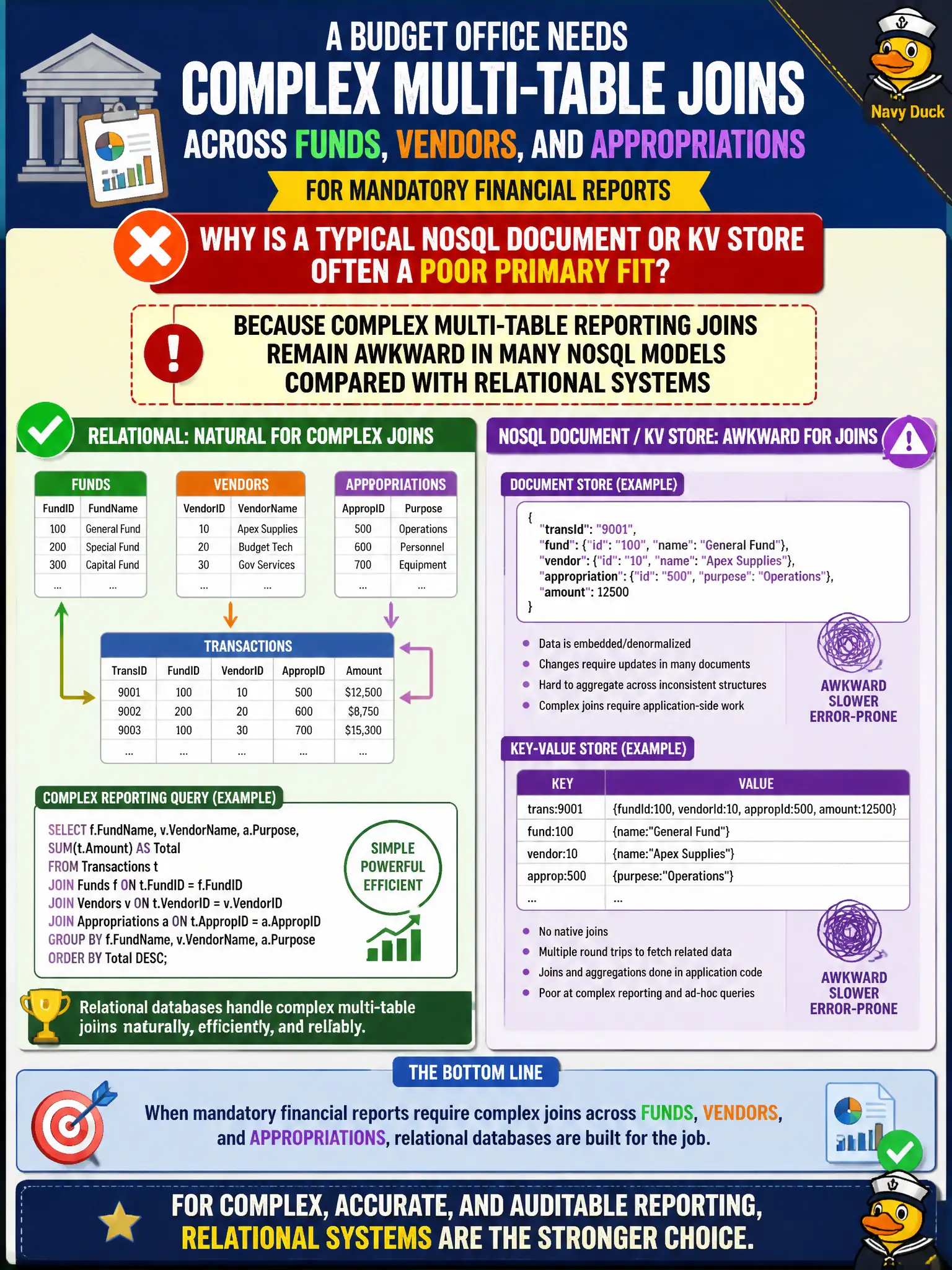
A budget office needs complex multi-table joins across funds, vendors, and appropriations for mandatory financial reports. Why is a typical NoSQL document or KV store often a poor primary fit?
Select an answer to reveal the explanation.
Short Explanation
Big multi-table budget joins are relational comfort food. Many NoSQL models make you contort or pre-bake those joins. Keep the heavy financial reporting where joins are natural.
Full Explanation
Complex multi-table joins across funds, vendors, and appropriations for mandatory financial reports remain awkward in many document or key-value NoSQL models compared with relational systems that were built for join-centric reporting. That is why a typical NoSQL store is often a poor primary fit for the budget office’s statutory reporting workload. Claiming NoSQL always outperforms relational engines on multi-table financial joins reverses the usual strength profile. Saying financial reports never need joins ignores how normalized fiscal schemas are queried. Asserting NoSQL legally forbids monetary amounts is false and irrelevant. Exam caveat: cities often keep billing/finance relational while moving high-scale or flexible profiles to NoSQL—choose by access pattern, not by fashion. Operational check: prototype the mandatory join-heavy report on the candidate primary store; if it requires application-side joins or denormalized sprawl that finance will not govern, keep the relational system of record. In production terms for relational joins for budget reporting, assign an owning team, wire a dashboard that shows the pattern is healthy under peak civic load, and require a staging drill that rehearses failure and recovery before resident impact. Revisit the choice when traffic shape, retention, or integrity needs change, and keep a named rollback owner on the change record. Re-test both the happy path and the failure path for relational joins for budget reporting after material dependency upgrades so regressions are caught before the next public release.