
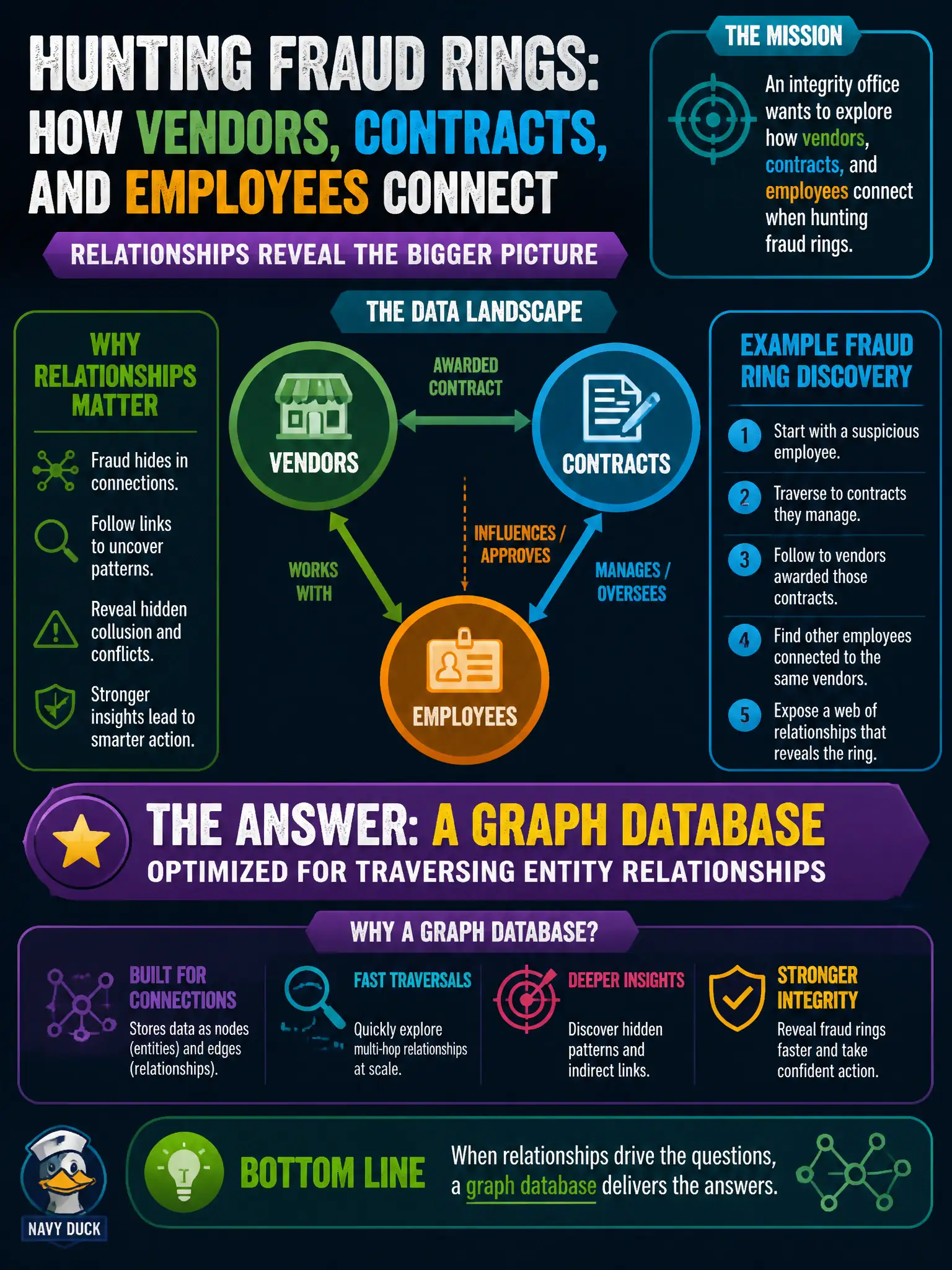
An integrity office wants to explore how vendors, contracts, and employees connect when hunting fraud rings. Which NoSQL type best supports relationship-centric queries?
Select an answer to reveal the explanation.
Short Explanation
Fraud rings are all about who knows whom and which contracts link people. Graph databases treat those connections as first-class citizens. Hopping edges beats joining endless tables by hand.
Full Explanation
Fraud and integrity investigations need to walk how vendors, contracts, and employees connect—multi-hop relationship queries—so a graph database optimized for traversing entity relationships is the right NoSQL type. Edge-centric storage makes ring detection and conflict-of-interest paths natural. A key-value cache that only stores password hashes serves authentication lookups, not exploratory link analysis across civic entities. A flat file of unrelated CSV rows with no edges forces analysts to reinvent joins outside the store and scales poorly for iterative path queries. A document archive that cannot express cross-entity links may hold case notes but will not efficiently answer “who connects to whom through which contracts.” Exam caveat: graphs complement rather than replace ledgers; monetary postings may still live in relational systems while the integrity office explores links in a graph. Operational check: load a small vendor–contract–employee graph from known fixtures, run a bounded-depth traversal for a suspect vendor, and verify the path results match the paper case file before expanding production feeds. In production terms for graph traversal for fraud rings, assign an owning team, wire a dashboard that shows the pattern is healthy under peak civic load, and require a staging drill that rehearses failure and recovery before resident impact. Revisit the choice when traffic shape, retention, or integrity needs change, and keep a named rollback owner on the change record. Re-test both the happy path and the failure path for graph traversal for fraud rings after material dependency upgrades so regressions are caught before the next public release.