
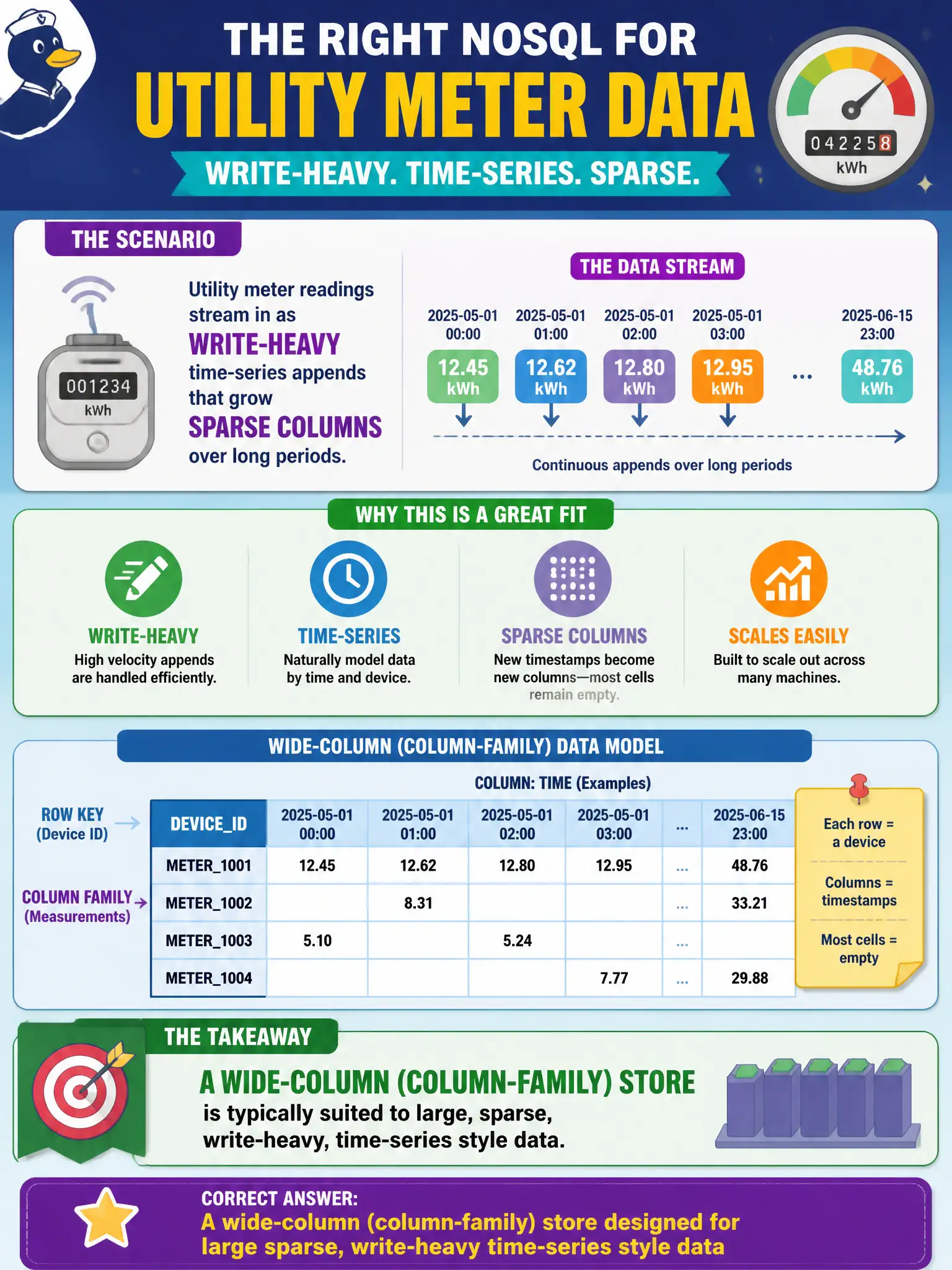
Utility meter readings stream in as write-heavy time-series appends that grow sparse columns over long periods. Which NoSQL family is typically suited to this pattern?
Select an answer to reveal the explanation.
Short Explanation
Meters just keep appending readings—tons of writes, lots of sparse columns over time. Wide-column stores like the Cassandra-style family are built for that grind. Think rows that stretch sideways as time marches on.
Full Explanation
Utility meter readings are write-heavy time-series appends that accumulate sparse attributes over long horizons—exactly the pattern wide-column (column-family) stores were popularized to handle at scale. They spread writes across partitions and tolerate sparse columns without dense relational padding. A single-row spreadsheet emailed nightly cannot absorb municipal meter cardinality or provide distributed durability. Graph databases focused on social friend edges optimize traversals, not high-rate numeric time-series appends. An in-memory queue without a durable column-oriented layout may buffer briefly but is not the durable analytical or operational store for years of meter history. Exam caveat: wide-column suitability assumes a partition/clustering key design around meter id and time; a poor key still creates hot spots. Operational check: model meter_id + timestamp as the access key, ingest a burst of readings in staging, and confirm write throughput scales across nodes while sparse optional attributes do not force full-row rewrites. In production terms for wide-column meter time-series ingest, assign an owning team, wire a dashboard that shows the pattern is healthy under peak civic load, and require a staging drill that rehearses failure and recovery before resident impact. Revisit the choice when traffic shape, retention, or integrity needs change, and keep a named rollback owner on the change record. Re-test both the happy path and the failure path for wide-column meter time-series ingest after material dependency upgrades so regressions are caught before the next public release.