
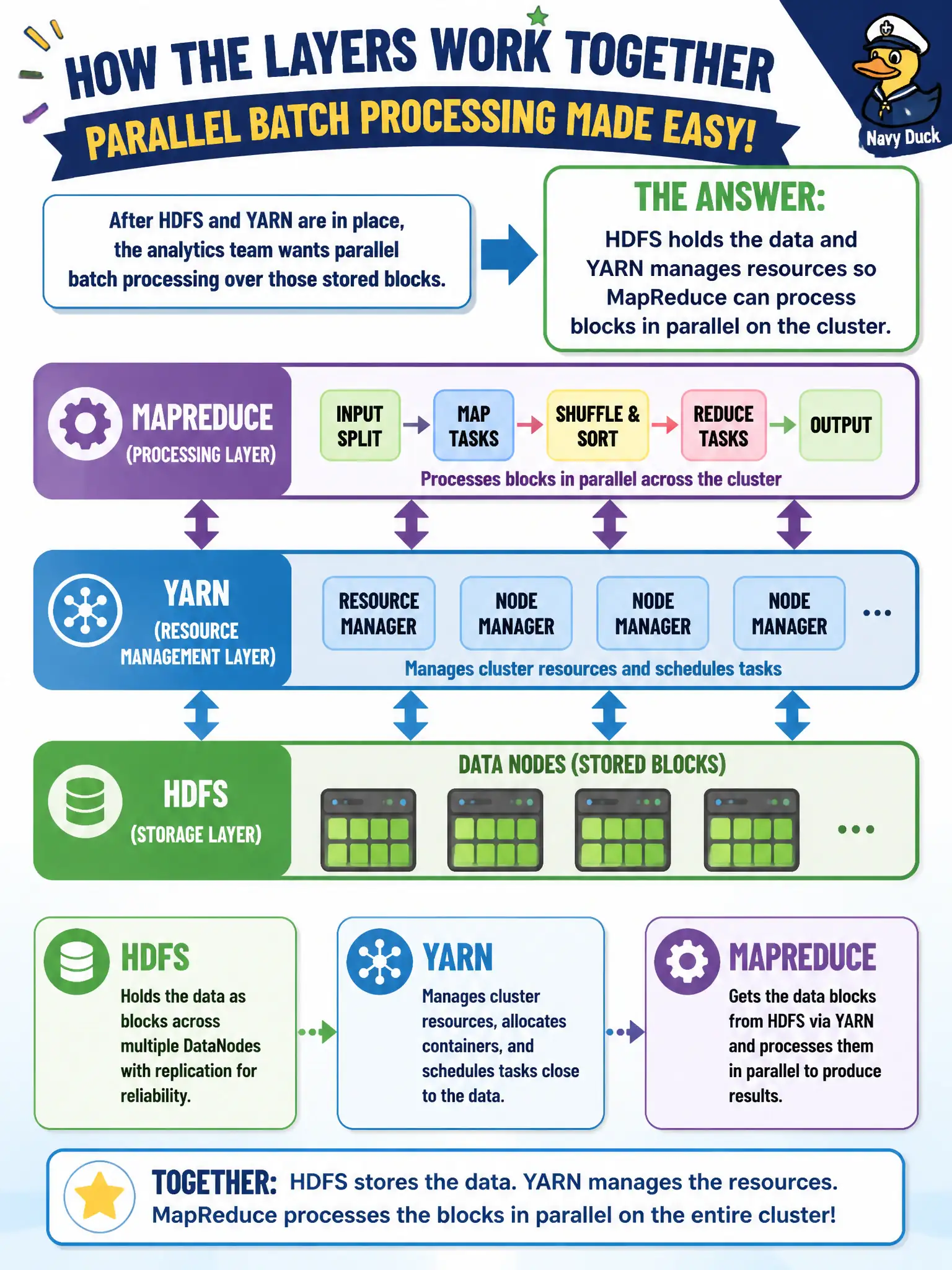
After HDFS and YARN are in place, the analytics team wants parallel batch processing over those stored blocks. How do the layers relate?
Select an answer to reveal the explanation.
Short Explanation
Pantry first, then the cooking line. HDFS holds the ingredients (blocks); YARN assigns kitchen stations; MapReduce is the parallel cooking. You do not throw out the pantry just because dinner started.
Full Explanation
After HDFS and YARN are in place, parallel batch processing relates as follows: HDFS holds the data and YARN manages resources so MapReduce can process blocks in parallel on the municipal cluster—storage, resources, and processing cooperate as layered concerns. MapReduce does not replace HDFS so that processed results never need durable storage for downstream civic consumers. YARN does not store all input bytes while HDFS only prints job banners to the console. MapReduce must not be confined to laptops on the theory that HDFS cannot feed distributed tasks—that claim inverts the architecture. Exam caveat: HDFS + YARN + MapReduce is the classic layered Hadoop batch story candidates should recite cleanly. Operational check: submit a sample MapReduce job reading HDFS paths, confirm YARN allocates containers, and verify outputs land back in HDFS for downstream civic services and exports. In municipal platform operations, record the rationale in the architecture decision record so future on-call staff know which pattern was chosen and which failure modes the rejected options would create for city services. Re-validate after the next maintenance window that monitoring, access paths, and recovery steps still match the documented design for agencies that depend on this platform.