
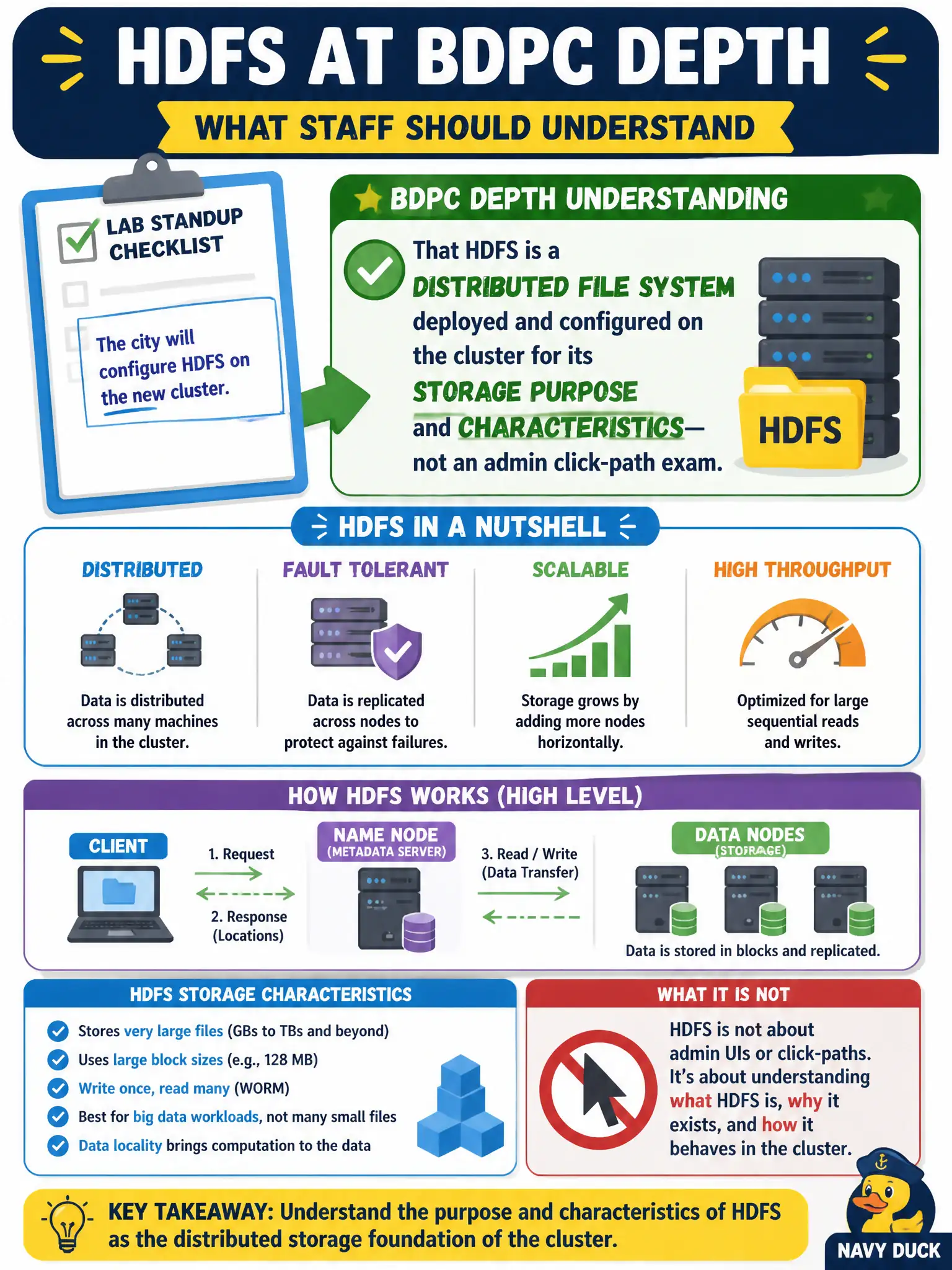
A lab standup checklist says the city will configure HDFS on the new cluster. At BDPC depth, what should staff understand?
Select an answer to reveal the explanation.
Short Explanation
Knowing the fire truck exists and what it does beats memorizing every valve diagram for a theory test. BDPC wants purpose and characteristics of HDFS on a cluster, not vendor click-paths. Configuration awareness is real; runbook trivia is not the exam’s point.
Full Explanation
At BDPC depth, configuring HDFS means understanding that HDFS is a distributed file system deployed and configured on the cluster for its storage purpose and characteristics—not memorizing every vendor installer click path as if this were a proprietary admin certification. Exact XML property paths and click sequences for one vendor installer exceed conceptual BDPC scope as the primary learning target. HDFS configuration is not unnecessary because YARN stores all durable files—YARN allocates compute and does not replace HDFS storage. Cloud marketplace SKUs alone do not erase the purpose concept of on-prem or self-managed HDFS-style distributed storage. Exam caveat: purpose and characteristics beat rote installer trivia on BDPC-style assessments. Operational check: brief staff on HDFS goals (large files, replication, metadata/data split), map local config items to those goals, and keep vendor click-sheets as runbook supplements rather than the conceptual syllabus. In municipal platform operations, record the rationale in the architecture decision record so future on-call staff know which pattern was chosen and which failure modes the rejected options would create for city services. Re-validate after the next maintenance window that monitoring, access paths, and recovery steps still match the documented design for agencies that depend on this platform.