
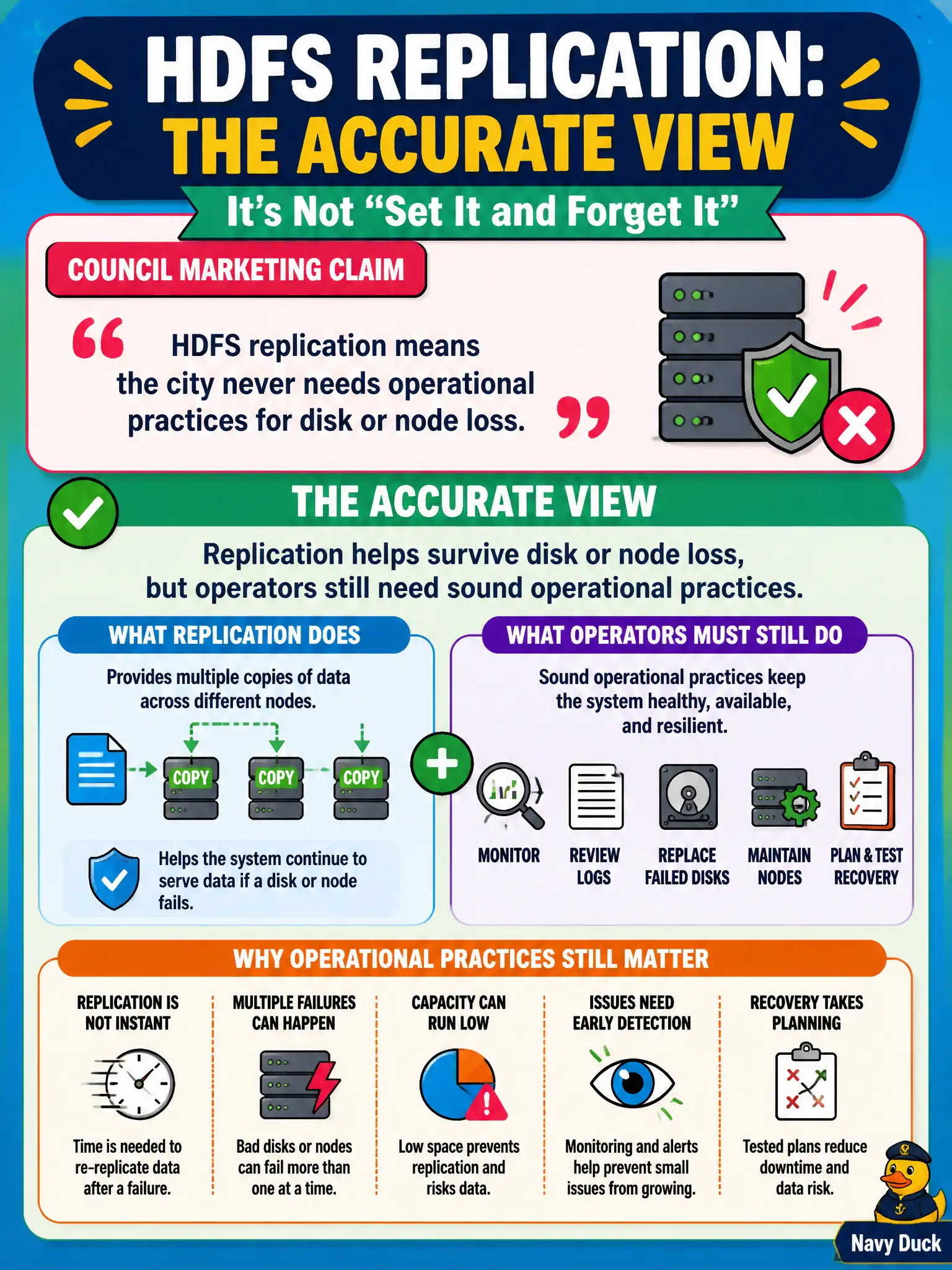
Council marketing claims HDFS replication means the city never needs operational practices for disk or node loss. What is the accurate view?
Select an answer to reveal the explanation.
Short Explanation
Spare tires help after a puncture—they do not retire the mechanic. HDFS replication cushions disk and node loss, yet monitoring, backups, and NameNode care still matter. Marketing that promises zero-ops from replicas alone oversells the feature.
Full Explanation
HDFS replication helps the city survive disk or node loss, but operators still need sound operational practices—monitoring, NameNode protection, backups or snapshots where required, and recovery drills. Marketing claims that replication removes all operational duty are inaccurate for public-sector platforms. Replication does not remove all need for backups, monitoring, or NameNode protection. Replication is not limited to protecting marketing slides; it genuinely helps when lost blocks still have replicas elsewhere. Enabling replication does not make failed disks automatically rewrite application code or heal bad deployments. Exam caveat: replication is not a complete operations program; metadata protection and process still matter. Operational check: verify replica factor, monitor under-replicated blocks, protect NameNode metadata, and rehearse node-loss recovery in the municipal runbook—not just cite replication in a press release. In municipal platform operations, record the rationale in the architecture decision record so future on-call staff know which pattern was chosen and which failure modes the rejected options would create for city services. Re-validate after the next maintenance window that monitoring, access paths, and recovery steps still match the documented design for agencies that depend on this platform.