
Transit analysts want MapReduce tasks to run close to the AVL block replicas they read. What benefit does data locality primarily provide?
Select an answer to reveal the explanation.
Short Explanation
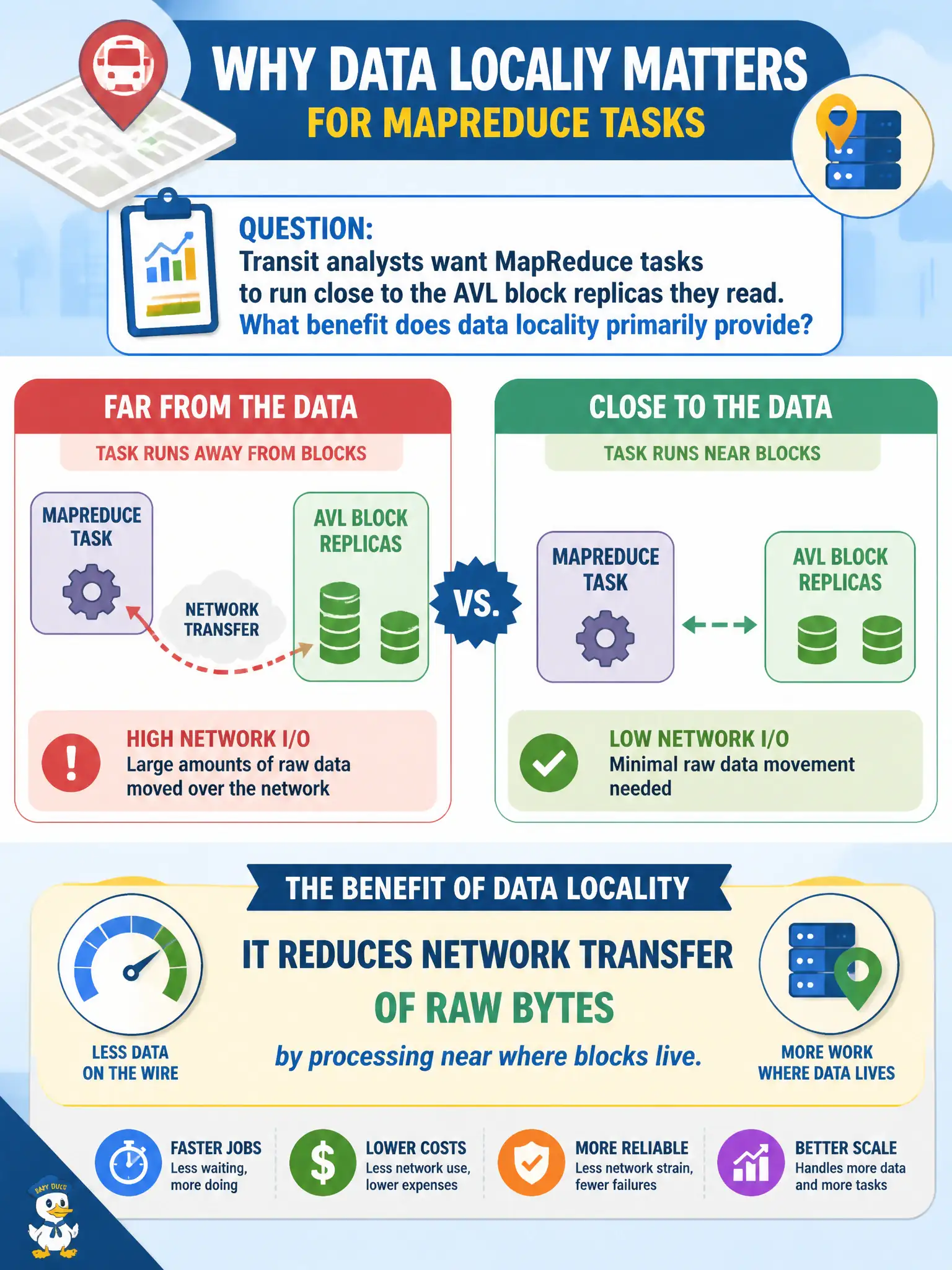
Hauling every raw crate across town just to open it is wasteful. Data locality keeps processing near the blocks so the network is not flooded with raw AVL bytes. It is a performance rationale, not a promise of magic millisecond SLAs or OLTP conversion.
Full Explanation
Data locality primarily benefits transit AVL analytics by reducing network transfer of raw bytes when MapReduce tasks run near the block replicas they read—critical for large municipal archives on constrained fabrics. Locality does not guarantee every query finishes in under one millisecond regardless of data size; that confuses batch efficiency with ultra-low-latency OLTP. It does not eliminate the need for replication or NameNode metadata in the HDFS design. It does not convert the Hadoop cluster into a transactional OLTP system of record for fare media or citations. Exam caveat: locality is about network efficiency for batch scans, not millisecond transactional SLAs. Operational check: compare job counters for data-local versus rack-local versus off-rack reads on an AVL MapReduce job and tune placement or scheduling when off-rack bytes dominate shuffle or read paths. In municipal platform operations, record the rationale in the architecture decision record so future on-call staff know which pattern was chosen and which failure modes the rejected options would create for city services. Re-validate after the next maintenance window that monitoring, access paths, and recovery steps still match the documented design for agencies that depend on this platform.