
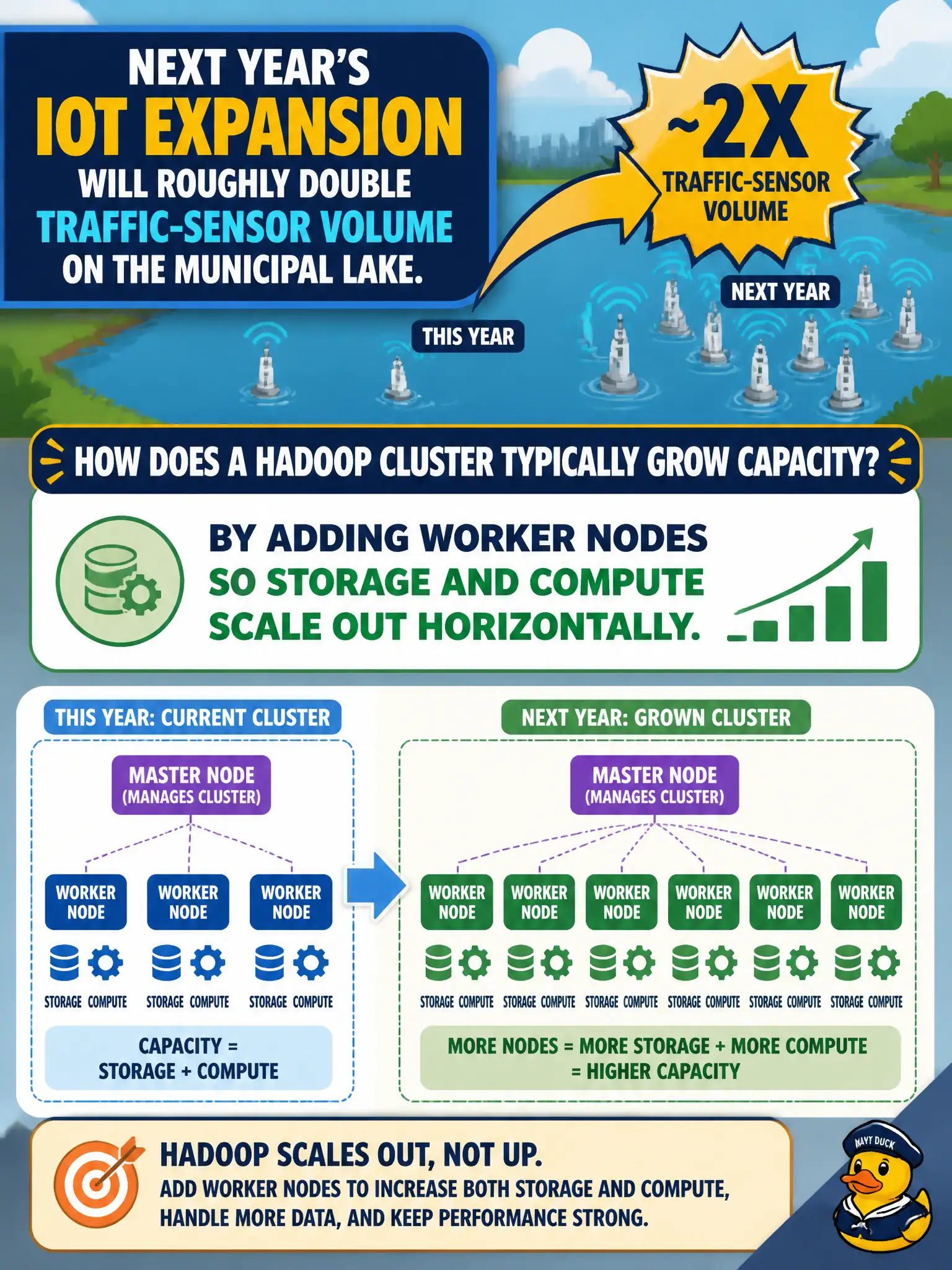
Next year’s IoT expansion will roughly double traffic-sensor volume on the municipal lake. How does a Hadoop cluster typically grow capacity?
Select an answer to reveal the explanation.
Short Explanation
When the library needs more capacity, roll in more shelving units instead of one mega-drawer. Hadoop grows by adding nodes—more DataNodes and workers for next year’s IoT flood. Vertical-only tricks and single-disk fantasies miss that scale-out story.
Full Explanation
When next year’s IoT expansion roughly doubles traffic-sensor volume, a Hadoop cluster typically grows by adding worker nodes so storage and compute scale out horizontally with the municipal lake rather than stretching a single machine. Rewriting every historical file into a single denser relational row format alone does not provide distributed capacity growth and may be orthogonal to the volume problem. Replacing HDFS with a lone desktop disk whenever volume increases abandons cluster architecture and resilience. Forcing all new sensors to write exclusively into one NameNode heap confuses metadata with data and will not absorb doubled volume safely. Exam caveat: horizontal scale-out via workers is the expected growth model, not NameNode-as-storage or laptop disks. Operational check: project doubled sensor footprint, plan DataNode additions with rack awareness, and validate post-expansion capacity against ingest forecasts before new vendor sensors go live. In municipal platform operations, record the rationale in the architecture decision record so future on-call staff know which pattern was chosen and which failure modes the rejected options would create for city services. Re-validate after the next maintenance window that monitoring, access paths, and recovery steps still match the documented design for agencies that depend on this platform.