
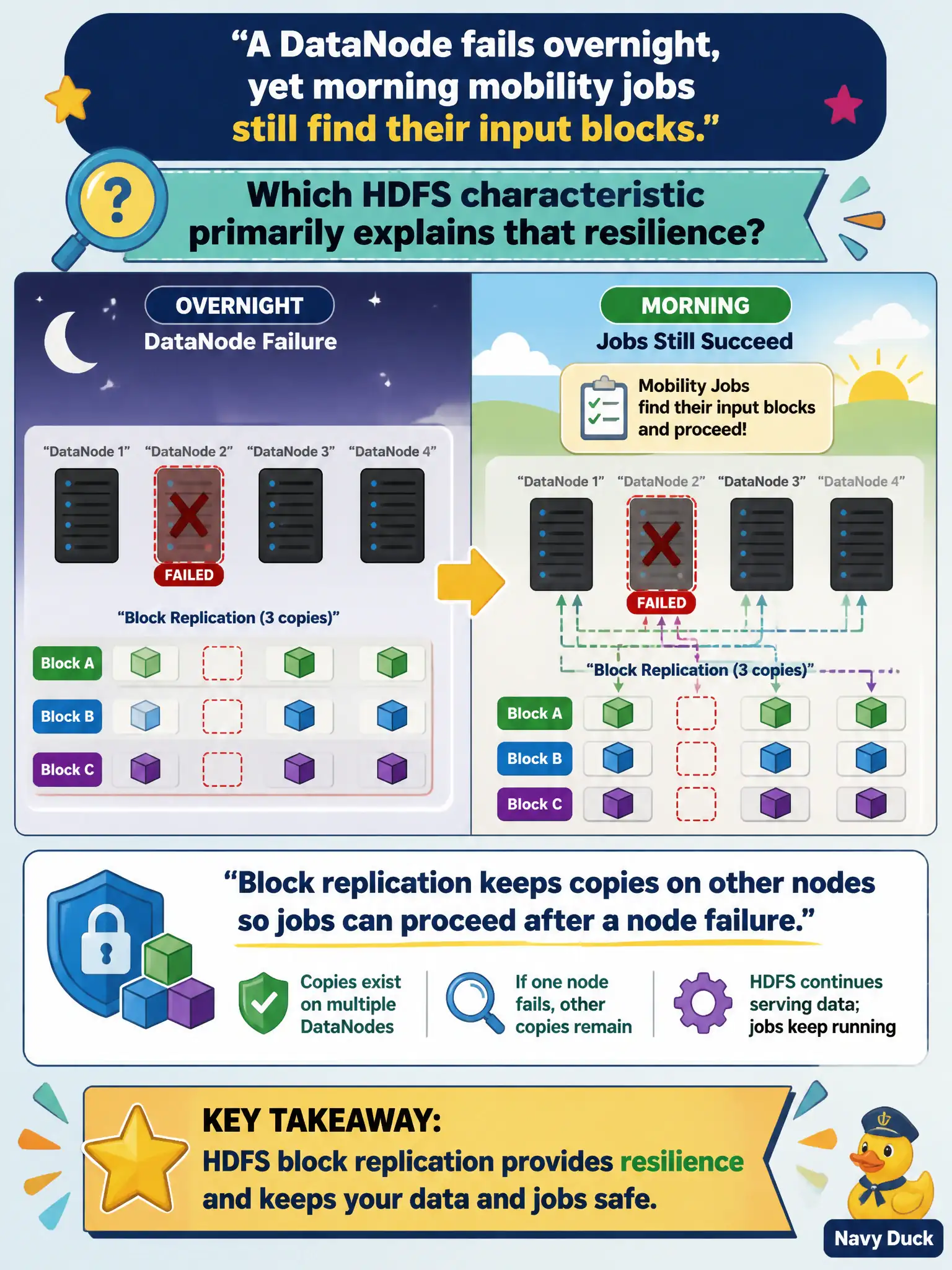
A DataNode fails overnight, yet morning mobility jobs still find their input blocks. Which HDFS characteristic primarily explains that resilience?
Select an answer to reveal the explanation.
Short Explanation
Nodes die; replicas live elsewhere. That is why the morning mobility job can still run instead of waiting on a funeral for one disk.
Full Explanation
If a DataNode fails overnight yet morning mobility jobs still find their input blocks, block replication is the HDFS characteristic that primarily explains that resilience: copies on other nodes allow jobs to proceed after node loss. Municipal overnight batch for mobility and permitting enrichment depends on this fault tolerance rather than on any single disk surviving until morning. HDFS does not delete all replicas when any node reboots so that jobs must restart from zero and re-ingest the city. Design does not intentionally keep the sole copy only on the failed node for efficiency; that would defeat the purpose of distributed storage. Fault tolerance does not come solely from printing checksums on paper in the network operations center, though checksums help detect corruption. Exam caveat: replication enables continued reads after failure; recovery still re-replicates blocks to restore the configured factor—do not confuse 'the job can run' with 'the cluster is fully healed.' Operational check: after a DataNode failure, confirm jobs locate alternate replicas, watch under-replicated block counts heal back to policy, replace or repair the node under change control, and record the incident in the municipal ops log with replica-factor verification.