
A county moves from self-hosted Kafka to a managed cloud messaging service for 311 events. What stays conceptually true?
Select an answer to reveal the explanation.
Short Explanation
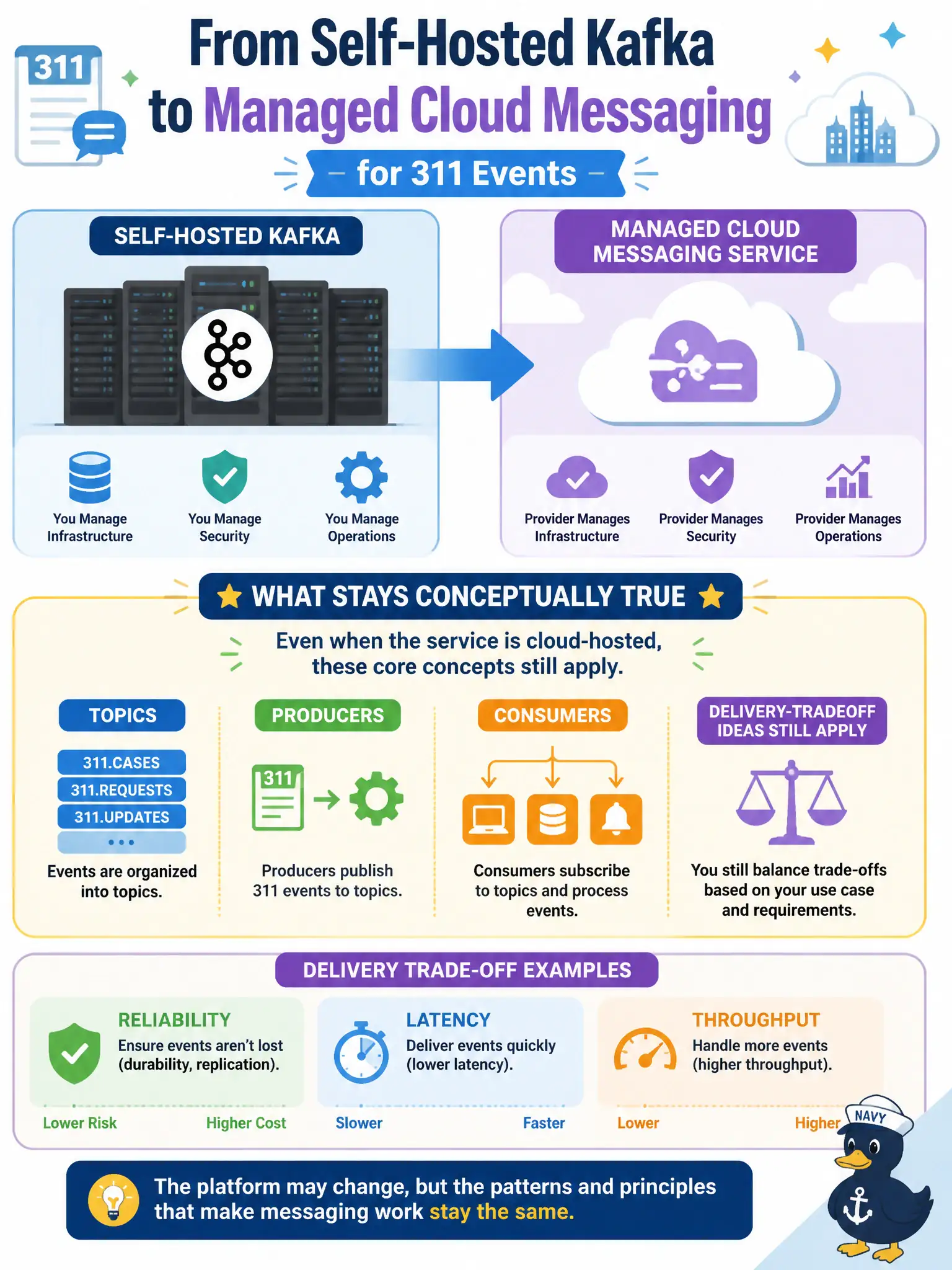
Renting the post office instead of owning the building does not erase how mail works. Topics, producers, consumers, and delivery tradeoffs still matter in managed cloud messaging. Same playbook, different landlord.
Full Explanation
Moving 311 events from self-hosted Kafka to a managed cloud messaging service does not erase core ingestion concepts: topics, producers, consumers, partitions, lag, schema, and delivery tradeoffs still apply. Cloud hosting changes who patches brokers, not whether civic architects must design for consumers and evolution. BDPC expects that conceptual continuity across deployment models.
Cloud hosting does not remove the need to think about partitions, lag, or consumer design; managed UIs still surface those concerns when dashboards go stale. Managed services likewise do not eliminate schema and security concerns for municipal data—authorization and payload protection remain city responsibilities under shared duty models. Claiming ingestion concepts only matter on bare metal is false; the syllabus ideas travel with the workload.
Exam caveat: managed services may expose slightly different knobs for retention, throughput units, or IAM, but exam questions usually test the shared concepts rather than a single vendor’s console labels. Operational check: after migration, verify consumer lag dashboards, topic ACLs, and a schema-evolution canary still work as they did conceptually on self-hosted Kafka.