
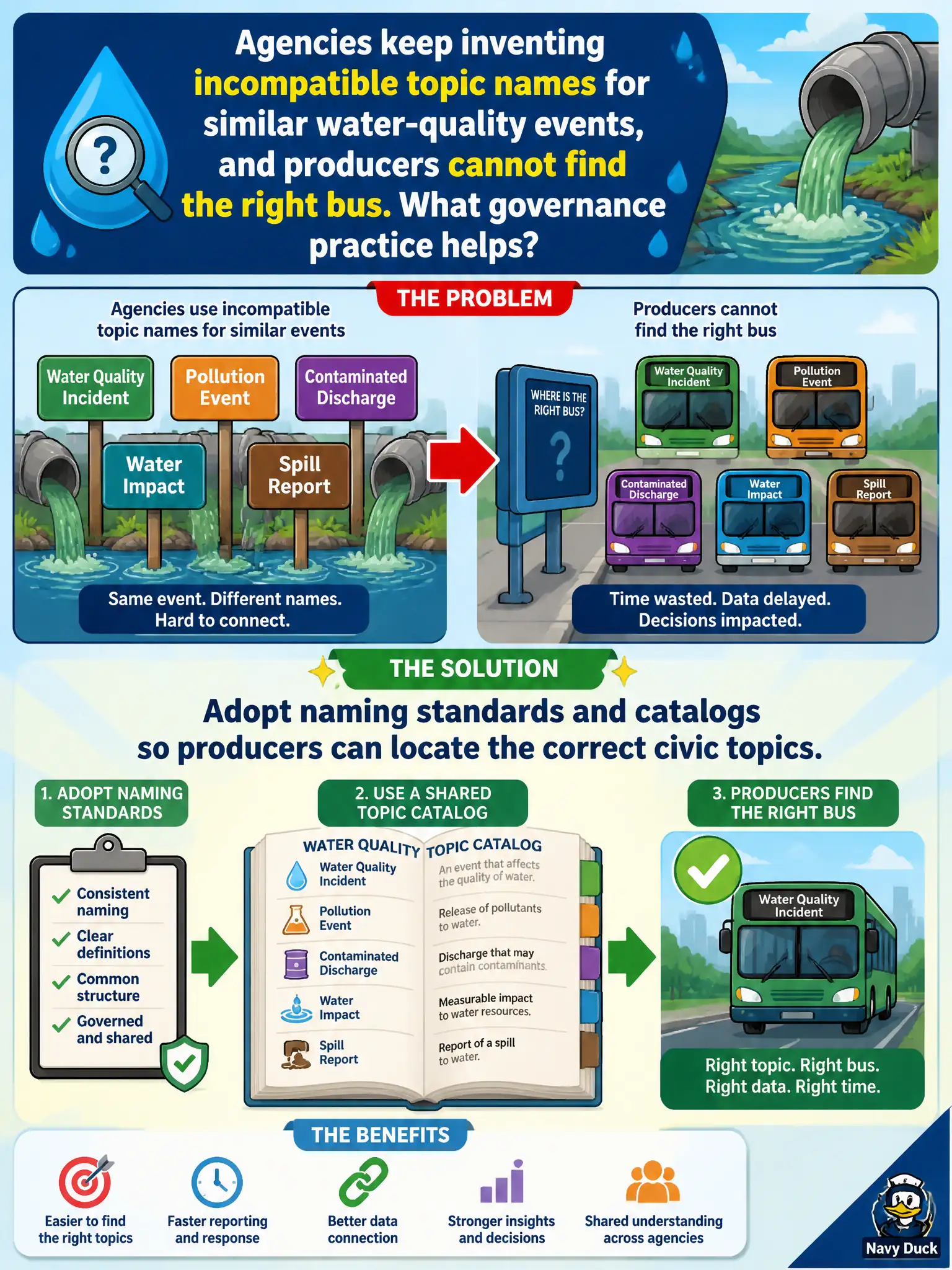
Agencies keep inventing incompatible topic names for similar water-quality events, and producers cannot find the right bus. What governance practice helps?
Select an answer to reveal the explanation.
Short Explanation
If every shop invents its own aisle labels, nobody finds the water aisle. Shared naming standards and a catalog turn topics into findable civic data products. Governance is the map of the bus.
Full Explanation
Naming standards and catalogs help agencies publish and find consistent water-quality topics instead of inventing incompatible names that hide the bus from producers. Governance of topic identity is part of municipal data-platform operations: discoverability, ownership, and schema links reduce accidental shadow topics. Without catalogs, similar events fragment across incompatible names and analytics cannot unify the feed.
Allowing each team private names with no shared catalog maximizes local freedom while destroying cross-agency reuse. Hiding topic lists so only the original author may publish blocks legitimate producers and undermines platform scale. Treating topic names as disposable and renaming weekly without notice breaks consumers and erases operational muscle memory.
Exam caveat: catalogs must stay accurate—stale entries are worse than sparse ones—and naming standards should cover environment suffixes, versioning, and sensitivity labels without becoming unreadably bureaucratic. Operational check: search the catalog for the canonical water-quality topic, confirm a new producer can obtain name, owner, and schema references, and verify a deliberately nonstandard name is rejected or flagged in review.