
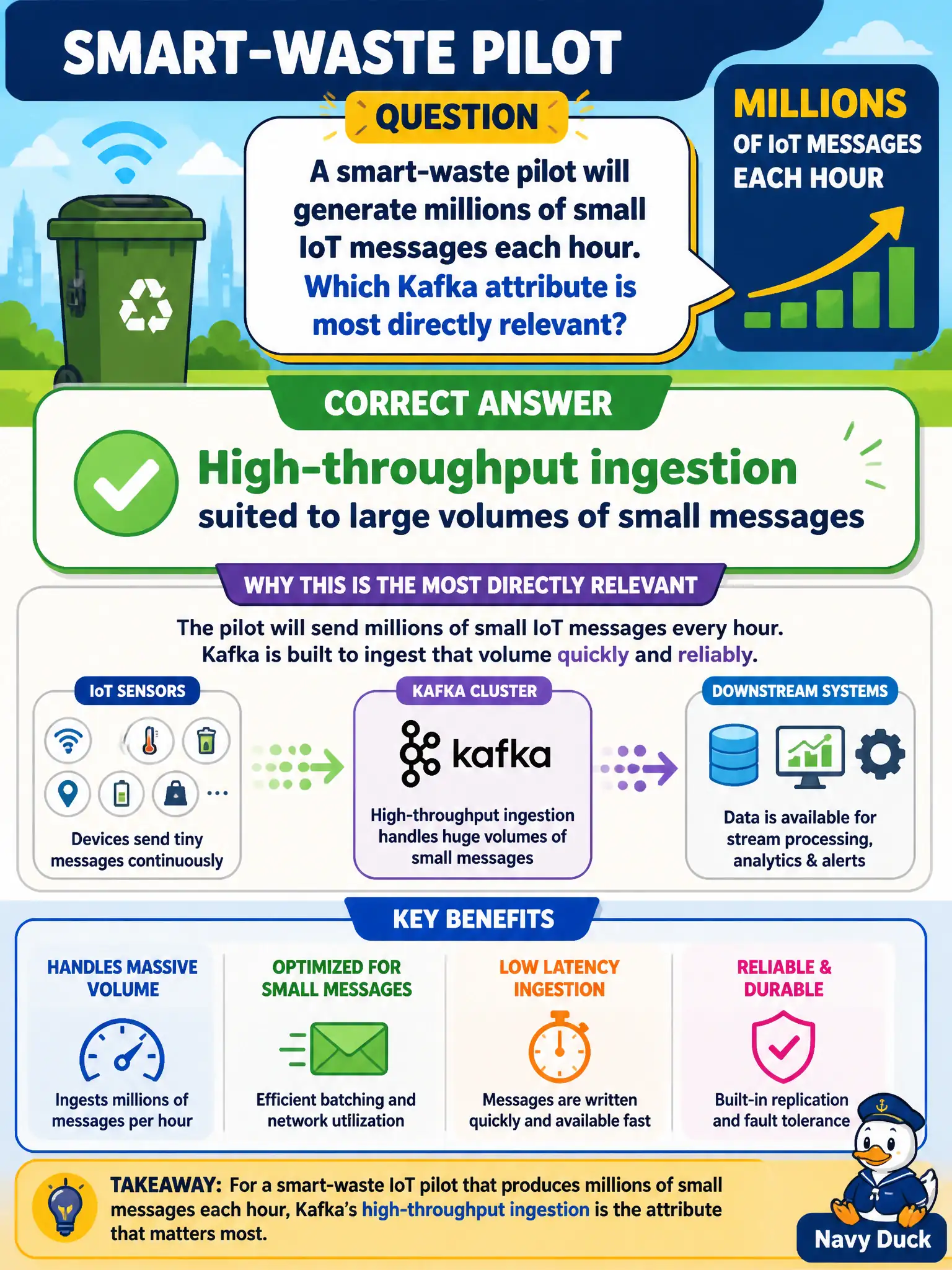
A smart-waste pilot will generate millions of small IoT messages each hour. Which Kafka attribute is most directly relevant?
Select an answer to reveal the explanation.
Short Explanation
Kafka is built like a high-speed mail sorter: lots of little envelopes flying through every hour without choking. That high-throughput trait fits chatty IoT fleets.
Full Explanation
A smart-waste pilot generating millions of small IoT messages each hour depends on Kafka’s high-throughput ingestion suited to large volumes of small messages. That attribute is directly relevant to IoT-scale civic telemetry. Low throughput limited to a few messages per day by design contradicts Kafka’s strengths. Mandatory human approval before every IoT message lands cannot sustain million-per-hour rates. Exclusive support for multi-gigabyte single-file uploads only misstates the small-message ingest pattern. Exam caveat: high throughput still needs appropriate batching, compression, and partition counts—defaults may underperform at IoT scale. Operational check: benchmark produce rates with representative small payloads, tune batch size and partitions, and confirm sustained ingest meets the pilot’s hourly volume with acceptable latency. In production terms for high-throughput small-message ingest, assign an owning team, wire a dashboard that shows the pattern is healthy under peak civic load, and require a staging drill that rehearses failure and recovery before resident impact. Revisit the choice when traffic shape, retention, or integrity needs change, and keep a named rollback owner on the change record. Re-test both the happy path and the failure path for high-throughput small-message ingest after material dependency upgrades so regressions are caught before the next public release.