
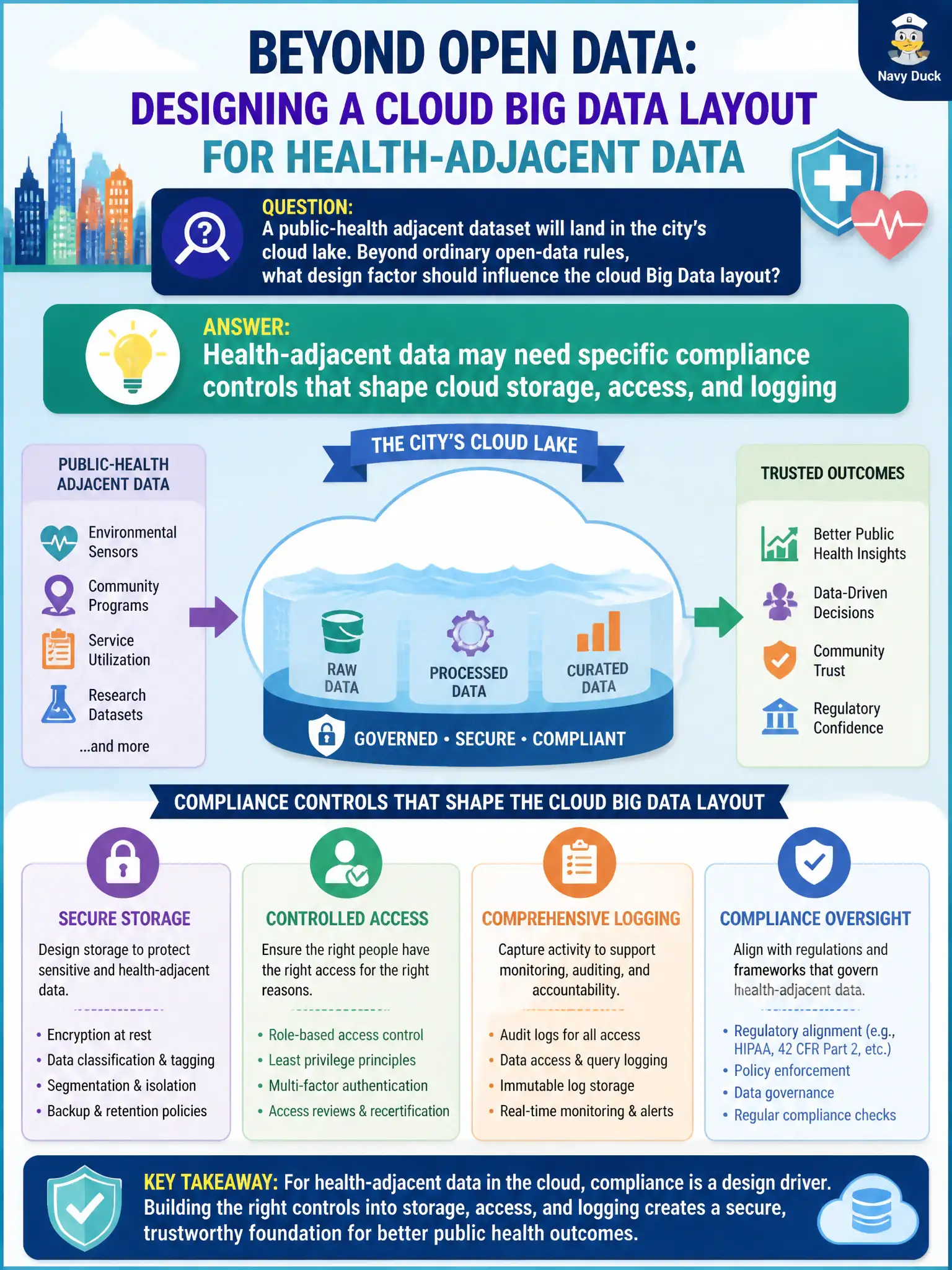
A public-health adjacent dataset will land in the city’s cloud lake. Beyond ordinary open-data rules, what design factor should influence the cloud Big Data layout?
Select an answer to reveal the explanation.
Short Explanation
A locked clinic cabinet is not the same as a bulletin board. Health-adjacent civic data often needs extra compliance controls on storage, access, and logging. Renaming it “analytics” does not erase those duties.
Full Explanation
Health-adjacent datasets landing in a city’s cloud lake may need specific compliance controls that shape storage locations, access paths, encryption, and logging beyond ordinary open-data rules. Layout decisions—separate zones, stricter IAM, enhanced audit—should follow that sensitivity from day one. Cloud Big Data design for municipalities must account for regulated or quasi-regulated categories even when the workload is labeled analytics.
Compliance frameworks do not vanish merely because data is labeled analytics instead of clinical care documentation. Any public cloud region does not automatically satisfy every health-related control worldwide without regard to residency and certifications. Publishing health-adjacent datasets as fully open downloadable dumps can violate privacy and regulatory expectations even when other civic datasets are open by policy.
Exam caveat: exact framework applicability is jurisdiction-specific; the exam point is that sensitivity changes cloud layout and controls, not that candidates memorize every statute name. Operational check: place a health-adjacent sample in a restricted lake zone, verify public/open roles cannot read it, and confirm access logs capture privileged reads for audit sampling.