
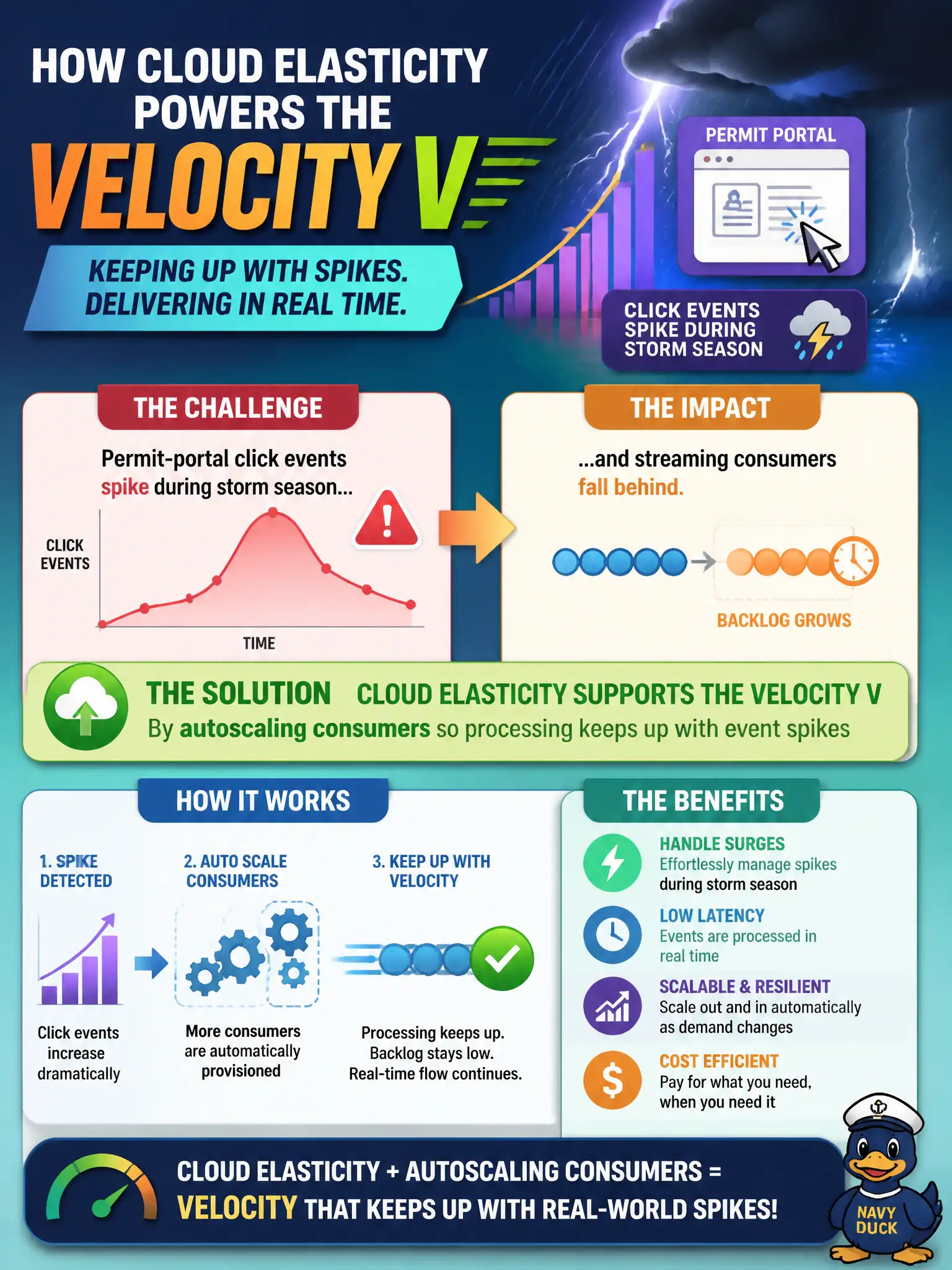
Permit-portal click events spike during storm season and streaming consumers fall behind. How does cloud elasticity primarily support the Velocity V in this scenario?
Select an answer to reveal the explanation.
Short Explanation
When the firehose opens wider, you add more hoses—not a smaller bucket. Autoscaling stream consumers is how cloud elasticity backs Velocity during civic event spikes. Freezing capacity just lets the backlog win.
Full Explanation
Cloud elasticity supports the Velocity V when permit-portal click events spike by autoscaling streaming consumers so processing keeps up with the firehose. Adding consumer capacity protects near-real-time civic pipelines during storm-season surges instead of letting lag grow unbounded on the bus. That is how elastic cloud capacity maps to velocity for event-heavy municipal workloads that must stay timely for operators and residents.
Freezing consumer count so backlogs grow in a predictable straight line preserves tidy charts and loses operational velocity citizens feel as stale status. Deleting events older than five minutes regardless of business need may shrink lag while destroying evidence needed for permits or audits. Converting all streams into monthly paper digests abandons streaming velocity entirely for the portal analytics platform.
Exam caveat: autoscaling needs meaningful lag or throughput metrics, scale limits, and idempotent consumers—otherwise scale events amplify duplicate processing or cost without catching up. Operational check: generate a synthetic click spike, confirm consumer autoscaling engages, watch lag return toward baseline, and verify no unexplained duplicate side effects in downstream counts.