
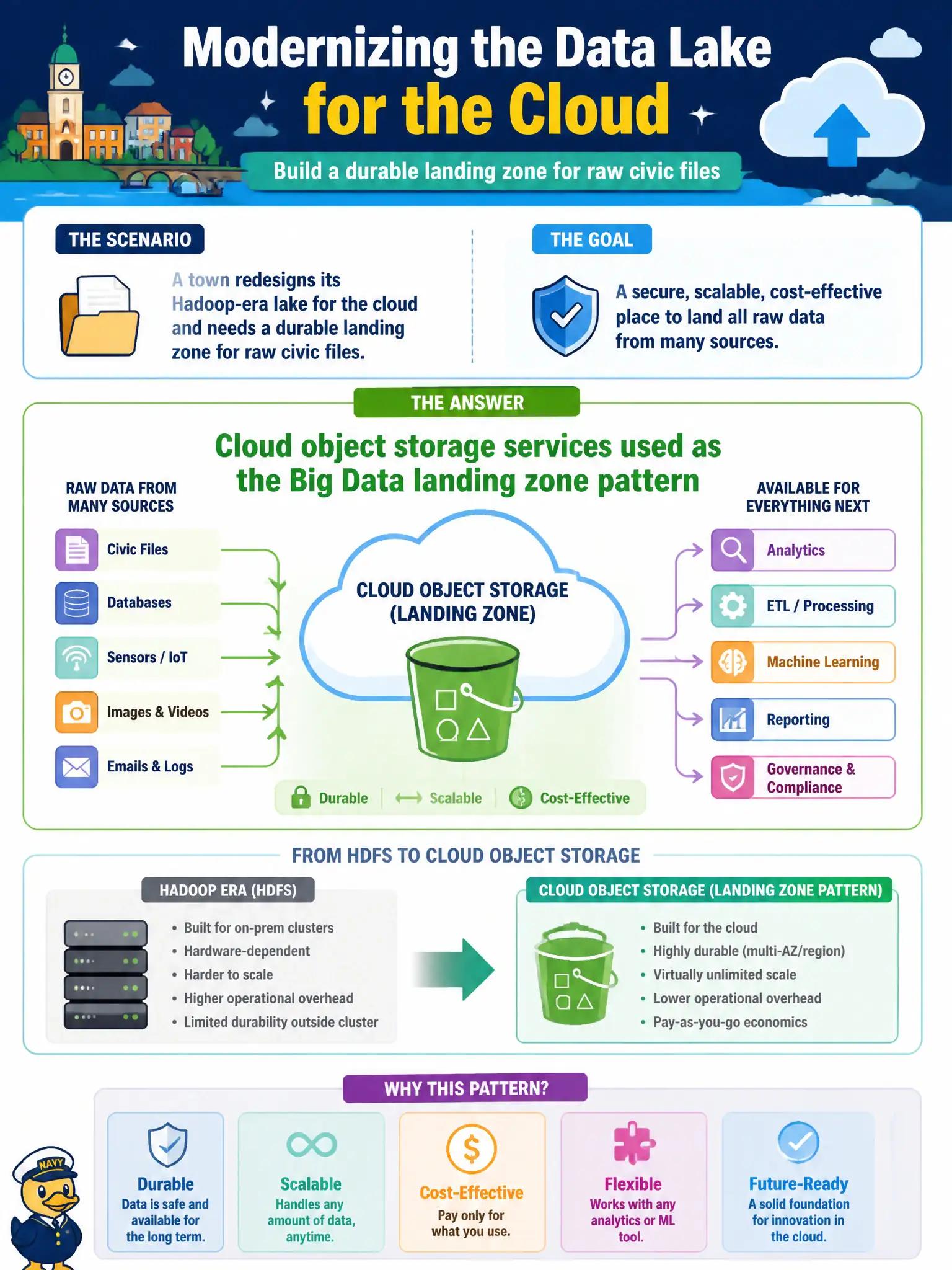
A town redesigns its Hadoop-era lake for the cloud and needs a durable landing zone for raw civic files. Which pattern commonly replaces or fronts classic HDFS in that setting?
Select an answer to reveal the explanation.
Short Explanation
Object storage is the cloud’s big shared filing cabinet for raw dumps. Cities often land telemetry and files there instead of standing up classic HDFS for every byte. USB drives and ticket databases are not lake-scale landing zones.
Full Explanation
Cloud object storage commonly replaces or fronts classic HDFS as the durable landing zone for raw civic files when a town redesigns a Hadoop-era lake for the cloud. Object stores provide scalable, durable landing for telemetry dumps and batch drops that downstream Spark or SQL engines process. That pattern is central Chapter 9 awareness for municipal lake modernization programs.
Desktop USB drives rotated through the mayor’s office each Friday are not lake-scale durable landing zones and fail chain-of-custody and availability expectations. Single-node relational databases sized only for operational tickets cannot absorb raw civic file volume at lake scale. Paper archives scanned only when an auditor arrives abandon continuous analytical landing entirely and cannot feed recurring jobs.
Exam caveat: object storage landing still needs lifecycle policies, encryption, least-privilege IAM, and clear raw-versus-curated zones—lifting files to the cloud without zone design recreates a swamp. Operational check: land a sample raw civic file set into the designated object-storage zone, verify encryption and access policies, and confirm a Spark job can read the landing path without using USB or ticket-DB workarounds.