
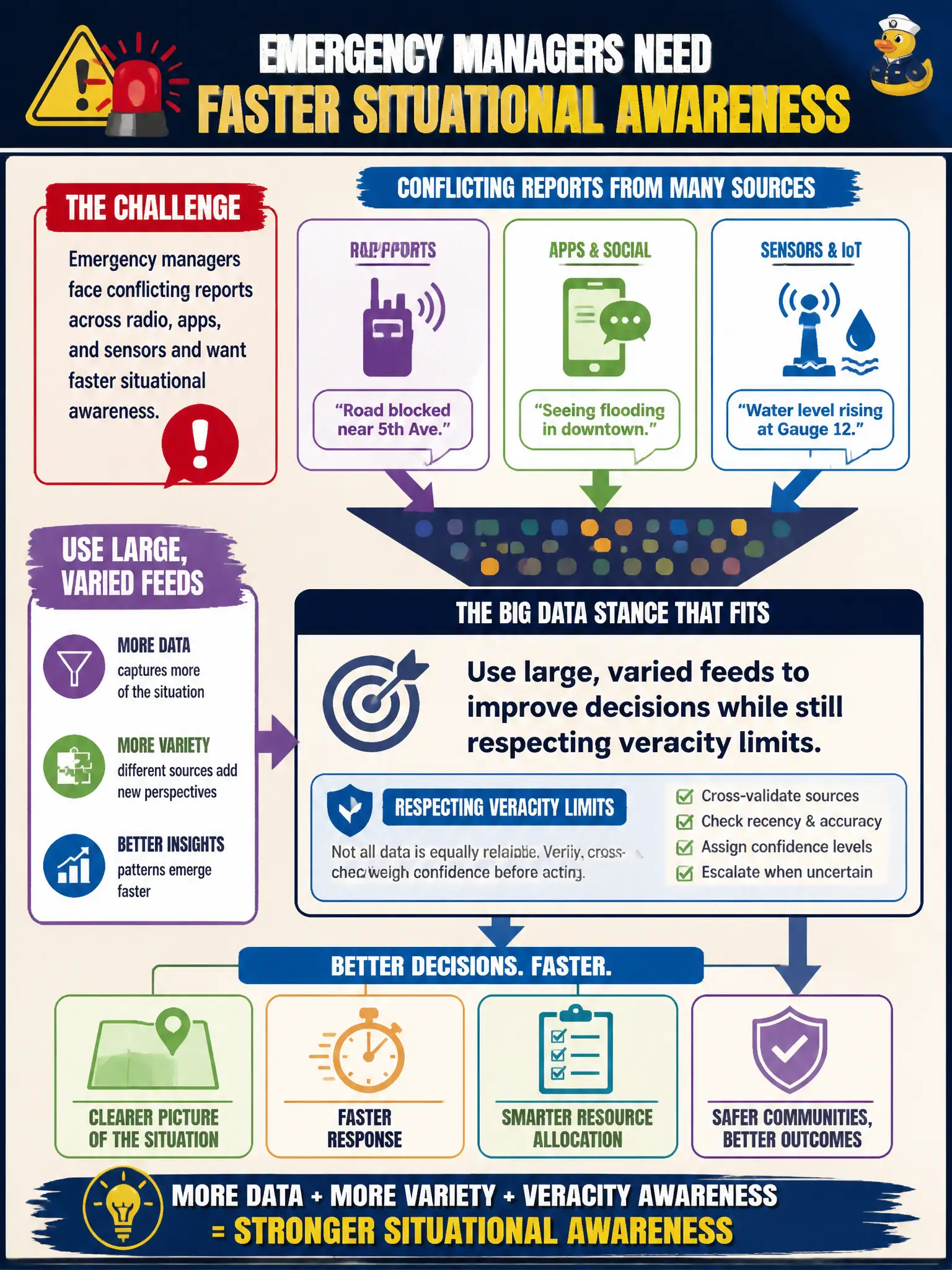
Emergency managers face conflicting reports across radio, apps, and sensors and want faster situational awareness. What Big Data stance best fits?
Select an answer to reveal the explanation.
Short Explanation
When channels disagree, more signals help—if you keep a healthy skepticism. Big Data can widen the picture for emergency decisions, but Veracity still says ‘trust, but verify.’ Faster awareness is not the same as believing every rumor.
Full Explanation
A core benefit of Big Data is improving decisions under uncertainty by integrating high-Volume and high-Variety inputs while still respecting Veracity limits. Emergency managers facing conflicting radio, app, and sensor reports should use large, varied feeds for faster situational awareness without treating every channel as ground truth. That balanced civic stance improves response without reckless belief in every rumor.
Discarding all varied sources to wait for one official paper form fails by concept: variety is an asset in situational awareness when governed. Treating every social post as ground truth without quality controls fails by concept: Veracity limits still apply. Disabling sensors during incidents to reduce cognitive load fails by concept: sensors are critical feeds; overload is managed with fusion and confidence, not blind shutdown.
Exam caveat: Use varied feeds to improve decisions while respecting truthfulness constraints—neither mono-source delay nor uncritical acceptance.
Operational check: Define confidence tiers for radio, apps, and sensors on the incident board, require corroboration rules for high-impact actions, and keep sensors online with filtered display rather than disabling them.