
A vendor demo sells one appliance as ‘the entire Big Data ecosystem.’ What should municipal architects emphasize instead?
Select an answer to reveal the explanation.
Short Explanation
An ‘ecosystem’ is a neighborhood of tools, not one shiny box. Cities still need pieces that ingest, store, process, and serve data. If a pitch collapses all of that into one SKU, treat it as marketing, not architecture.
Full Explanation
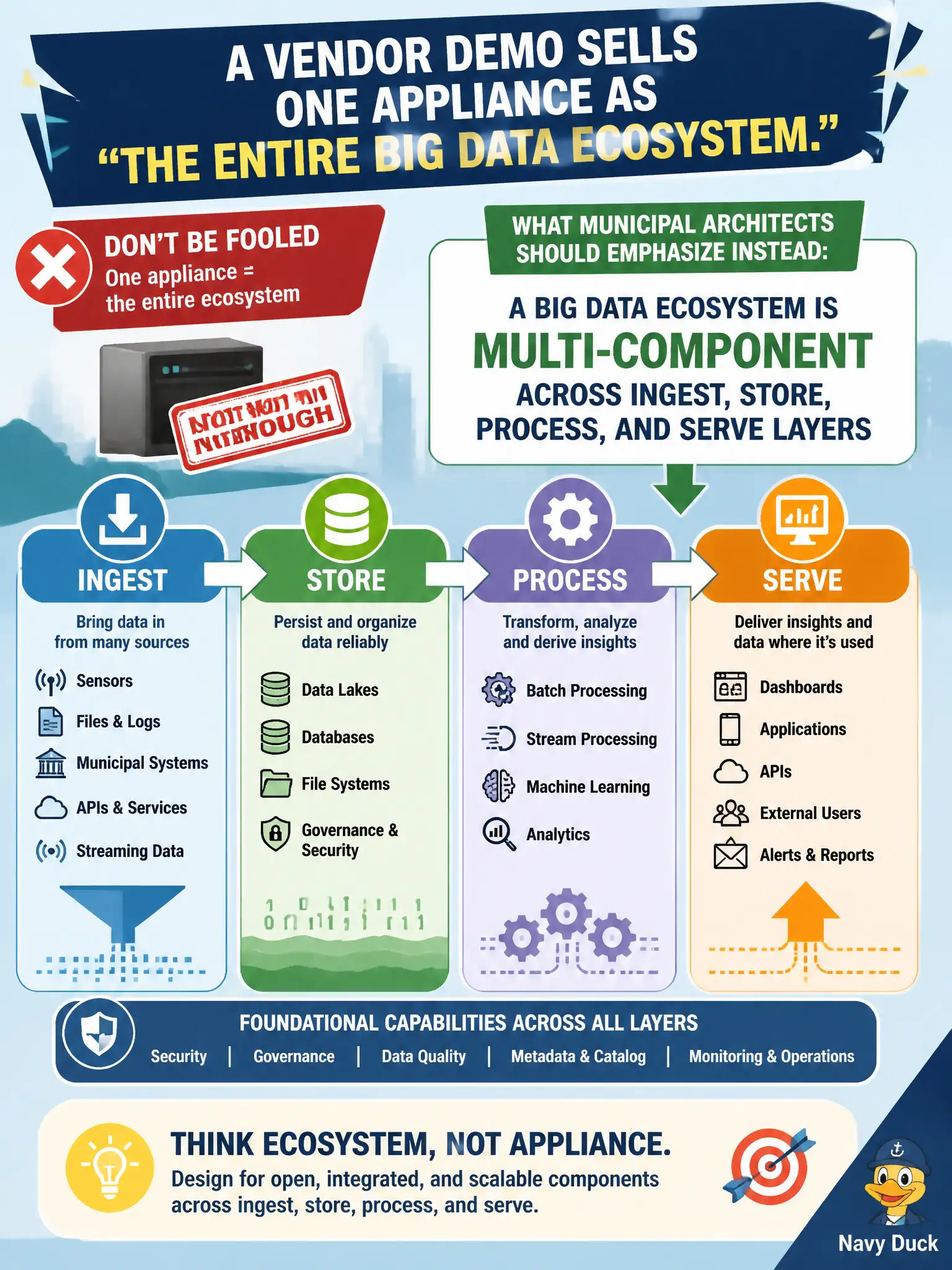
A Big Data ecosystem is multi-component across ingest, store, process, and serve layers. Municipal architects facing a vendor demo that sells one appliance as “the entire Big Data ecosystem” should emphasize that civic architectures still need deliberate layering and integration—not a single SKU mythology. Residents depend on pipelines that collect, keep, transform, and deliver, not on a magic box label.
Claiming one appliance always outperforms any multi-tool architecture fails by concept: ecosystems are designed as cooperating components. Claiming ecosystems only apply to consumer internet companies fails by concept: cities run multi-layer data estates too. Claiming a single SKU removes integration planning fails by concept: integration and layer ownership remain necessary.
Exam caveat: Ecosystem literacy means multi-component layers—not “one appliance equals entire ecosystem.”
Operational check: Map the proposed appliance to ingest, storage, processing, and serving responsibilities; list integration gaps; refuse architecture diagrams that show only a vendor logo with no layer roles. Document residual risk for civic operators and revisit after the next production change window.