
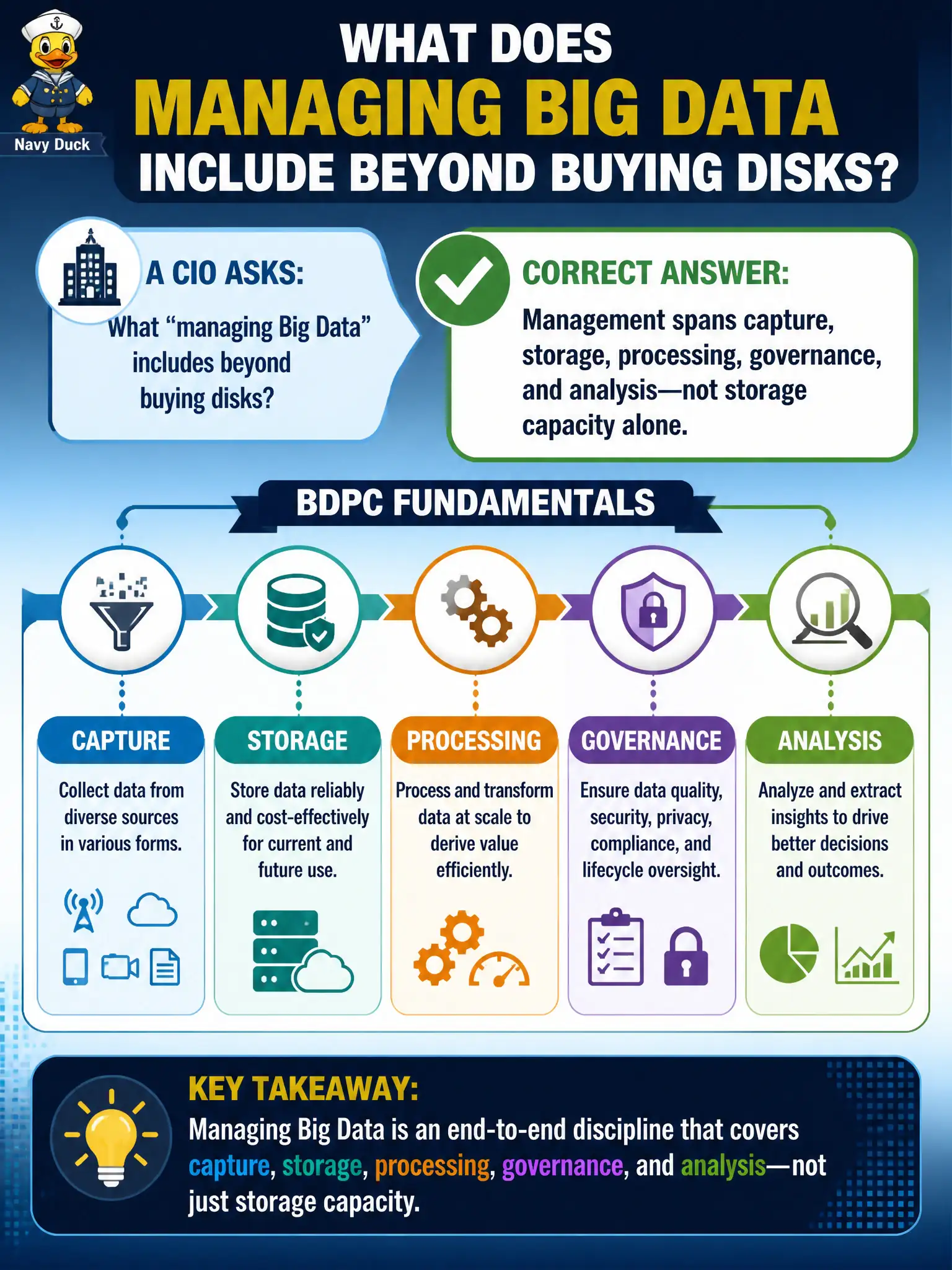
A CIO asks what "managing Big Data" includes beyond buying disks. Which answer matches BDPC fundamentals?
Select an answer to reveal the explanation.
Short Explanation
Disks are just the pantry. Managing Big Data is the whole kitchen—getting data in, keeping it trustworthy, processing it, and turning it into decisions. Buy shelves if you need them, but do not stop at the receipt.
Full Explanation
BDPC frames Big Data management as an end-to-end concern: capture, storage, processing, governance, and analysis. Disk capacity is necessary but not sufficient. A CIO briefing should present management as the full civic pipeline—getting data in, keeping it trustworthy, transforming it, and analyzing it for public services—not as a shopping trip for drives.
Reducing management to disk purchases only fails by concept: capture, processing, governance, and analysis remain in scope. Replacing every analyst with one unmonitored script fails by concept: management includes people, controls, and accountable analysis. Excluding analysis from management fails by concept: analysis is part of professional Big Data practice in the BDPC framing.
Exam caveat: Management spans capture through analysis and governance; storage capacity alone is not the discipline.
Operational check: Update the CIO management checklist to include ingest SLAs, storage tiers, processing jobs, governance owners, and analysis consumers for each major civic dataset. Document residual risk for civic operators and revisit after the next production change window. Confirm owners, SLAs, and rollback criteria in the runbook.