
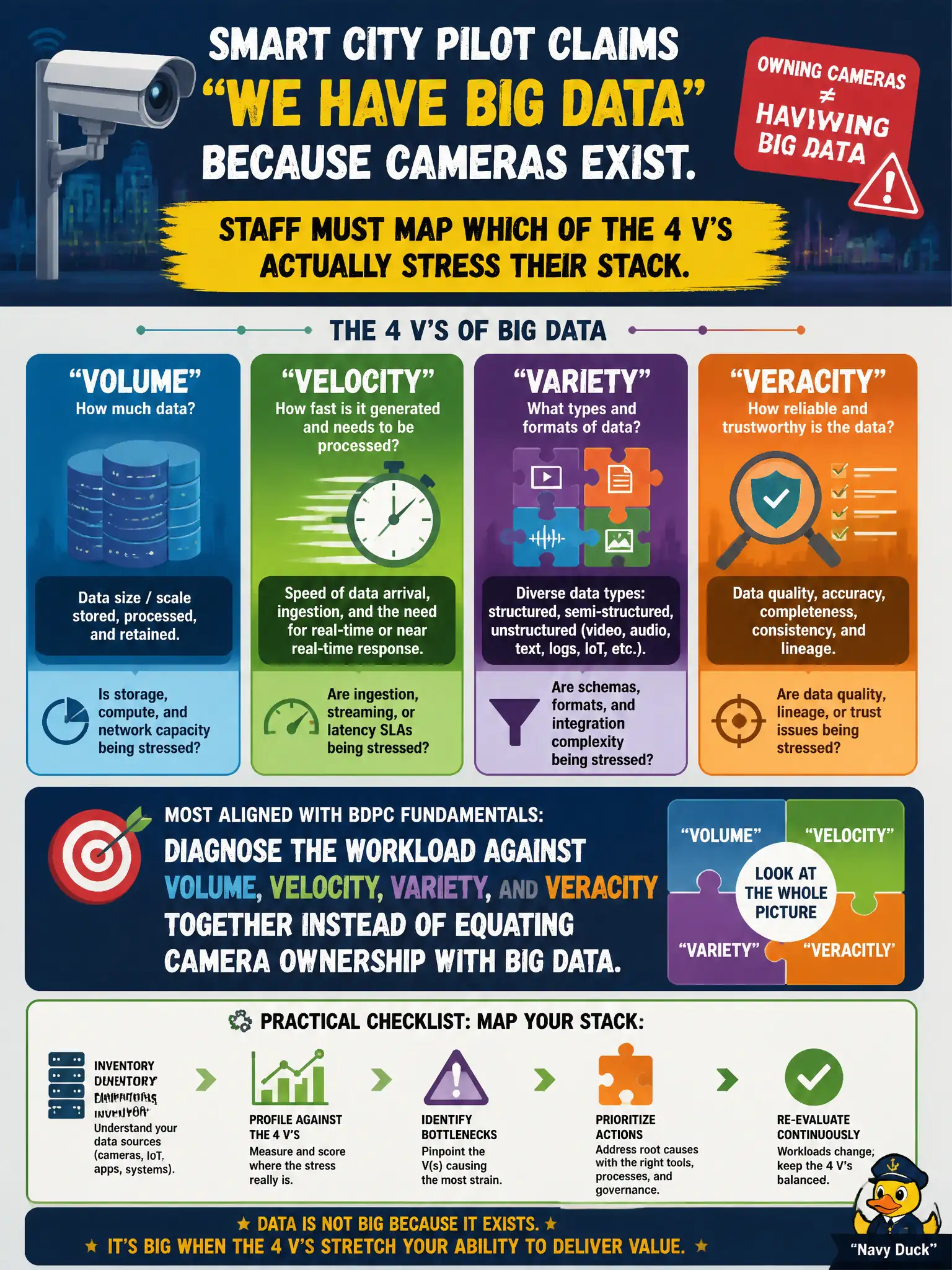
A smart-city pilot claims "we have Big Data" because cameras exist. Staff must map which of the 4 V's actually stress their stack. Which approach is most aligned with BDPC fundamentals?
Select an answer to reveal the explanation.
Short Explanation
Owning a camera is like owning a hose—you still have to ask how much water, how fast, what kind of mess, and whether the reading is trustworthy. Big Data claims need all four V's checked against the real stack, not a hardware receipt. Staff should diagnose, not declare victory.
Full Explanation
Owning cameras does not automatically mean the city "has Big Data." BDPC fundamentals ask staff to diagnose the workload against volume, velocity, variety, and veracity together. A smart-city pilot should map which Vs actually stress the stack—storage growth, stream rates, format mix, and trustworthiness—before equating hardware purchase with a Big Data program that serves residents.
Declaring all four Vs solved because one camera was purchased fails by concept: a device SKU does not retire workload diagnosis. Ignoring veracity forever once any stream is online fails by concept: camera feeds still need quality and interpretation controls. Treating volume as the only V that can ever apply to municipal data fails by concept: civic workloads routinely stress multiple Vs.
Exam caveat: Camera ownership is not a Big Data certificate; diagnose the 4 Vs against real workload symptoms instead of slogan claims.
Operational check: For each camera-fed use case, record measured Volume, Velocity, Variety, and Veracity controls in a one-page architecture note before labeling the pilot "Big Data complete." Document residual risk for civic operators and revisit after the next production change window.